
How to Sleep When Stressed: Why Trying Harder Fails
Key Takeaways
- You can't make yourself sleep. You give up being awake.
- Leave the day's worries in the daytime. Spend 10 minutes each day emptying your mind of all the tasks you have on your plate.
- Trying harder to sleep may be keeping you awake. Every technique here works by taking the ‘finger’ off the awake side of the switch.
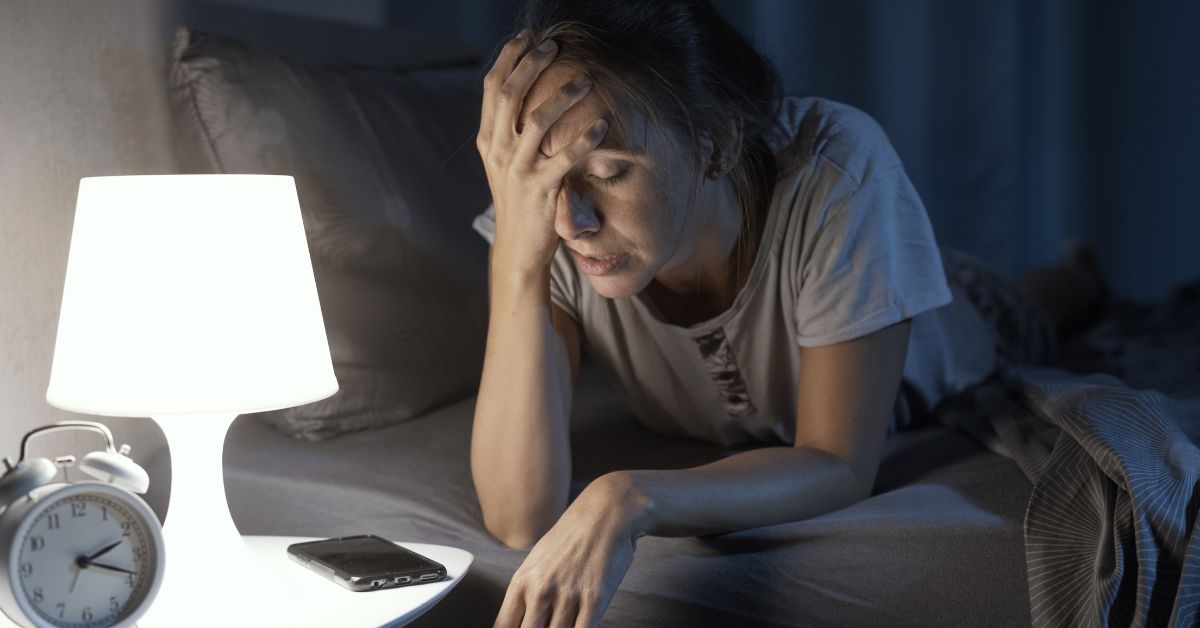
Stress is arguably the greatest disruptor of sleep.
As Professor Russell Foster, one of the world's leading sleep researchers, told me: "Most people don't have a sleep issue. It's an anxiety or a stress issue."
Yet the sleep industry tends to focus on doing more and trying harder, and seldom addresses the life stresses that cause most people to sleep badly. In fact, trying harder probably makes the issue worse. For many, doing less is the answer.
I'm an emergency medicine doctor and a CBT-i sleep coach. I find this topic fascinating, but frustrating. If anything, we have overcomplicated the entire art of sleeping. So this article aims to make it simple: why stress affects your sleep, why trying harder backfires, and the three things that will make the greatest difference.
The Switch in Your Brain
You're only ever in one of two states — awake or asleep.
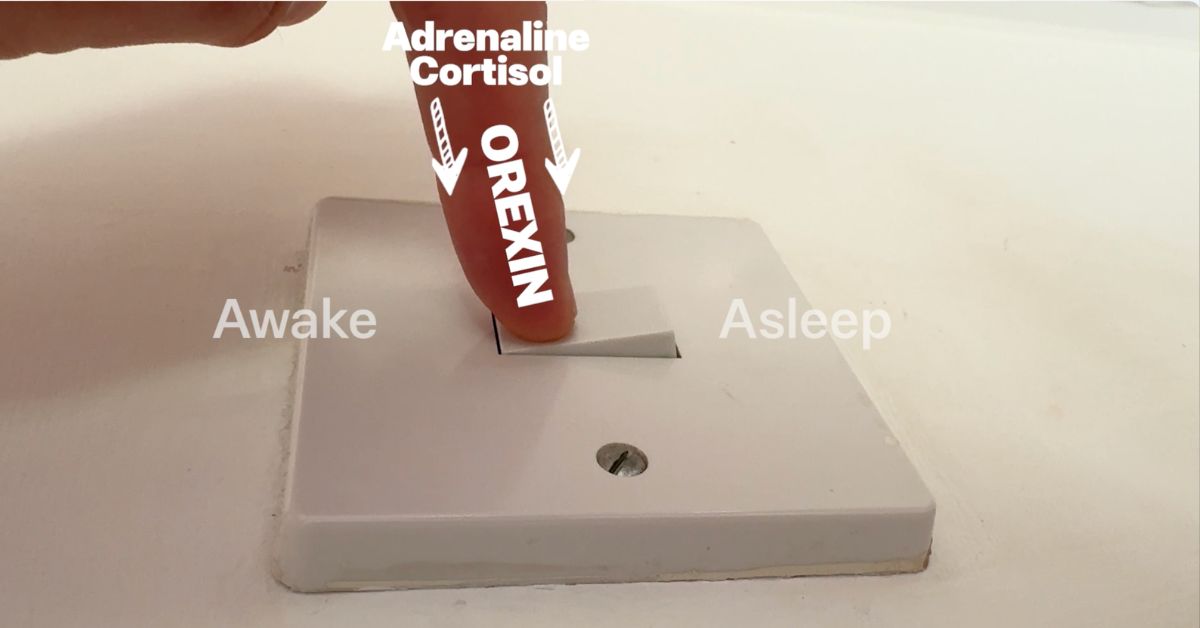
That's because deep in your brain lies a switch. On one side, the system that keeps you awake and alert. On the other, the system that lets you sleep. And they can't both be on. When one is on, the other is off.
And there is a chemical called orexin that holds that switch on the awake setting. Think of it like a finger resting on it, keeping you alert.
But there's no equivalent finger for the sleep side. Nothing presses sleep on. The sleep system only takes over when the awake side lets go.
You don't turn sleep on. You give up being awake.
And when you're under pressure, your body releases adrenaline and cortisol — and those make orexin press harder. The more stressed you are, the firmer that finger holds the awake switch on, and the harder it is to sleep.
And why does this occur? To keep you alive.
Why Stress Presses the Switch
Sleep is profoundly important — it's when your body repairs itself and your brain clears away the waste and files away the day. But for millions of years it was also a dangerous time. Lying unconscious in the dark left you exposed to predators and rival tribes.
So we evolved mechanisms to protect us as much as possible. We spend a lot of the night in light sleep, still half-aware of our surroundings, and if we feel under threat, our body activates our stress response and jolts us into action, ready to fight or run away.
Nowadays, sleep is not so dangerous, but we have new stresses and pressures, and our body has not evolved a new mechanism to handle them. So the same stress response is activated.
A dreaded email, a difficult conversation, money, the kids, your health. We often carry these thoughts and worries into the nighttime, and they trigger the same survival mechanisms. Our fight-or-flight response is activated, adrenaline and cortisol push hard on the awake side of the switch, and sleep is near impossible.
That's not failure. That's our biology keeping us alive.
And modern life adds more and more disruption. We carry work home in our pockets. We scroll through war, disaster and outrage right up until we close our eyes. Bright light in the evening tells the body it's still daytime.
And, recently, we've added a new one. We've started measuring our sleep. There's even a name for the problem it causes — orthosomnia — and sleep doctors now see people whose sleep gets worse the harder they chase a better score.
Every one of these is another press on the awake switch, at exactly the time you need to ease off.
I also cover this topic on my YouTube channel - https://www.youtube.com/@stressfreelongevity
Why Trying Makes It Worse
Imagine I offered you a million pounds to fall asleep in the next few minutes. Could you do it?
Even if you were tired and it was your usual bedtime, the wanting, and the effort to do so, would keep you awake.
Now ask a good sleeper why they sleep so well. They won't have an answer. They'll say something like: "I don't know, I just get into bed and I'm gone." No technique. No effort.
Sleep is involuntary. You cannot make it happen. You simply give up being awake. And trying is the one thing guaranteed to backfire. Effort is stress, stress presses the switch, and sleep despises stress. Then you notice it isn't working, which adds more worry, which presses harder again.
That's why good sleepers can't explain how they sleep. There's nothing to explain. They aren't making any effort. They are very good at letting go of being awake.
So the question isn't how do I make myself sleep. It's how do I take the pressure off the awake side of the switch.
Three Things That Help
In a perfect world your bedroom would be an oasis of calm. A relaxed body, a quiet mind, and the day's worries left behind in the day. Nothing pressing on the awake switch, and sleep can arrive easily.
Here are three steps to get you closer to that — actions for the daytime, the evening and the night.
1. Leave your worries in the daytime
For many of us, we carry the day's worries and stresses into bed, and when light sleep arrives, they can pop out and very quickly trigger our stress response.
So deal with them earlier. Ten minutes at the end of your working day or in the early evening. Empty your head onto paper or a digital document. Everything that is important at that time. Then go a step further and write the next action beside each one — the more specific, the better.
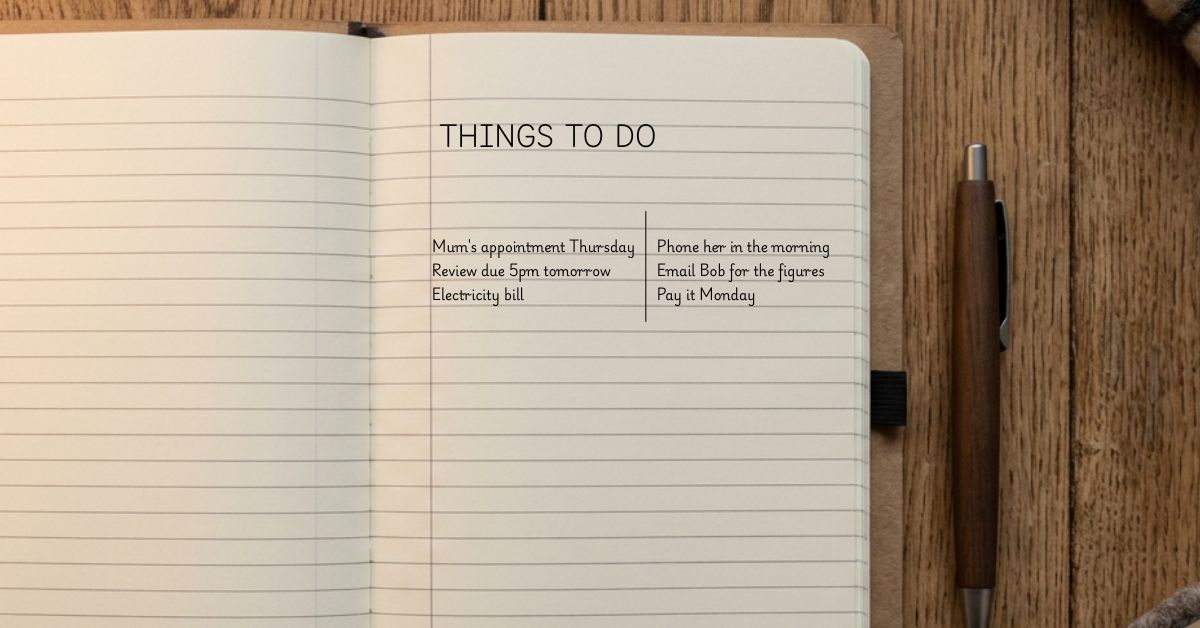
What you're doing is telling your brain it's all stored, it's under control, and you know what needs to happen. There's no need to run through it at 2am, because it's on the list and you'll deal with it tomorrow.
One companion step: keep a pen and paper by the bed. If something new arrives in the night, write it down and let it go. There is nothing you can do about it in the middle of the night. But you've logged it, you won't forget it, and you'll handle it tomorrow.
2. Separate the day from the night
The second step is about creating a psychological gap between the day and night. You're telling your brain the day is over and you are winding down and preparing for sleep.
That takes time, so allow at least thirty minutes, ideally an hour.
Start with a few small actions that mark the shift. Locking the front door, brushing your teeth, filling the dishwasher. Do them at the same time each night and your brain starts reading them as the signal that the night has begun.
Then spend the rest of the hour on things that genuinely settle you. Quiet music, a podcast, reading, a warm bath. Whatever works for you.
And bring the lights down low. It doesn't need to be dark. Low light helps your body clock, and it also lowers your alertness directly — bright light keeps you switched on. You can read more about that here.
And what about blue light? The fear of screens is overhyped. What matters is the content of what you are watching. So if watching something gentle relaxes you, that's fine. But you may want to avoid the news, a horror film, or anything that leaves you angry or wired.
One additional thing worth mentioning. If stress is what's keeping you awake, there's a good chance you're reaching for a glass of wine to take the edge off. It's a common thing people do, but it works against you. You may feel like you fall asleep faster, but the quality of your sleep will be worse, and you are more likely to experience disrupted sleep in the second half of the night. Avoid it if you can.
3. Take the last of the pressure off in bed
If you've done the first two steps and you keep a regular sleep schedule, you may not need this step. You might just get into bed and drift off.
But if your mind is still racing, or you wake feeling stressed through the night, the following actions can be really useful.
Firstly, avoid adding any stress. Don't look at the clock. What matters is when your alarm goes off, not how long you've got until it does — knowing the time tells you nothing useful and gives you something new to worry about. Cover it up or turn the clock face away from you.
Progressive muscle relaxation has the strongest evidence of all bedtime relaxation techniques. Ten minutes working from your toes up to your head, tensing each muscle group for five seconds and letting go. The muscles relax and the mind follows. I've made a full video walking through it.
Slow breathing works by switching on your parasympathetic system through the vagus nerve, slowing your heart and settling your body. There are a number of options. One is the 4-7-8 technique — breathe in for four seconds, hold for seven, out for eight. Then repeat.
A neutral word. When your mind is racing, repeat the word "the" to yourself every few seconds. It occupies your mind, blocking other thoughts from entering, and it means nothing, so there's no emotional trigger. It hasn't been well studied, but it costs you nothing and it's worth a try.
Cognitive defusion is for a busy mind filled with lots of random thoughts. Picture yourself beside a stream with leaves drifting past. When a thought arrives, place it on a leaf, and let it float away. Don't fight it, don't chase it.
And if all else fails, try to stay awake. Lie there with the lights off and gently try to keep your eyes open. This is a real technique that doctors use: when you stop chasing sleep, you take the pressure off the switch, and sleep can arrive more easily. The evidence is modest and fairly old, but the logic is sound.
Why It Hits You and Not Your Partner
You'll possibly know someone who 'sleeps through anything'. They experience similar levels of stress to you, but appear to sleep much better.
That difference is real. Sleep researchers call it sleep reactivity: how much your sleep is disrupted when life gets difficult. And it's measurable.
Some people simply have a sleep system that tolerates stress better than others. A good part of it is inherited. Twin studies put the heritability somewhere between a third and a half.
It also predicts what will likely happen following a stressful event. People who score high are considerably more likely to develop insomnia. People who score low tend to have a rough week and then recover.
So if stress reliably wrecks your sleep and your partner sleeps through the same worries, that's not a weakness on your part. You've got a more reactive system, in the way some people have a more reactive gut.
The same three steps still apply, for you more than your partner!
What Changes After 40
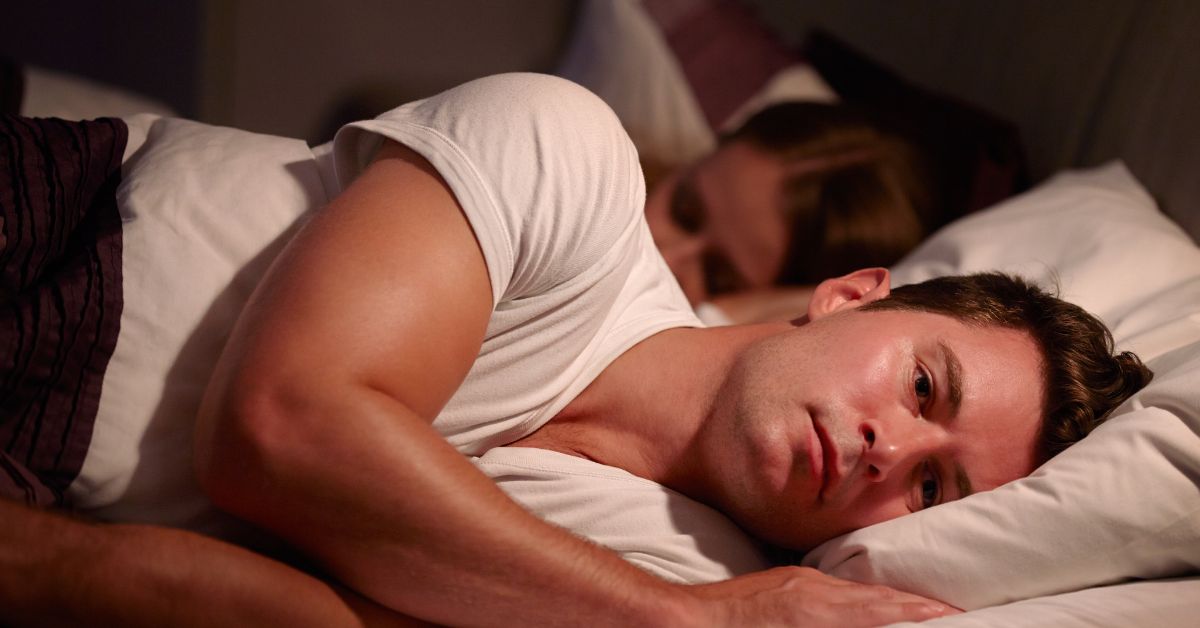
It's fairly common for stress to cause more sleep disruption as we age. And it's not that we're more stressed, or that our stress response gets stronger as we age. If anything, we get slightly less rattled by things as we get older.
What changes is the sleep itself.
You spend less time in deep sleep — roughly two per cent less with each passing decade — and more time in the lighter stages. You surface more often. And each of those moments is an opportunity for a thought or worry to grab hold and force you awake.
And for women, the perimenopausal years add something specific. Falling oestrogen appears to make the stress system more sensitive, - cortisol can be higher overnight than it should be, pressing more on your awake switch. If that's you, the three steps here still apply, but it's worth also speaking to your doctor about the hormonal side rather than assuming it's all stress.
When the Stress Becomes Too Much
Sometimes these steps aren't enough.
If you've been struggling three or more nights a week for three months or more, that's insomnia rather than a 'stressful patch'. And by that point something else has usually happened. Weeks of lying awake create their own additional layer of stress. You begin to fear nighttimes, and the bed itself starts to trigger it. You walk into the bedroom and your body tenses, expecting another bad night. The original worry may have long since resolved, but the sleeplessness carries on without it.
The answer here isn't a stronger sleeping tablet.
It's cognitive behavioural therapy for insomnia, or CBT-i. Every major sleep authority — NICE, the American and European sleep societies — recommends it as the first-line treatment. It works better than medication in the long run, and unlike medication, the benefit stays after you stop.
Everything in this article is part of it. But the full CBT-i programme goes further, working on the psychology of poor sleep and turning an anxious sleeper back into a relaxed one.
Access can be patchy, depending on where you live. Speak to your family doctor. In the UK, Sleepful.org.uk is free. Sleepio is available in some regions depending on local commissioning. There are also books, apps and online courses, including my own.
The Bottom Line
You're not bad at sleeping. You have a body that's very good at keeping you safe, but is now being triggered by the wrong things.
The email. The worry. The number on your watch.
And the harder you fight for sleep, the harder you press the switch that's keeping you awake.
So leave the worries in the daytime. Create a proper gap between the day and the night. Have a couple of tools ready to settle you in bed.
Sleep isn't something you do. It's something you allow.
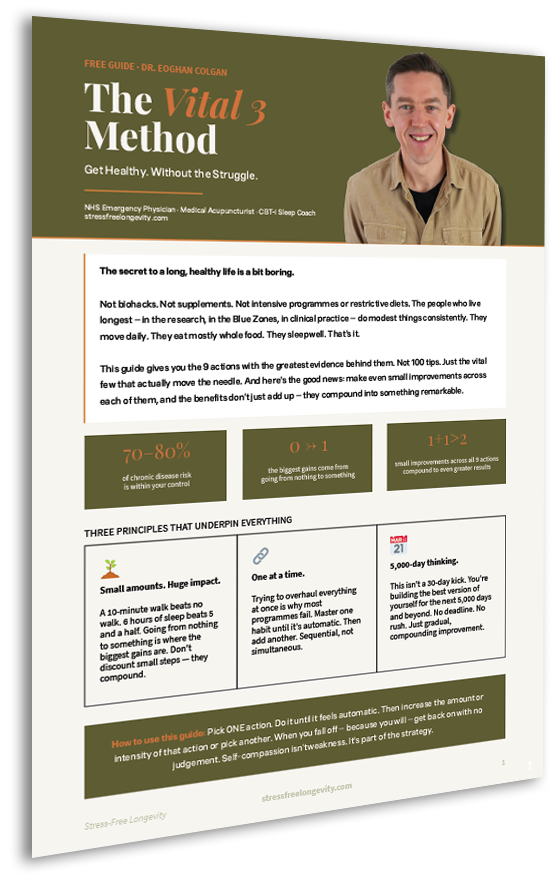
Ready to Take the Pressure Off?
Better sleep rarely comes from adding more. It comes from removing what's in the way — and the same is true of most things worth doing for your health.
- The highest-impact actions across Sleep, Nutrition, and Exercise
- The Build Good Habits framework to make changes stick
- Start with one, build from there — no overhaul required
No spam. Unsubscribe anytime.
Frequently Asked Questions
Sources
- Espie CA et al. (2006). The attention–intention–effort pathway in the development of psychophysiologic insomnia: a theoretical review. Sleep Medicine Reviews. PubMed
- Tamaki M et al. (2016). Night watch in one brain hemisphere during sleep associated with the first-night effect in humans. Current Biology. PubMed
- Scullin MK et al. (2018). The effects of bedtime writing on difficulty falling asleep: a polysomnographic study comparing to-do lists and completed activity lists. Journal of Experimental Psychology: General. PubMed
- Ellis JG et al. (2012). The natural history of insomnia: focus on prevalence and incidence of acute insomnia. Journal of Psychiatric Research. PubMed
- Gardiner C et al. (2025). The effect of alcohol on subsequent sleep in healthy adults: a systematic review and meta-analysis. Sleep Medicine Reviews. PubMed
- Riemann D et al. (2023). The European Insomnia Guideline: an update on the diagnosis and treatment of insomnia 2023. Journal of Sleep Research. PubMed
Medical disclaimer
This content is for informational purposes only and is not intended as medical advice. Always consult your healthcare provider before making changes to your health routine. What works for one person may not work for another — this is a roadmap, not a prescription.
About Dr. Eoghan Colgan
Emergency medicine physician researching what actually works for longevity. I interview world-class experts in health and longevity and test everything personally. Everything I teach is what I'm implementing myself. More about me →

Related Articles

How to Calculate Protein Intake: A Doctor’s Simple Rule
How to Calculate Protein Intake: A Doctor’s Simple Rule Key Takeaways The simplest way to […]

Does Creatine Cause Hair Loss? What the Evidence Shows
Does Creatine Cause Hair Loss? What the Evidence Shows Key Takeaways No study has shown […]

Creatine Side Effects: What’s Real and What Isn’t
Creatine Side Effects: What’s Real and What Isn’t Key Takeaways Creatine is one of the […]