
High Protein Foods for GLP-1 (When You Can Barely Eat)
Key Takeaways
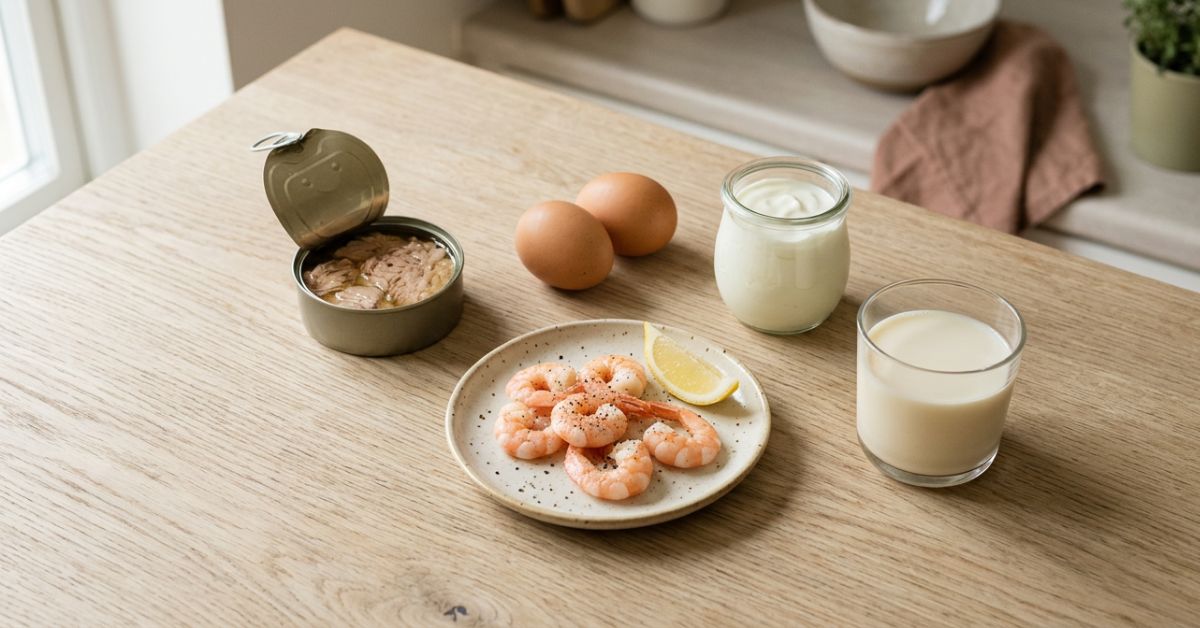
- Aim for 25 to 30 grams of protein, three or four times a day. That's a tin of tuna, a protein shake, or a palm-sized piece of chicken.
- Choose protein that's dense and low in fat. Fat is what sits longest when the drug has already slowed your stomach.
- Eat the protein first. Your appetite runs out before the plate does.
If you're on a GLP-1 — Ozempic, Wegovy, Mounjaro, Zepbound — you've probably been told to eat more protein.
The reason is simple. When you lose weight quickly, you lose some muscle along with the fat, and protein is the raw material your body uses to hold onto the muscle you have.
But eating more protein is not easy when your appetite has been switched off.
So this article is about getting enough protein in, in a way you can actually manage on a small appetite.
I'm an emergency medicine doctor, with a passion for health and longevity, and in this article I'll show you how much protein you need, what that looks like on a plate, and the high protein foods for GLP-1 users that go down easiest.
How Much Protein Do You Actually Need?
Around 25 to 30 grams per meal, three or four times a day.
That's the current recommended target — and it applies to everyone, whether you're on one of these medications or not.
As we age, muscle becomes a little less responsive to protein, so you need a slightly bigger amount in one sitting to get the same signal to build muscle (aim for 30g). Going higher than that doesn't add anything — your body simply can't use it all at once.
And if you're strength training, you don't need more. Training makes your muscle more sensitive to protein, so the same amount works harder for you.
What that looks like on a plate
If you're like me, you may not find food weight to be particularly helpful. The following are examples of what 20g of protein looks like ona plate:
- Two or three eggs
- A pot of Greek yogurt or skyr
- A large glass of milk
- Two slices of lean ham
And these get you closer to 30:
- A palm-sized piece of chicken, fish or meat — about the size of your hand, not counting fingers
- A tin of tuna
- A protein shake
If you like numbers: the current advisory suggests 1.2 to 1.6 grams per kilogram of body weight daily. One caution — if you're carrying a lot of extra weight, using your full body weight will overestimate what you need and set you an impossible target. Most people are better served by the 80 to 120 grams a day the same advisory offers as an alternative.
I also cover this topic on my YouTube channel - https://www.youtube.com/@stressfreelongevity
Why It’s Harder Than It Sounds
Plenty of people fall short of that target, but being on a GLP-1 makes it considerably harder. Here's why:
Your appetite is gone. That's the drug doing its job. When researchers tracked what people on these medications were actually eating, protein made up the same proportion of their diet as everybody else's. They hadn't gone off protein specifically, they were simply eating less of everything. In absolute terms, most were getting around half the protein they needed.
Your stomach empties slowly. Also the drug working as intended — food sits longer, so you stay full for longer. But it means anything slow to leave gets slower still, so you find it harder to finish a meal.
The good news is that this is at its worst in the first few weeks, and after each dose increase your body partially adapts. So it will get a little easier.
Fat makes it worse. Of the three macronutrients, fat is the slowest to clear the stomach. A fatty lamb chop and a tin of tuna will be very different experiences.
The High Protein Foods That Work on a GLP-1
So with a smaller appetite and a slower stomach, the answer isn't to eat more. It's to be deliberate about how you ingest protein.
Three things make the greatest difference:
- Dense — getting the most protein in the smallest volume
- Low in fat — so it doesn't sit so long in the stomach
- Soft or liquid — so it moves through easily
Here are the foods that best match all three. A good place to start.
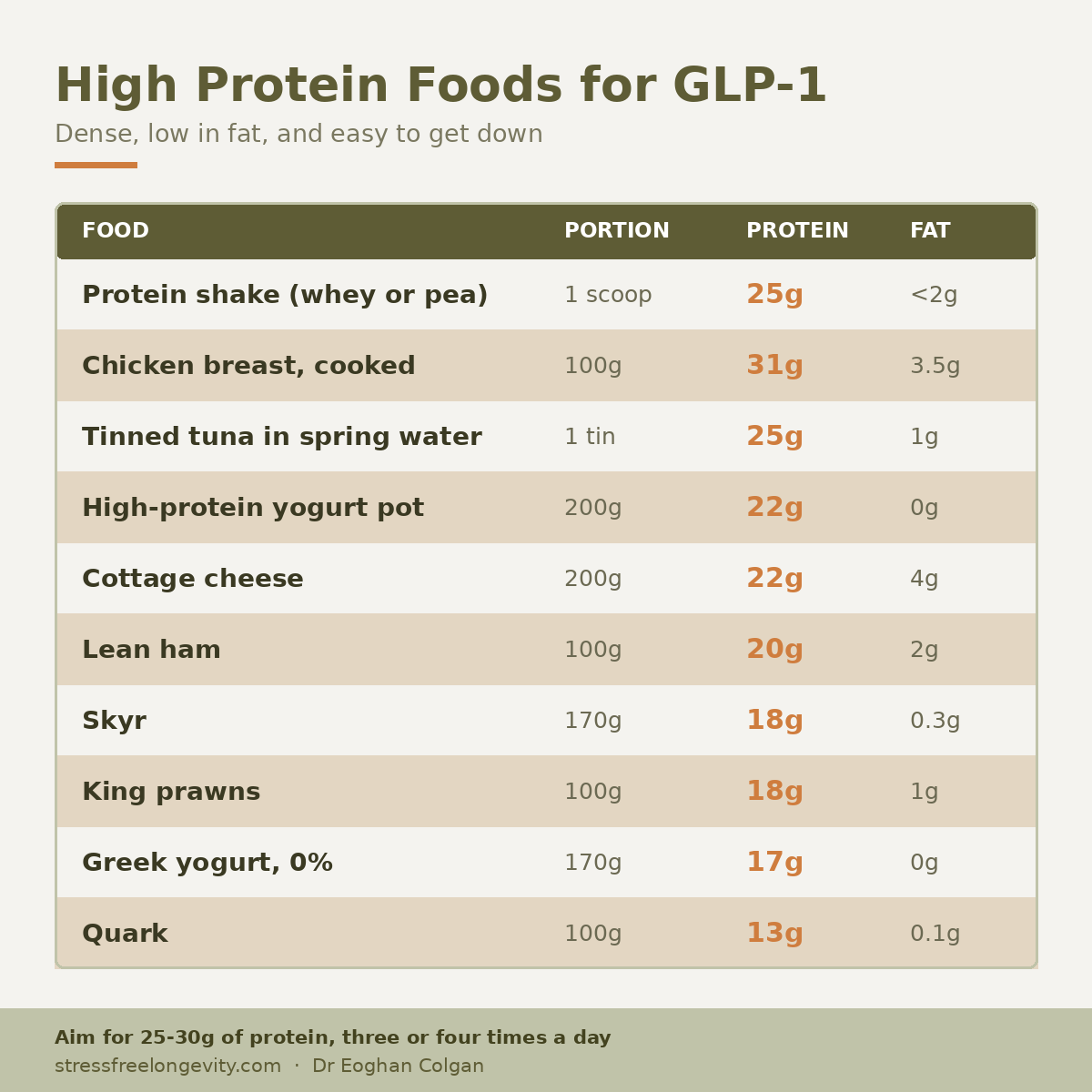
Also good, slightly heavier: eggs, tinned salmon, mackerel, lean beef or turkey mince. All excellent protein, a bit higher in fat, so smaller portions until you know how you tolerate them.
Plant-based options are less dense. Lentils give you about 9 grams per 100g, tofu about 14 — so you need a lot more volume to reach the recommended amounts. Soya foods are the strongest whole-food choice, and a pea protein powder is very effective: in trials it builds muscle just as well as milk protein, with none of the bulk.
One tip worth knowing: finely divided protein is absorbed faster than a solid piece. Mince beats steak. Flaked fish beats a thick fillet. Slow-cooked, shredded meat beats a chop. It's easier going down, too.
What a day might look like
There are many ways to do this, and you'll work out what suits you. But here's one example.
Breakfast — a pot of Greek yogurt, or a shake if nothing appeals. Around 20 grams.
Lunch — a tin of tuna, or some lean ham. Small, quick, no cooking. Around 25 grams.
Dinner — a palm-sized piece of chicken or fish alongside whatever else you're having. Eat the protein part first. Around 30 grams.
If you're short — a shake, or a pot of yogurt before bed. Around 20 grams.
That's 75 to 100 grams without any real effort, and without a single meal that feels like a challenge.
Four Things That Make It Easier
Here are a few other things that help.
Eat the protein first. Not for any clever metabolic reason. You have a finite appetite now and it will run out mid-meal. Whatever's left on the plate when it does, you won't eat. So put the protein in while you still can.
Spread it out. Three or four smaller protein meals beat one large evening meal. Your body responds to each one separately, so four modest portions do more for your muscle than the same amount squeezed into dinner — which you may not finish anyway.
Sit up and chew well. This sounds like something your mother would say. It's also measurably true. Professor Luc van Loon at Maastricht University has shown that both speed up how quickly food leaves your stomach and how fast the amino acids reach your blood. When a slow stomach is your bottleneck, that's worth having. And it costs you nothing.
Try some before bed. If mornings are hopeless, this is a useful workaround. Protein taken before sleep is digested overnight and used to build muscle while you're asleep. It doesn't need to be a meal — a shake or a pot of yogurt is ideal, and won't leave you lying down on a full stomach.

Protein Is Only Half of It
The point of all this is to hold onto your muscle while you lose the fat. And protein alone won't do that.
Protein is the raw material. Strength training is the signal that tells your body to use it.
Your body doesn't keep muscle because you've eaten well. It keeps muscle it's using. In studies of people losing weight, higher protein on its own slows muscle loss modestly. Resistance training does considerably more. Together, they protect most of it.
Two short sessions a week is enough — bands, bodyweight, or dumbbells at home. I've written about what that looks like in practice here.
And one addition worth making: if you are strength training, three to five grams of creatine a day helps you build a little more muscle and strength on top of what the training delivers. It's cheap, it's well studied, and it's one of the few supplements genuinely worth taking. I've covered it in more detail here.
One honest note on the evidence. No trial has yet tested whether higher protein intake preserves muscle in people specifically on these drugs. The target comes from the wider weight-loss research, where the evidence is solid, and studies in GLP-1 users are only now recruiting. It's a well-reasoned recommendation rather than a proven one — but it's clearly the right thing to do.
The Bottom Line
"Eat more protein" is hard advice to follow when the whole point of the drug is that you eat less.
So be thoughtful about how you get it.
Aim for 25 to 30 grams with each meal. Start with the foods that are dense in protein and low in fat. Eat it first, and spread it through the day. And don't forget to work your muscles — around 30 minutes a week, split into two sessions, is a great place to start.
I hope the medication works for you. Just don't let the muscle go with the fat. That's the part that carries you through the rest of your life.
Protein Is Part of the Answer
You've just learned how to get the protein in. The other half is the training that makes it count — and the habits that keep both going.
- The 9 highest-impact actions across Sleep, Nutrition, and Exercise
- A two-session-a-week strength routine that fits a busy life
- The Build Good Habits framework to make it stick
No spam. Unsubscribe anytime.
Frequently Asked Questions
Sources
- Mozaffarian D et al. (2025). Nutritional priorities to support GLP-1 therapy for obesity: A joint Advisory from the American College of Lifestyle Medicine, the American Society for Nutrition, the Obesity Medicine Association, and The Obesity Society. Obesity. Wiley
- Symons TB et al. (2009). A moderate serving of high-quality protein maximally stimulates skeletal muscle protein synthesis in young and elderly subjects. Journal of the American Dietetic Association. PubMed
- Jalleh RJ et al. (2025). Clinical Consequences of Delayed Gastric Emptying With GLP-1 Receptor Agonists and Tirzepatide. Journal of Clinical Endocrinology & Metabolism. Oxford Academic
- Vinelli V et al. (2026). Dietary intake in users of GLP-1 receptor agonists. Abstract presented at the European Congress on Obesity, Istanbul, May 2026. Conference abstract — not yet peer-reviewed.
- Pinckaers PJM et al. (2024). Muscle protein synthesis rates following ingestion of pea protein versus milk protein. European Journal of Nutrition. PubMed
Medical disclaimer
This content is for informational purposes only and is not intended as medical advice. Always consult your healthcare provider before making changes to your health routine. What works for one person may not work for another — this is a roadmap, not a prescription.
About Dr. Eoghan Colgan
Emergency medicine physician researching what actually works for longevity. I interview world-class experts in health and longevity and test everything personally. Everything I teach is what I'm implementing myself. More about me →

Related Articles

How Much Strength Training Do You Actually Need Per Week?
How Much Strength Training Do You Actually Need Per Week? Key Takeaways Most of the […]

Does Losing Weight Increase Testosterone? What the Evidence Says
Does Losing Weight Increase Testosterone? What the Evidence Says Key Takeaways Yes – and it’s […]
Types of Magnesium: What Actually Works (and What Doesn’t)
Types of Magnesium: What Actually Works (and What Doesn’t) Key Takeaways The form on the […]