
The 8-Hour Sleep Myth: How Much Sleep Do You Actually Need?

Key Takeaways
- The eight-hour rule isn't science. It came from a factory workers' campaign 200 years ago.
- Most adults need somewhere between six and nine hours. There's no single number that's right for everyone.
- The simplest way to know if you're getting enough: how you feel the next day.
You've probably been told you need eight hours of sleep. It's one of the most repeated numbers in health.
The eight-hour sleep myth is exactly that — a myth.
Getting a good amount of sleep definitely matters. But the specific number, eight hours, was never a medical finding. And treating it as a target you have to hit has made a lot of people anxious.
I'm an emergency medicine doctor and a CBT-i trained sleep coach, and this is a topic I find genuinely frustrating. So I'd like to make it simple.
In this blog, I'll show you where the eight-hour rule came from, how much sleep you actually need and how to get it.
Where the 8-Hour Sleep Myth Came From
It came from a cotton mill in Scotland.
In 1817, a mill owner named Robert Owen was campaigning against the working conditions of the time — days of fourteen or sixteen hours. He imagined the day divided into three equal parts, and he had a slogan for it:
Eight hours labour, eight hours recreation, eight hours rest.
The slogan spread, and over the years the "eight hours rest" part slowly turned into a 'health rule'. Nobody had measured how long people actually needed to sleep. There was no science behind it. But the mantra stuck.
So How Much Sleep Do You Actually Need?
Firstly, there is no one-size-fits-all. Individual need depends on many factors including age, health, and genetics. But most adults need somewhere between six and nine hours a night.
We can be a little more precise about where the middle of that range sits. When researchers tracked how long people sleep and how long they live, and plotted one against the other, they got a U-shaped curve.
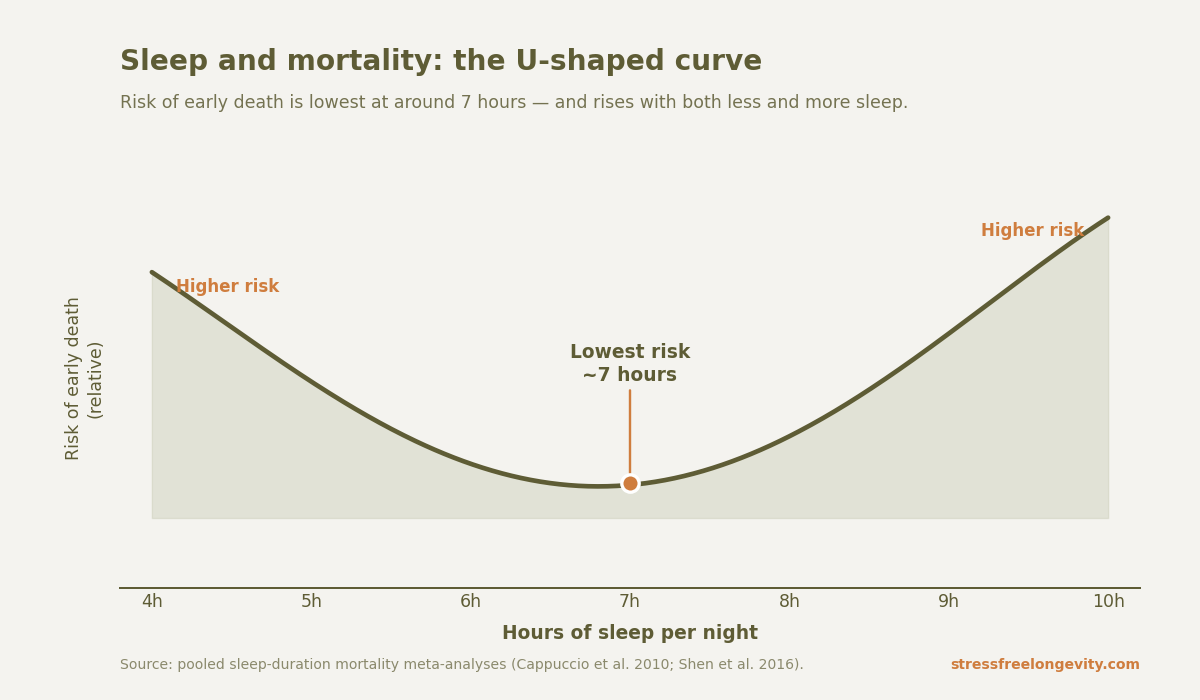
The sweet spot, the number of hours linked to the longest life span, is around 7 hours, not 8.
Now, two things are worth saying about that curve, because it's often misread.
The differences are small, and they're averages. This shows where risk sits across millions of people. It doesn't mean your six-and-a-half-hour night is doing you harm. My own average sits a little under seven hours, and I don't worry about it — and in the next section I'll explain why.
And, similarly, people who regularly need a lot of sleep aren't being harmed by the hours — the long sleep is typically a sign of something else going on underneath, like an undiagnosed illness or poor quality sleep that leaves them needing more. You probably don't need nine or ten hours. If you find you do, and you still wake up tired, that's worth a conversation with your doctor.
So the science gives you a range. But it can't tell you your number — whether you're a six-hour person or an eight-hour one. For that, you need something simpler.
The Simplest Way to Know You’re Getting Enough
Here's the one measure that actually works: how you feel the next day.
If you wake up most days feeling reasonably rested, and get through the day without fighting to stay awake, you're getting enough. Whatever the number was. That's what sleep is for, and it's the one signal that reflects your own body rather than a population average.
It sounds almost too simple, so let me explain why it beats the alternatives. As we've seen, sleep need varies from person to person — so no number, and no device, can tell you what yours is.
And you can't count your own hours accurately. When researchers compare what people think they slept against what actually happened, most of us are off — and poor sleepers are the most off of all. People with insomnia slept, on average, about 46 minutes more than they believed. Lying there convinced you've had three hours is not only miserable, it's often wrong.
Your watch isn't the answer either. Trackers are reasonable at telling whether you're asleep or awake, but far less reliable at how much you actually slept — often out by anywhere from fifteen to forty-five minutes a night against clinical equipment.
And here's why that matters. What you believe about your sleep affects how you feel — even when the belief is wrong. In one striking study, people were told how well they'd slept the night before. The feedback was fake, unconnected to their actual sleep. The ones told they'd slept badly, even though they hadn't, performed worse all day. Believing you slept badly can create a bad day on its own.
So, perhaps the best thing you can do is stop trying to calculate how much you slept — and simply notice how you feel.
I also cover this topic on my YouTube channel - https://www.youtube.com/@stressfreelongevity
Does Sleep Need Change as You Get Older?
As you get older, you might notice your sleep getting lighter, or find yourself waking in the night — and it's easy to assume something's going wrong. For most people, it isn't. It's just how sleep changes with age.
You spend a little less time in deep sleep, and you wake more easily and more often. A large review of healthy people — no sleep disorders, just ordinary ageing — found exactly this pattern. It's normal, not a sign of a problem.
What barely changes is how much sleep you actually need. There's a common belief that older adults need much less, and that isn't really true — the requirement drops only slightly. You need roughly the same as you always did. You just tend to get it less easily, because sleep has become lighter and more broken.
None of this means anything's wrong. The same rule applies at every age: if you feel rested and function well through the day, you're getting what you need.
How to Get the Sleep You Need
Here's the reassuring part. Your body is very good at getting the sleep it needs. The problem is we often get in the way of it. The goal isn't to do more. It's more commonly to remove what's blocking you.
For most people, that comes down to three things.
Keep a regular schedule. Going to bed and getting up at roughly the same time — including weekends — is the single most useful thing you can do. Your body has two internal drivers of sleep: your body clock and your homeostatic sleep drive. A regular routine keeps your behaviour lined up with your body clock, so the two work together rather than against each other — making it easier to drift off and stay asleep. And this has a big impact on our health. One large study found that regular sleep timing predicted health outcomes even better than sleep duration did. If you change only one thing, make it this. You can read more about this on my blog on sleep regularity.
Remove the disruptors. A few common things quietly work against you. Caffeine has a half-life of around five hours, so an afternoon coffee is still in your system at midnight, keeping you from settling. Alcohol can help you drift off but then fragments the second half of the night, impacting your sleep quality. And a bedroom that's too warm, too bright, or too noisy keeps nudging you out of deeper sleep without fully waking you.
Deal with a busy mind. Arguably the least appreciated disruptor of all. If you're lying there running through tomorrow's to-do list, that's not really a sleep problem — it's a stress problem. And sleep despises stress. Bedtime should be an oasis of calm. Some things that help: constructive worry time, where you put all your worries, concerns and to-dos on a list earlier in the evening, so they're out of your head and not waiting for you overnight. A proper wind-down routine — soft lighting, no devices, calm activities like reading. And a few techniques you can use in bed to settle body and mind, such as progressive muscle relaxation, 4-7-8 breathing, or cognitive diffusion. I have a blog coming on this in the next few weeks.
Notice what's not on that list. No supplements. No gadgets. No expense at all. For most people, clearing these blocks is enough.

When to See Your Doctor
Sometimes clearing the blocks isn't enough, and it's worth getting help.
If you've done the sensible things — a regular schedule, cutting the caffeine and alcohol, winding down — and you're still consistently sleeping under six hours or waking up tired day after day, see your doctor.
The first job is to rule things out. Sleep apnoea is common, treatable, and often missed — loud snoring, or someone noticing you stop breathing in the night, is the classic sign. Thyroid problems, anaemia and depression can all show up as unrefreshing sleep too. A conversation and a simple blood test cover most of it.
If those are excluded and sleep is still a genuine struggle, the next step isn't a stronger sleeping tablet. It's CBT-I — cognitive behavioural therapy for insomnia — which every major sleep authority recommends as the first-line treatment for chronic insomnia. It works better than medication over the long term, and unlike medication, the benefit lasts after you stop. You can access it through books, apps, or a trained therapist. I have my own online course here.
The Bottom Line
Eight hours was never a medical fact. It was a factory slogan for human rights that became ingrained in our psyche.
Most adults need somewhere between six and nine hours. Keep a regular schedule, clear away the things that disrupt you, and leave your worries out of the bedroom.
Then judge it by the only measure that matters — how you feel the next day. If you wake up most days reasonably rested and get through without fighting to stay awake, you're getting enough sleep. Whatever the number was.
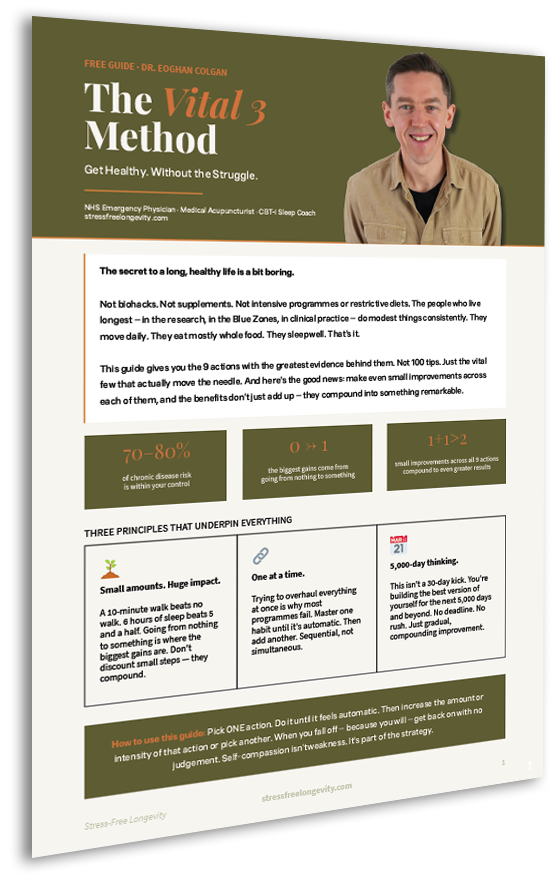
Ready to Stop Optimising and Start Sleeping?
The best health decisions are the consistent ones, not the perfect ones — and that's as true for sleep as anything else.
- The highest-impact actions across Sleep, Nutrition, and Exercise
- The Build Good Habits framework to make changes stick
- Start with one, build from there — no overhaul required
No spam. Unsubscribe anytime.
Frequently Asked Questions
Sources
- Hirshkowitz M et al. (2015). National Sleep Foundation's sleep time duration recommendations. Sleep Health. ScienceDirect
- Cappuccio FP et al. (2010). Sleep duration and all-cause mortality: a systematic review and meta-analysis. Sleep. PubMed
- Windred DP et al. (2024). Sleep regularity is a stronger predictor of mortality risk than sleep duration. Sleep. Oxford Academic
- Ohayon MM et al. (2004). Meta-analysis of quantitative sleep parameters across the human lifespan. Sleep. PubMed
- Draganich C & Erdal K (2014). Placebo sleep affects cognitive functioning. Journal of Experimental Psychology: Learning, Memory, and Cognition. PubMed
- National Institute on Aging. Sleep and Older Adults. NIA
Medical disclaimer
This content is for informational purposes only and is not intended as medical advice. Always consult your healthcare provider before making changes to your health routine. What works for one person may not work for another — this is a roadmap, not a prescription.
About Dr. Eoghan Colgan
Emergency medicine physician researching what actually works for longevity. I interview world-class experts in health and longevity and test everything personally. Everything I teach is what I'm implementing myself. More about me →

Related Articles

How to Calculate Protein Intake: A Doctor’s Simple Rule
How to Calculate Protein Intake: A Doctor’s Simple Rule Key Takeaways The simplest way to […]

Does Creatine Cause Hair Loss? What the Evidence Shows
Does Creatine Cause Hair Loss? What the Evidence Shows Key Takeaways No study has shown […]

Creatine Side Effects: What’s Real and What Isn’t
Creatine Side Effects: What’s Real and What Isn’t Key Takeaways Creatine is one of the […]