
How to Calculate Protein Intake: A Doctor's Simple Rule
Key Takeaways
The simplest way to calculate your protein intake: your weight in kilos is roughly the grams you need a day, at any age.
It doesn't need to be exact. About 25 to 30 grams at each meal, breakfast included, gets most people there.
Protein matters most when you're ill. Your needs go up just as your appetite goes down.
How to calculate protein intake should be simple. But there is so much conflicting advice. The new US guidelines say most of us should be eating more. Some longevity experts say we should be eating less.
I'm an emergency medicine doctor. I've been through the research and interviewed the people who do it, including Professor Luc van Loon, one of the world's leading protein researchers.
My take is that we should, and can, keep it simple. In this article I'll show you how to work out your number, what it looks like on a plate, why you don’t need to overthink it, and the one time you really should.
How Do I Calculate My Protein Intake?
The official guidance sets a minimum of 0.8 grams of protein for every kilo you weigh. From 65, the expert groups for older adults raise it to 1.0.
To keep it simple, use 1 gram per kilo, whatever your age. Your weight in kilos is roughly your protein in grams a day. If you weigh 80 kilos (about 12½ stone, or 176 pounds), that's about 80 grams.
If you do not use kg and grams, the calculator below will allow you to use stones and pounds.
It doesn't need to be exact. The aim is to clear the minimum. If you eat a bit more than you need, your body simply burns it for energy or gets rid of it.
If you'd rather not think in daily totals, there's an even simpler rule: about 25 to 30 grams of protein at each of your three meals. If you have a high BMI, aim for the top of that range.
For a more exact figure, use the calculator. It also adjusts if you're carrying extra weight, because multiplying your full weight overestimates what you need (fat needs very little protein). And it gives you two numbers: what you need most weeks, and what you need when you're ill.
Protein intake calculator
Enter your height and weight, in whichever units you use. You'll get your number for a normal week, and for a week when you're ill or recovering.
In a normal week
The official minimum is 0.8 g per kilo under 65, and 1.0 from 65. One gram per kilo covers both. It doesn't need to be exact.
For a sense of scale: a palm-sized piece of chicken is about 30 g, a shop-bought tuna sandwich about 18 g, two eggs about 13 g.
When you're ill, recovering or losing weight
When you can't face a meal, small things count: a glass of milk, a yoghurt, a shake. If you've barely eaten for more than a few days, or you're losing weight without trying, see your GP.
If you've been told your kidneys aren't working fully, don't aim this high without checking with your doctor first.
Not for pregnancy or breastfeeding, under-18s, or anyone with kidney or liver disease, including if you've been told your kidney function is reduced. If that's you, ask your doctor, dietitian or renal team.
| Your weight | Most weeks | When you're ill |
|---|---|---|
| 50 kg7 st 12 lb · 110 lb | 50 g | 60–75 g |
| 55 kg8 st 9 lb · 121 lb | 55 g | 65–80 g |
| 60 kg9 st 6 lb · 132 lb | 60 g | 70–90 g |
| 65 kg10 st 3 lb · 143 lb | 65 g | 80–100 g |
| 70 kg11 st 0 lb · 154 lb | 70 g | 85–105 g |
| 75 kg11 st 11 lb · 165 lb | 75 g | 90–110 g |
| 80 kg12 st 8 lb · 176 lb | 80 g | 95–120 g |
| 85 kg13 st 5 lb · 187 lb | 85 g | 100–130 g |
| 90 kg14 st 2 lb · 198 lb | 90 g | 110–135 g |
| 95 kg14 st 13 lb · 209 lb | 95 g | 115–140 g |
| 100 kg15 st 10 lb · 220 lb | 100 g | 120–150 g |
Grams of protein a day, rounded to 5 g. If your BMI is over 30, use the calculator above.
Why Do You Hear Different Recommendations?
In January 2026, the new US Dietary Guidelines set protein at 1.2 to 1.6 grams per kilo for everyone. Some well-known longevity doctors go further, with "a gram per pound", which is about 2.2 grams per kilo.
For a healthy person eating normally, the evidence doesn't support either. In a six-month trial, older men ate either 0.8 grams per kilo or about 60% more. At the end, the extra protein had made no difference to their muscle, their strength, their walking speed or how easily they climbed stairs. A 2025 review pulled together 33 earlier reviews, covering 441 studies, and found the same: in healthy older people, extra protein didn't add muscle, strength or physical performance.
The 1.2 to 1.6 figure comes largely from trials of people losing weight, where it's reasonable. The gram per pound comes from bodybuilding, and even in young people lifting weights, the benefit levels off at about 1.6 grams per kilo.
The opposite claim, that eating less protein helps you live longer, comes mostly from studies in mice fed restricted diets for their whole lives. It hasn't been tested in people over 65. In the large US study often quoted on this, the pattern actually reversed after 65: people who ate more protein had a lower risk of dying over the following years.
When we put the studies together, eating more than the recommended amount doesn't seem to help most people. Eating less has only been shown to help mice. And in people who weren't getting enough, topping up to the recommended levels does help.
Which takes us back to what works for most people: 25 to 30 grams of protein at every meal.
What Does That Look Like on a Plate?
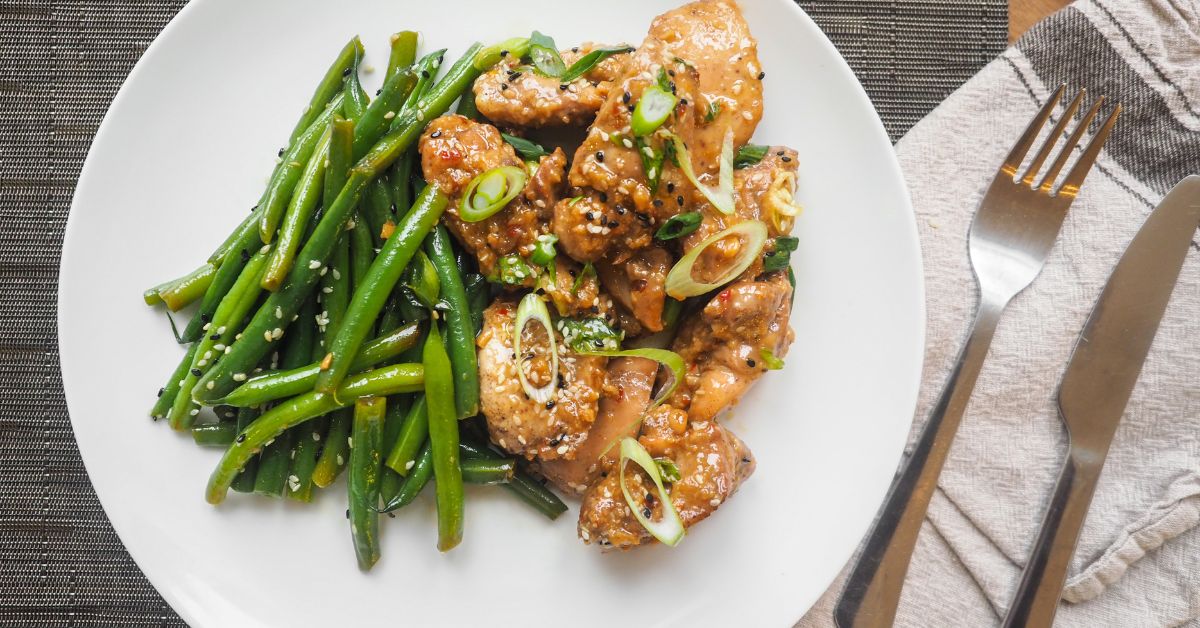
Protein is in most foods, in very different amounts. There's a lot in meat, fish, eggs and dairy, and a fair amount in beans, lentils, nuts and soya. Bread and potatoes have a little. Fruit and most vegetables have very little.
Vegetarians and vegans will find it a little harder, but it's absolutely possible to get enough. You just need to eat a bit more, from a wider variety of plant foods.
Some rough figures:
- An egg: about 6 grams
- A slice of bread: about 4 grams
- A glass of milk (200 ml): about 7 grams
- A pot of Greek yoghurt: 9 to 15 grams, depending on the brand
- Half a tin of baked beans: about 10 grams
- A palm-sized piece of chicken, meat or fish: about 30 grams
For anything in a packet, the label gives you the protein per portion.
Here's an example day that gets an 80-kilo person to their number, from ordinary food:
Breakfast: two eggs on two slices of toast. About 20 grams.
Lunch: a shop-bought tuna sandwich. About 18 grams.
Dinner: a palm-sized piece of chicken. About 30 grams.
Somewhere in the day: a glass of milk or a pot of Greek yoghurt. Another 7 to 10 grams.
That's around 75 grams, and the potatoes and vegetables on the plate take you to about 80. No shakes, no special products.
How to begin
Most of us manage a decent amount at dinner. Breakfast is where it usually falls short: tea and toast is about 8 grams.
So start there. Look at what you're already eating, using the figures above or what’s written on the box or tub, and estimate what you are currently eating. If you fall short, add something: a couple of eggs, some Greek yoghurt, a glass of milk. Once breakfast is sorted, move on to lunch.

What I do
Personally, I don't count my protein intake. I find it frustrating. Instead, I make sure every meal has a reasonable amount of protein in it. Lunch is kefir with nuts and seeds. Dinner is meat or fish with beans or lentils and vegetables. Breakfast was the weak one. It's a fruit and vegetable smoothie, and I felt it was probably lacking, so I added some protein powder. A pot of Greek yoghurt would have done the same job.
Optional Extras
- Protein powder. If you can't get enough from food, protein powder can be added to shakes or yoghurts. This is a great option for vegetarians and vegans. Most people don’t need it.
- The high-protein aisle. Similarly, high-protein foods are not necessary. Most people get enough from regular food. Many foods labelled ‘high-protein’, such as cottage cheese and Greek yoghurt, were high in protein long before anyone put it on the label.
- Tracking apps. You don't need them. But if you are someone who enjoys counting and tracking, use one.
Want the complete framework?
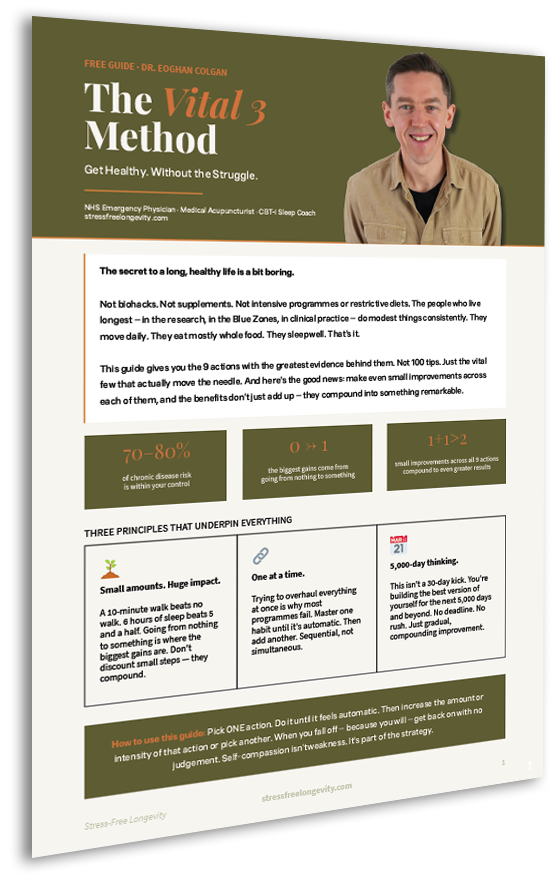
Get "The Vital 3 Method" free guide - the system I use to build sustainable health habits across Sleep, Nutrition, and Exercise.
Do Most People Get Enough Protein?
If you eat three proper meals, chances are you're already getting enough. But some people fall short without realising. In large surveys, about one in five adults over 65 eat less than the basic minimum.
You're more likely to be one of them if:
- Your appetite has dropped, or you're eating less than you used to.
- You're losing weight, including on GLP-1 drugs like Ozempic or Mounjaro. While you're losing weight, aim a little higher, around 1.2 grams per kilo. I've written a separate guide to high protein foods for GLP-1.
- You eat mostly plants. Plant protein is a little harder to digest, so you need a bit more of it.
- You're over 65. Appetite naturally drops with age, and muscle responds less well to protein, so it's sensible to aim a little higher.
If your appetite has dropped, the number doesn't change. It's just harder to reach. But there's one time almost everyone falls short.
I cover this topic in my latest youtube video:
When Does Everyone Need More?
Researchers like Luc van Loon now believe that short spells of illness, more than age itself, are behind much of the muscle we lose as we get older. A chest infection, a fall, an operation.
Illness raises your need for protein. Your body uses it to fight the infection, to repair damaged tissue and, when you're not eating, to make energy. So your needs go up, to about 1.2 to 1.5 grams per kilo. For an 80-kilo person, that's 95 to 120 grams a day.
But this is exactly when we eat less and move less. Luc van Loon's team weighed the leftover food of fit, active patients having planned hip and knee replacements. They ate less than half the protein they needed.
So if the body doesn’t get enough from food, it takes it from your muscles, your protein stores. In one study, healthy people with an average age of 67 spent ten days in bed. They lost almost a kilo of muscle from their legs, and their legs became about 16% weaker.
And the muscle lost in one bad week usually hasn't been rebuilt before the next urine infection, flu or knee replacement. Each illness chips away at the muscle and unless you deliberately rebuild it, it often doesn't fully come back. We often put frailty down to old age, but mismanaging our muscle during ill-health is likely one of the greatest factors.
So what can you do?
Firstly, maintain a healthy intake of protein and do some strength training throughout your life. This means you have the reserves in place when the illness strikes. If you don't do any strength training, a great place to start would be my blog on this topic.
While you're ill:
Eat more protein. That can be hard when your appetite is low, but a few things help:
- Eat the protein first. If your appetite goes halfway through the meal, the protein is already in.
- When you can't face a meal, small high-protein things count. A glass of milk, a yoghurt, a shake. This is when protein powder is genuinely useful.
- Have a protein-rich snack in the evening. It shortens the long overnight gap without food.
And then move as soon as it's safe. In a hospital trial, patients with an average age of 87 did two short exercise sessions a day while they were admitted. They went home stronger and more independent than those who didn't.
And following the illness: go back to your normal protein and your strength work, and you can get back to where you were, though it can take weeks or months. Most people are sent home before that recovery has happened, so it's on you. I've written more about rebuilding muscle after illness here.
If it's your mum or dad in hospital: check what's actually being eaten. Bring in high-protein food they like. And ask the physio what extra they can be doing both in the hospital and afterwards.
The Bottom Line
If you eat three proper meals, chances are you're already close to enough.
Aim for your weight in kilos, in grams of protein, or about 25 to 30 grams at each meal. Make small changes one meal at a time, starting with breakfast. And use your muscles a couple of times a week.
Above all, be conscious of it when you're unwell. That's when it really counts. Eat what you can, protein first, and get moving again as soon as it's safe.
Your future self is counting on it.
Protein Is One Part of It
You know your number. The rest is the strength work that makes it count, and the habits that keep both going.
- The 9 highest-impact actions across Sleep, Nutrition and Exercise
- A strength routine that fits a busy week
- The Build Good Habits framework to make it stick
No spam. Unsubscribe anytime.
Frequently Asked Questions
Sources
Bhasin S et al. (2018). Effect of protein intake on lean body mass in functionally limited older men: a randomized clinical trial. JAMA Internal Medicine. https://doi.org/10.1001/jamainternmed.2018.0008
Obasi CN et al. (2025). Effects of supplemental protein in older people: an overview of meta-analyses. Age and Ageing. https://academic.oup.com/ageing/article/54/12/afaf351/8378198
Volkert D et al. (2019). ESPEN guideline on clinical nutrition and hydration in geriatrics. Clinical Nutrition. https://doi.org/10.1016/j.clnu.2018.05.024
Weijzen MEG et al. (2019). Protein intake falls below 0.6 g·kg⁻¹·d⁻¹ in healthy, older patients admitted for elective hip or knee arthroplasty. Journal of Nutrition, Health and Aging. https://pmc.ncbi.nlm.nih.gov/articles/PMC6399806/
Kidney Disease: Improving Global Outcomes (KDIGO) CKD Work Group (2024). KDIGO 2024 clinical practice guideline for the evaluation and management of chronic kidney disease. Kidney International. https://doi.org/10.1016/j.kint.2023.10.018
Also referred to:
US Department of Agriculture and Department of Health and Human Services (2026). Dietary Guidelines for Americans 2025–2030. https://cdn.realfood.gov/DGA.pdf
Kortebein P et al. (2007). Effect of 10 days of bed rest on skeletal muscle in healthy older adults. JAMA. https://doi.org/10.1001/jama.297.16.1772-b
Martínez-Velilla N et al. (2019). Effect of exercise intervention on functional decline in very elderly patients during acute hospitalization. JAMA Internal Medicine. https://doi.org/10.1001/jamainternmed.2018.4869
Morton RW et al. (2018). A systematic review, meta-analysis and meta-regression of the effect of protein supplementation on resistance training-induced gains in muscle mass and strength in healthy adults. British Journal of Sports Medicine. https://doi.org/10.1136/bjsports-2017-097608
Levine ME et al. (2014). Low protein intake is associated with a major reduction in IGF-1, cancer, and overall mortality in the 65 and younger but not older population. Cell Metabolism. https://doi.org/10.1016/j.cmet.2014.02.006
Effect of a protein intervention during resistance training with varying training intensities on muscle outcomes in frail community-dwelling older adults: a randomized controlled trial (2026). https://pmc.ncbi.nlm.nih.gov/articles/PMC13087472/
Trommelen J et al. (2023). The anabolic response to protein ingestion during recovery from exercise has no upper limit in magnitude and duration in vivo in humans. Cell Reports Medicine. https://doi.org/10.1016/j.xcrm.2023.101324
Medical Disclaimer
This content is for informational purposes only and is not intended as medical advice. Always consult your healthcare provider before making changes to your health routine. What works for one person may not work for another — this is a roadmap, not a prescription.
About Dr. Eoghan Colgan
Emergency medicine physician researching what actually works for longevity. I interview world-class experts in health and longevity and test everything personally. Everything I teach is what I'm implementing myself. More about me →

Related Articles

High Protein Foods for GLP-1: The Short List That Actually Works
High Protein Foods for GLP-1 (When You Can Barely Eat) Key Takeaways Aim for 25 […]

Does Losing Weight Increase Testosterone? What the Evidence Says
Does Losing Weight Increase Testosterone? What the Evidence Says Key Takeaways Yes – and it’s […]
GLP-1 Muscle Loss: What’s Real, What’s Overstated, and What to Do
GLP-1 Muscle Loss: What’s Real, What’s Overstated, and What to Do Key Takeaways The headline […]