
What Is Sleep Consistency? (And Why It Might Matter More Than Hours)

Key Takeaways
- When you sleep may matter as much as how long. Irregular sleepers have higher heart and diabetes risk, even when they get their seven to nine hours.
- Your wake time is the lever. Getting up at the same time every day, then getting morning light, is the most powerful fix. It's also the easiest.
- You don't need a perfect schedule. As long as your bedtime and wake time don't drift by more than an hour or so from one day to the next, you get most of the benefit.
If you've wondered whether a consistent sleep schedule actually matters — the short answer: it matters more than almost anyone realises. When researchers track large numbers of people, when you sleep predicts your long-term health at least as strongly as how many hours you get.
And here's the catch. You can hit your eight hours every night and still carry the risk that comes with irregular timing. The hours don't cancel it out.
I'm Dr. Eoghan Colgan, an emergency medicine doctor and sleep coach. In this article I'll explain what sleep consistency is, why your body cares about timing this much, and the one change that does most of the work to fix it.
What Sleep Consistency Actually Means
Sleep consistency is simple: going to bed and waking up at roughly the same times, day after day. The opposite is a schedule that moves around — late one night, early the next, a lie-in at the weekend to make up for the week.
Researchers score this with something called the Sleep Regularity Index — a number from zero to a hundred, where a hundred means you sleep and wake at exactly the same times every single day.
In practice, nobody's perfect, and you don't need to be. Here's the useful version. The most regular sleepers keep their bedtime and wake time within about a one-hour window most nights. So if you get up at 7am during the week, you would get up no later than 8am at the weekend.
Does It Matter What Time You Sleep If You Get Your 8 Hours?
For decades the whole conversation about sleep has come down to one number. Eight hours. Hit it and you've done your job. Fall short and you should feel guilty. But the evidence says consistency now matters just as much, and maybe more.
In one of the largest studies ever done on this, researchers tracked around 60,000 adults using wrist monitors rather than questionnaires. And what they found: sleep regularity predicted dying early more strongly than how much sleep the participants got. The most regular sleepers had roughly 20 to 48% lower risk of death over the study than the least regular.
And further studies have demonstrated the specific health impacts that might explain this.
Your heart. A study of over 72,000 people found irregular sleepers had a 26% higher risk of a major cardiovascular event — heart attack, heart failure, or stroke. The crucial part: this held even among people getting the recommended seven to nine hours. Hitting their hours did not remove the risk.
Your blood sugar. Irregular sleepers had roughly a 35 to 38% higher risk of developing type 2 diabetes. And again, meeting the sleep duration guidelines did not cancel it out.
Your brain. In a study of over 80,000 people, the most regular sleepers had up to a 40% lower risk of dementia than the most irregular — and the protection was strongest in people who weren't already sleeping well.

But Does Irregular Sleep Actually Cause This?
Maybe people with pre-existing medical complaints simply sleep more erratically. Maybe the illness causes bad sleep rather than the other way around.
So researchers ran an interesting experiment to answer this question.
They took healthy young volunteers and shifted their sleep to the wrong times of day — but kept the amount of sleep identical. Same hours. Just at the wrong time.
Within days, their bodies began to struggle. Blood sugar ran higher — some drifted into pre-diabetic territory after meals. Blood pressure rose. And their cortisol, the stress hormone that should peak in the morning, flipped and peaked at night instead.
These were healthy young people getting a normal amount of sleep. The only thing that changed was the timing. So the harm is real.
So, why does your body care so much about when you sleep, if you're getting enough of it?
You Don’t Have One Body Clock — You Have Trillions
There is one master clock in your brain called the suprachiasmatic nucleus, set by light, keeping time for the whole system.
But what was unknown until very recently - almost every cell in your body has its own clock too. Your liver. Your pancreas. Your gut. Your heart. Each organ has its own set of timekeepers running its own daily schedule, deciding which genes switch on, and when.
Here's the catch. These clocks don't all take their cue from the same signal.
The master clock in your brain runs on light. But the clocks in your liver and your gut run mostly on food — or, more specifically, when you eat. So when your sleep and your meals are all over the place, the two drift apart. Your brain says it's morning. Your liver still thinks it's the middle of the night.
And this can wreak havoc on the body.
I also cover this topic on my YouTube channel - https://www.youtube.com/@stressfreelongevity
What That Mismatch Does to You
A finely tuned body does the right things at the right times of the day. This is what happens when our body clocks run in synch with each other. But when they drift apart, the body does the right things but at the wrong times, and this has detrimental effects. For example:
- You wake earlier than usual and eat breakfast. But your liver clock is still in night mode — running the programme for fasting and sleep, not for handling a meal. So the food arrives but the liver isn't ready for it. Your blood sugar climbs higher than it should. Your pancreas has to strain to keep up. Do that once, and you recover fine. Do it for years, and that daily mismatch is part of how irregular sleep quietly raises your risk of type 2 diabetes.
- There are impacts on the heart also. Normally your blood pressure falls while you sleep — it's the body's nightly chance to recover. But when your clocks are out of sync, that dip doesn't happen properly. Your blood pressure stays up when it should be coming down. The heart doesn't get the rest it needs leading to higher risk of heart disease.
- And there may be a cost to the brain too. While you sleep, your brain runs a kind of overnight clean-up, clearing out waste products, and disrupted sleep may interfere with that. This is the likely reason that people with irregular sleep patterns have higher rates of dementia.
So, how do you synchronise your body clocks?

How to Build a Consistent Sleep Schedule
The good news: it does not require a demanding life overhaul. It comes down to three things — and the first does most of the work.
Anchor your wake time. This is the single most powerful move. Get up at roughly the same time every day, weekends included. A fixed wake time is the easiest lever you have, and it makes everything else easier. If you only change one thing, change this.
Why does it work so well? Your sleep runs on two systems. One is your sleep drive. It's a kind of hunger for sleep that builds the longer you're awake. The other is your body clock. When you keep a steady wake time, the two line up. Your sleep drive peaks just as your clock expects night, and sleep arrives easily instead of being a fight.
Get morning light. Light is the signal that sets your master clock for the day and is best first thing in the morning. Daylight is best as it is much brighter than indoor lighting (even when overcast). Aim for about ten minutes on a clear morning, twenty to thirty when it's dull. If you can't get outside on dark winter mornings, a light box does the same job. But make sure it has at least 10,000 lux.
Don't eat late. This is the one most people miss. Your organ clocks run on food. So a big meal late at night drags them out of step with your brain. You don't need a strict cut-off. Just leave a few hours between your last proper meal and bed where you can.
And remember, the goal isn't a perfect schedule down to the minute. As long as your bedtime and wake time don't drift by more than an hour or so from day to day, you get most of the benefit. Consistency, not rigidity.
When life gets in the way. For some people, at some stages of life, sleep consistency is much harder to control. New parents, shift workers, anyone going through a hard patch. If that's you, keep as much of your routine as steady as you can and get back to a consistent schedule as soon as things ease. Some regularity is far better than none.
What About Catching Up at the Weekend?
Most of us get less sleep than we need during the week and count on a weekend lie-in to make up for it. Here's the honest answer on whether that works.
If you're genuinely short on hours, a lie-in does help a little — some extra sleep eases a real shortage. But there's a limit. A big lie-in, sleeping until ten when you normally wake at seven, is a three-hour swing in your schedule. And that swing is the very thing that pulls your clocks apart. You'd be topping up your hours while disrupting your schedule which has negative health effects.
So the advice is simple. A small lie-in is fine — keep it within about an hour of your usual wake time, and you top up the hours without wrecking the timing. The real answer, though, is to get enough sleep on weeknights so you don't need to catch up at all.
The Bottom Line
You don't have one body clock — you have many, and they work best when they agree. Keep your sleep and wake times steady and they stay in sync. Let them swing, and the mismatch quietly raises your health risk, even if the hours add up.
The evidence here is still mostly observational — but it's strong, it's consistent, and in 2025 the American Heart Association recognised sleep regularity, not just length, as part of heart health. And the fix costs nothing and carries no downside, which makes it one of the easier high-value changes you can make.
So anchor your wake time. Get some morning light. Don't eat too late. You don't need perfection, and you can't bank sleep at the weekend to make up for a chaotic week. When you sleep, it turns out, matters nearly as much as how long — and it's one of the few things about your health you can hold steady, starting tomorrow morning.
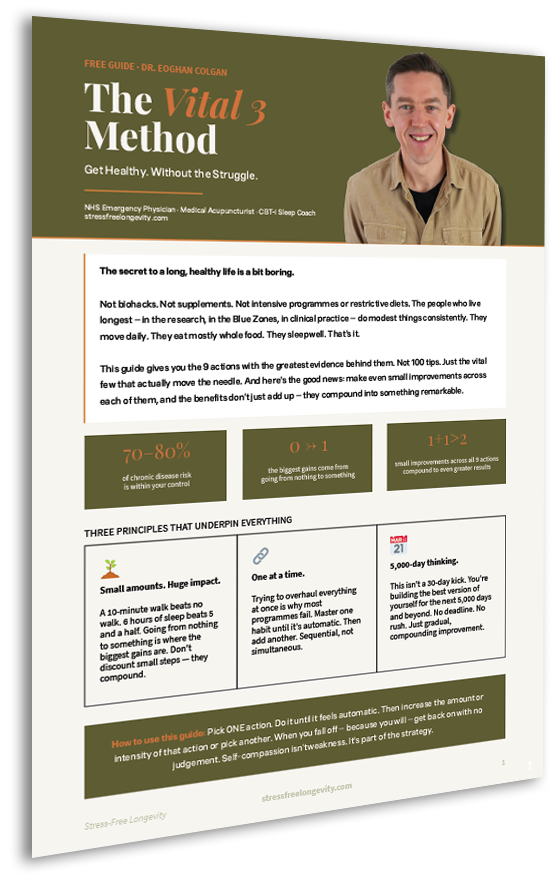
Ready to Sleep Better — for Good?
Consistent timing is one of the three foundations of healthy sleep. Get them right and the rest follows.
- The highest-impact actions across Sleep, Nutrition, and Exercise
- The Build Good Habits framework to make changes stick
- Start with one, build from there — no overhaul required
No spam. Unsubscribe anytime.
Frequently Asked Questions
Sources
- Windred DP et al. (2024). Sleep regularity is a stronger predictor of mortality risk than sleep duration. Sleep. PubMed
- Chaput JP et al. (2024). Sleep regularity and major adverse cardiovascular events. Journal of Epidemiology & Community Health. PubMed
- Scheer FAJL et al. (2009). Adverse metabolic and cardiovascular consequences of circadian misalignment. PNAS. PubMed
- Morris CJ et al. (2016). Circadian misalignment increases cardiovascular disease risk factors in humans. PNAS. PubMed
- Yiallourou SR et al. (2024). Sleep regularity and incident dementia. Neurology. PubMed
- St-Onge MP et al. (2025). Multidimensional Sleep Health: Definitions and Implications for Cardiometabolic Health. Circulation: Cardiovascular Quality and Outcomes. Journal
Medical disclaimer
This content is for informational purposes only and is not intended as medical advice. Always consult your healthcare provider before making changes to your health routine. What works for one person may not work for another — this is a roadmap, not a prescription.
About Dr. Eoghan Colgan
Emergency medicine physician researching what actually works for longevity. I interview world-class experts in health and longevity and test everything personally. Everything I teach is what I'm implementing myself. More about me →

Related Articles

The Sitting-Rising Test: What Your Score Actually Means
The Sitting-Rising Test: What Your Score Actually Means Key Takeaways A score of 8 or […]

High Protein Foods for GLP-1: The Short List That Actually Works
High Protein Foods for GLP-1 (When You Can Barely Eat) Key Takeaways Aim for 25 […]
How to Sleep When Stressed: Why Trying Harder Fails
How to Sleep When Stressed: Why Trying Harder Fails Key Takeaways You can’t make yourself […]