
Is Sitting All Day Bad for You? (Yes — Even If You Exercise)

Key Takeaways
- Your morning workout doesn't fully cover the rest of the day. Exercise benefits fade within hours. Sitting triggers its own damage through separate biological pathways.
- Your muscles do more than move you — they're a chemical signalling system. When you sit, that system goes quiet. Fat accumulates, blood sugar rises, and inflammation builds.
- Just 2 minutes of movement every hour cuts the risk of dying by 33%.
Is sitting for long periods through the day bad for you? Unfortunately yes — and probably more than you think.
A landmark analysis of over one million people found that prolonged sitting is associated with significantly higher rates of early death, type 2 diabetes, and cardiovascular disease — even among people who exercise regularly.
In this article I'll walk you through the three biological mechanisms that explain what sitting actually does to your body, why exercise alone can't fully reverse it, and the specific evidence on how often you need to move — and for how long — to make a real difference.
Why Does Sitting Cause So Much Damage?
There are three interconnected systems in your body that need regular movement to function properly. When you sit for extended periods, all three shut down.
1. Your fat-clearing system switches off
Your body has an enzyme called lipoprotein lipase — LPL — that's responsible for clearing fat from your bloodstream. It's most active in the large muscles of your legs. When those muscles are working, even gently, LPL breaks down circulating triglycerides and converts them into usable energy.
When you sit down, those muscles go quiet. Animal studies show that LPL activity drops by up to 95% within hours of inactivity.
The result: fat accumulates in your blood. Over time, it gets deposited in and around artery walls. That's atherosclerosis — the underlying process behind heart attack and stroke.
And there's a second consequence. Excess fat circulating in the blood promotes chronic inflammation. That matters — and I'll come back to why shortly.
2. Blood sugar regulation breaks down
Active muscles also pull glucose out of your bloodstream to fuel their contractions. When your muscles are inactive, they stop doing that. Blood sugar rises and your body produces more insulin to bring it back down.
But here's what's striking. One study took young, fit adults and had them sit for just a single day. Insulin action — how effectively the body was clearing glucose — dropped by 39%. In just one day.
That effect is reversible. But repeat it day after day, year after year, and your cells gradually become less responsive to insulin. That's insulin resistance — the precursor to type 2 diabetes.
On top of that, persistently elevated blood sugar also directly damages blood vessel walls, accelerating atherosclerosis further. And just like elevated fat, elevated blood sugar is pro-inflammatory. More on that shortly.
3. Your muscles stop talking to the rest of your body
Your muscles aren't just for movement. Every time they contract — even gently — they release chemical signals called myokines. Scientists now recognise muscles as a kind of endocrine organ, communicating with the brain, liver, fat tissue, immune system, and more.
Over 600 myokines have been identified. The best understood is IL-6 — which, when released by contracting muscle, triggers a cascade of anti-inflammatory effects throughout the body. It suppresses inflammatory markers, promotes fat burning, and improves glucose uptake.
When you sit, this signalling stops. No contraction means no myokines. Fat accumulates, blood sugar dysregulates, and — critically — the anti-inflammatory protection disappears.
Why inflammation ties it all together
Each of these three mechanisms feeds into chronic low-grade inflammation — one of the key drivers of heart disease, stroke, cancer, and dementia. Inflammation also accelerates biological ageing, damaging cells and DNA faster than the body can repair them.
One study found that those who sat the most and exercised the least had aged biologically eight years faster than those who moved more regularly.
Regular movement reverses all three pathways simultaneously: it clears fat from the blood and pulls glucose into muscles - removing their inflammation-promoting effects - and releases myokines that suppress inflammation. When you sit, all three go quiet — and the damage compounds.

Why Doesn’t Exercise Fix It?
You might assume that if you exercise regularly, you're covered. But exercise and regular movement are independent needs — and one doesn't replace the other.
Aerobic exercise — any movement that raises your heart rate — strengthens the heart, improves every organ system, and extends life. Strength training builds and maintains muscle, which releases powerful protective chemicals and supports cardiometabolic health. Both are genuinely important. But both deliver their benefits in short, intense bursts — and those benefits wear off within a few hours of finishing.
For the rest of the day, while you're sitting at your desk, in your car, on the sofa — the metabolic systems that depend on regular movement are shutting down.
All three matter. Aerobic fitness, strength, and regular movement through the day. So try and do all three if you can. Even small amounts.
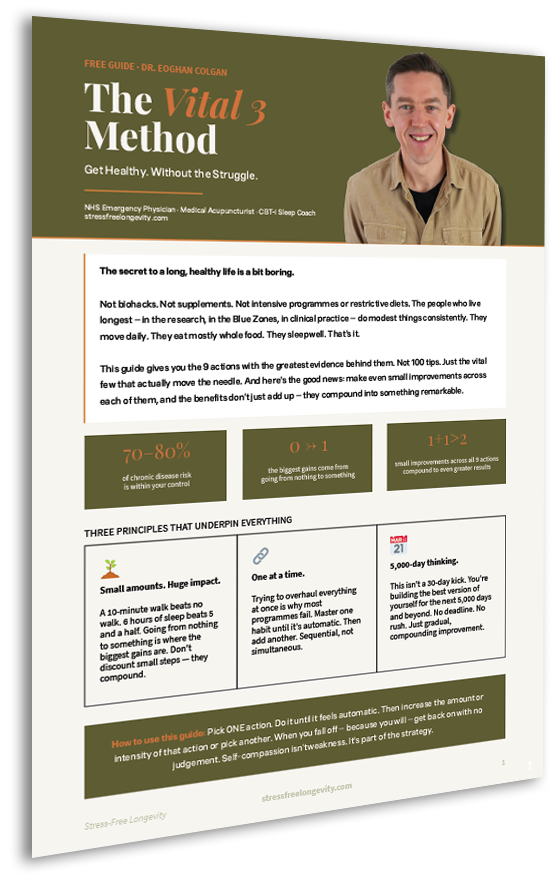
Want the complete framework?
Get "The Vital 3 Method" free guide — the system I use to build sustainable health habits across Sleep, Nutrition, and Exercise.
Does It Get Worse with Age?
In short, yes — and the reasons map directly to the three mechanisms above.
Insulin sensitivity declines naturally as you age. Your body becomes slower at clearing glucose from the blood, so the same period of sitting now produces a longer window of elevated blood sugar and a larger inflammatory response.
Muscle mass also decreases gradually from around age 30 if you don't actively maintain it. Less muscle means fewer myokines released during movement which results in less glucose pulled from the blood, lower LPL activity and less suppression of inflammation.
In other words, the protective systems are already weaker as you age before sitting switches them off entirely. That's why regular movement through the day becomes more important as you get older — not less.
But the good news is that these systems still work at any age. Regular movement activates all three whether you're 30 or 70.

How Often Do You Need to Move?
Here's what the best evidence shows.
The ideal is a few minutes every 30 minutes. One study found that five minutes of light walking every half hour reduced blood sugar spikes by 58% — a large effect from a small intervention.
If that's not practical, even one to two minutes every hour makes a meaningful difference. Another study found that this level of movement was associated with a 33% lower risk of early death.
And gentle movement is sufficient to reactivate all three mechanisms. A light walk to see a colleague rather than phoning them. A quick lap around the building. Taking the stairs instead of the lift.
If you genuinely can't easily get up, simple exercises at your desk work too. A repeated heel raise — lifting your heels while keeping your toes on the floor — activates the calf muscles enough to meaningfully improve blood sugar control and circulation. Alternatively, one study concluded that longer periods of exercise — around 60 to 75 minutes per day, even in one session — may offset the impact of prolonged sitting.
Standing desks are better than sitting, but they're not the full solution. Standing doesn't activate your muscles the way walking does, and prolonged standing brings its own problems — back pain and poor circulation in the legs. If you use one, try adding movement too. Those heel raises work well here.
A note on step counts
If you're aiming for 10,000 steps a day, that's a great goal — it's aerobic exercise and regular movement rolled into one. But how you distribute them matters.
Multiple studies have compared a single bout of exercise followed by prolonged sitting against the same total activity spread throughout the day. Consistently, the spread-out pattern produces better metabolic outcomes — better blood sugar control, better fat clearance, better insulin sensitivity.
So if you're hitting your step count in a morning walk and then sitting for the rest of the day, you're getting the aerobic benefit but missing the movement benefit. Try to spread some of those steps throughout the day for more benefit.
I also cover this topic in a video on my YouTube channel - https://www.youtube.com/@stressfreelongevity
What I Actually Do
When I first got my smartwatch, I didn't fully understand the hourly movement reminders. Now I do. When it goes off, I get up — a walk around the house or the hospital corridor.
I've recently started working on a treadmill desk when I'm at home. And I find every excuse to add movement to the day — always the stairs, always the longer route, parking further from where I'm going, walking laps of the hospital when I get a break.
This is all on top of regular aerobic exercise and strength training. They're separate needs. Regular movement keeps the metabolic systems running that sitting switches off.
For more on building an exercise routine that works, explore my exercise content →.

The Bottom Line
Sitting for long periods triggers three distinct forms of biological harm — your fat-clearing enzymes shut down, your blood sugar regulation breaks, and your muscles stop releasing the chemical signals that protect you from inflammation and disease.
Exercise reduces the risk, but it doesn't eliminate it. Your body needs both: periodic exercise for fitness and strength, and consistent low-level movement through the day to keep those metabolic systems running.
The fix is small. A few minutes every half hour. A short walk after meals. Some steps spread through the day rather than all taken at once.
You don't need to overhaul your life. You just need to stop sitting still for so long.
Ready to Move More — and Make It Stick?
Sitting less is one piece of the puzzle. But it works best alongside the right exercise, nutrition, and sleep habits — all reinforcing each other.
Get the complete Vital 3 Method guide — free:
- The 3 highest-impact changes for each pillar (9 total)
- The Build Good Habits framework to make them stick
- Start with one, build from there — no overhaul required
No spam. Unsubscribe anytime.
Frequently Asked Questions
Sources
- Biswas A et al. (2015). Sedentary Time and Its Association With Risk for Disease Incidence, Mortality, and Hospitalization in Adults. Annals of Internal Medicine. PubMed
- Ekelund U et al. (2016). Does physical activity attenuate, or even eliminate, the detrimental association of sitting time with mortality? A harmonised meta-analysis of data from more than 1 million men and women. The Lancet. PubMed
- Peddie MC et al. (2013). Breaking prolonged sitting reduces postprandial glycemia in healthy, normal-weight adults: a randomized crossover trial. American Journal of Clinical Nutrition. PubMed
- Stephens BR et al. (2011). Effects of 1 day of inactivity on insulin action in healthy men and women. Metabolism. PubMed
- Dunstan DW et al. (2012). Breaking up prolonged sitting reduces postprandial glucose and insulin responses. Diabetes Care. PubMed
- Hamilton MT et al. (2007). Role of low energy expenditure and sitting in obesity, metabolic syndrome, type 2 diabetes, and cardiovascular disease. Diabetes. PubMed
- Severinsen MCK & Pedersen BK (2020). Muscle–Organ Crosstalk: The Emerging Roles of Myokines. Endocrine Reviews. PubMed
Medical disclaimer
This content is for informational purposes only and is not intended as medical advice. Always consult your healthcare provider before making changes to your health routine. What works for one person may not work for another — this is a roadmap, not a prescription.
About Dr. Eoghan Colgan
Emergency medicine physician researching what actually works for longevity. I interview world-class experts in health and longevity and test everything personally. Everything I teach is what I'm implementing myself. More about me →

Related Articles

How to Calculate Protein Intake: A Doctor’s Simple Rule
How to Calculate Protein Intake: A Doctor’s Simple Rule Key Takeaways The simplest way to […]

Does Creatine Cause Hair Loss? What the Evidence Shows
Does Creatine Cause Hair Loss? What the Evidence Shows Key Takeaways No study has shown […]
Creatine Side Effects: What’s Real and What Isn’t
Creatine Side Effects: What’s Real and What Isn’t Key Takeaways Creatine is one of the […]