
GLP-1 Muscle Loss: What's Real, What's Overstated, and What to Do
Key Takeaways
- The headline "40% of weight lost is muscle" overstates what's really happening. A meaningful part of that "lean tissue" is your liver shrinking back to normal — and the muscle that remains is leaner and healthier.
- The drug isn't destroying muscle. Eating less is. Any rapid weight loss does this, whether it's a GLP-1, a crash diet, or fasting. The biology is the same.
- The plan to protect your muscle is genuinely simple. Two short strength sessions a week. Around 25 grams of protein at every meal. A few grams of creatine a day.
If you've started a GLP-1 medication — Ozempic, Wegovy, Mounjaro, Zepbound — or you're considering one, you've probably seen the headline. A third of the weight you lose is muscle. Maybe more.
It's everywhere. Cleveland Clinic. Mayo Clinic. The fitness influencers.
The reality is less alarming than it sounds. You will lose some muscle, but less than the numbers suggest — and the reason is straightforward biology, not something specific to the drug. Once you understand what's actually happening, the plan to protect yourself is genuinely simple.
Let me walk you through it.
What the Headlines Get Wrong
When the trials report "muscle loss," they're using body composition scans — usually a type called DXA. DXA divides the body into three parts: fat, bone, and lean mass. Most reporting then treats that lean mass as muscle. It isn't.
Lean mass is everything in your body that isn't fat or bone. Muscle is part of it. But so are your liver, your other organs, your connective tissue, your skin, and a lot of body water — all bundled into one number.
So when an article says "up to 40% of weight loss on GLP-1s is muscle," what they actually mean is up to 40% is lean mass. And the best evidence we have suggests that 40% breaks down into roughly two halves.
About half of it isn't muscle at all. It's the liver, body water, and other tissues — and most of it represents good things happening in the body.
Most people who qualify for these drugs have some degree of fatty liver disease. As they lose weight, the fat inside the liver clears and the organ shrinks back toward a healthy size. A 2026 study from a UC Davis lab looked at this directly — in their experiment, the loss of liver mass was actually greater than the loss of muscle mass.
Body water also drops: muscle stores energy as glycogen, and every gram of glycogen is bound to about three grams of water. When you eat less, glycogen drops and water drops with it. That's real lean mass coming off the scan — but it's not muscle, and it returns the moment you eat properly again.
The other half is actual muscle — probably closer to 20% of the weight you lose. This is the real muscle loss. And here's where it gets interesting.
Even some of that 20% isn't muscle tissue exactly. As we age, fat builds up inside and around our muscle fibres — it's one of the reasons strength fades over time. MRI scans of people on GLP-1s show this muscle fat drops substantially. So part of what looks like muscle loss is actually muscle getting cleaner and healthier.
Genuine skeletal muscle loss does occur but it is smaller than the headlines suggest. And it's similar to what happens with any form of weight loss — which I'll come to in the next section.
Now here's the part that matters most. Even though some muscle does come off, you're losing far more fat. So after a year on a GLP-1, you will have less muscle in absolute terms — but you will have proportionally much more muscle relative to fat than when you started. That ratio is what your body actually responds to. A better muscle-to-fat ratio means better blood sugar control, lower inflammation, lower cardiovascular risk, and better function for any given activity.
So yes, some muscle loss does occur. But it's less than the headlines suggest, the muscle that remains is leaner, and the ratio of muscle to fat is healthier. And the whole process is part of how a body normally responds to losing weight.
I also cover this topic in a video on my YouTube channel - https://www.youtube.com/@stressfreelongevity
Why This Happens — And Why It’s Normal
Your body has a simple rule. When food is plentiful, it builds and stores. When food runs short, it breaks down what it already has. Fat first — that's what we want. But other tissue too, including muscle.
There are two things your body wants from breaking down muscle in a deficit. It wants the energy. And it wants the amino acids — the building blocks proteins are made of — to keep other essential processes running. When you don't eat enough, your body strips them from where it can. Muscle is one of those places.
This isn't a glitch. It's how every body has always worked. Carrying less weight makes you faster, lighter, and more efficient on limited fuel — a useful adaptation when food was hard to come by.
It's how fasting works. It's how dieting works. And it's how GLP-1s work. Eating less is the issue.
This was neatly demonstrated in one study, in which scientists gave one group of mice a GLP-1, and a second group exactly the same number of calories without the drug. Both groups lost the same fat. Both lost the same lean mass. Both showed the same drop in grip strength. The drug wasn't doing anything to muscle that hunger wasn't already doing.
In other words: the drug isn't melting your muscle. It's making you eat less, and your body is responding the way bodies have always responded to eating less. This isn't an Ozempic problem. It's a weight-loss problem — and it's a solvable one.

Muscle Still Matters
So far the picture is reassuring. The headline numbers are overstated. The cause is normal biology. The muscle that remains is healthier than the muscle you started with.
But muscle still matters. Muscle doesn't simply help you to move. It is essential for health and longevity - and as you get older, it matters more.
Muscle is what carries you through life. It helps your body manage blood sugar and supports your immune system. It releases signalling molecules called myokines that reduce inflammation, suppress tumour growth, and protect brain health. People with more muscle survive serious illness at higher rates and recover faster. Grip strength — a simple proxy for total muscle — is one of the strongest predictors of how long you'll live.
And we naturally lose about 1% of our muscle a year from our 40s onwards, with the rate accelerating after 60. And most of us aren't doing nearly enough to slow that drift. And here's why.
Our hunter-gatherer ancestors moved and built and foraged all day. Now we sit at desks and have our food delivered. Our body, working off the same rules it always has, looks at our daily activity and concludes we don't really need much muscle. So it quietly strips it away. Use it or lose it isn't a slogan — it's how the body is designed.
Add rapid weight loss on top of that — whether from a GLP-1, a diet, or anything else — and the muscle loss accelerates.
This is the genuine reason to act. Not because GLP-1s are unusually harmful to muscle. But because we should be protecting our muscle anyway.
The good news is that the plan to protect it is simple — and it works whether you're on a GLP-1 or not.
Want the complete framework?
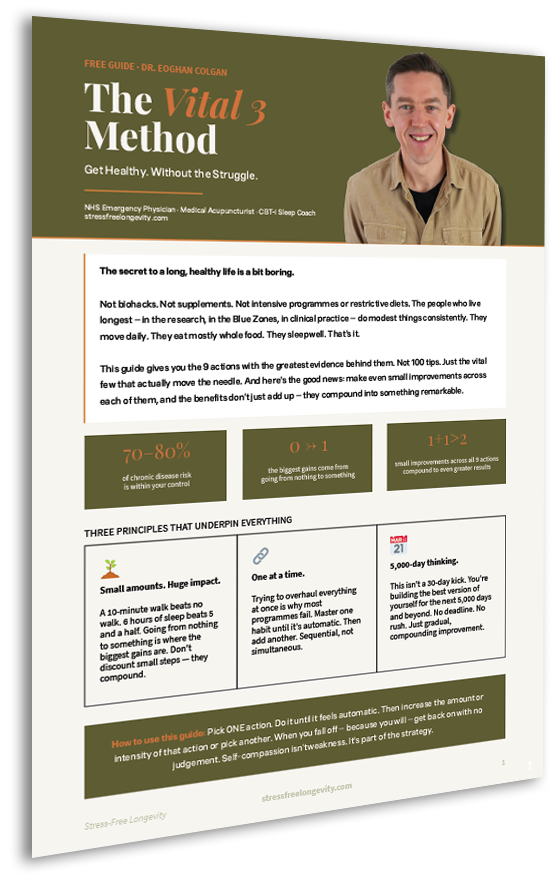
Get "The Vital 3 Method" free guide — 9 evidence-based principles across Sleep, Nutrition, and Exercise that protect your strength whether you take a GLP-1 or not.
What Actually Protects You
Three things, in order of importance. Strength training is the signal that tells your body to keep its muscle. Protein gives it the materials. Creatine helps it train harder. Together, they protect almost all of the muscle a GLP-1 would otherwise cost you.
1. Strength training, twice a week
Your body builds what you ask it to and quietly removes what you don't use. If you don't load your muscles, your body assumes you don't need them and lets them go. Strength training is the ask.
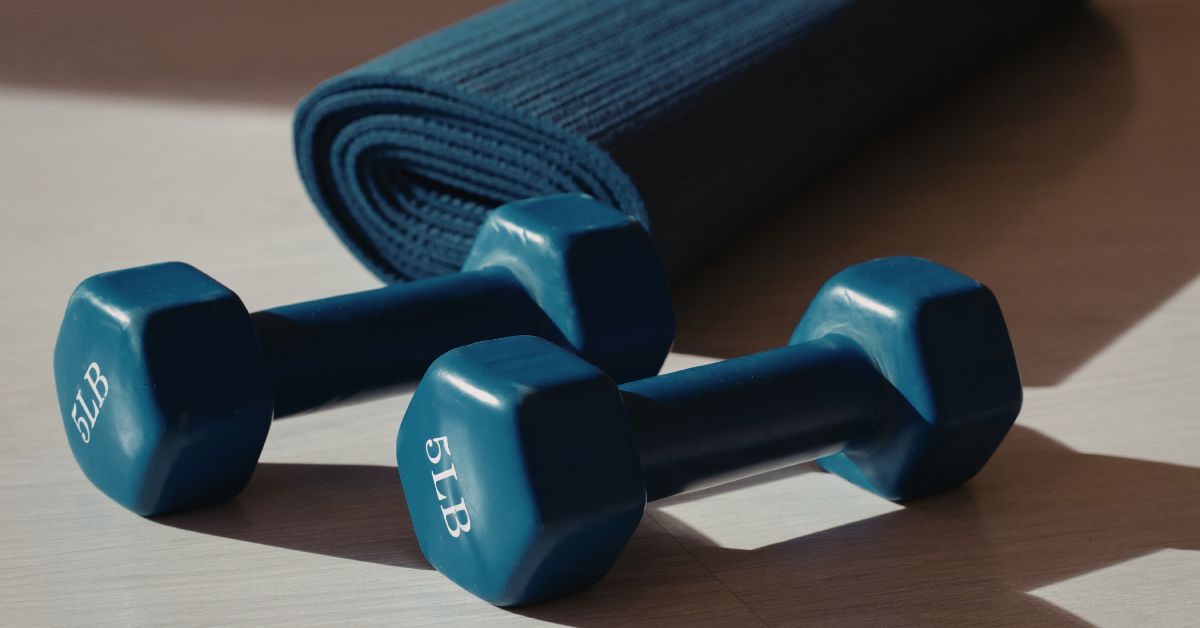
The equipment doesn't matter. Bodyweight squats and push-ups. Resistance bands. Dumbbells at home. A gym, if you like gyms. Your body doesn't know what form of exercise is happening. It just knows there's a load on the muscle. They all send the same signal.
And it doesn't need to be intensive. The health benefits are greatest at the start - going from nothing to something. Even two short sessions (around 15-minutes each) a week is enough, working the major muscle groups hard enough that the last few reps are genuinely difficult.
But when starting out, start small. Start lighter than you think you need to. Get the movement right first, then add resistance gradually. Done sensibly, the injury risk is much smaller than the risks of not training at all.
2. Enough protein, evenly spread
Protein provides the amino acids your body needs — both to build new muscle, and to spare the muscle you already have from being broken down for those amino acids when you're eating less. Eating protein directly stimulates muscle building on its own, but it's far more impactful when paired with strength training.
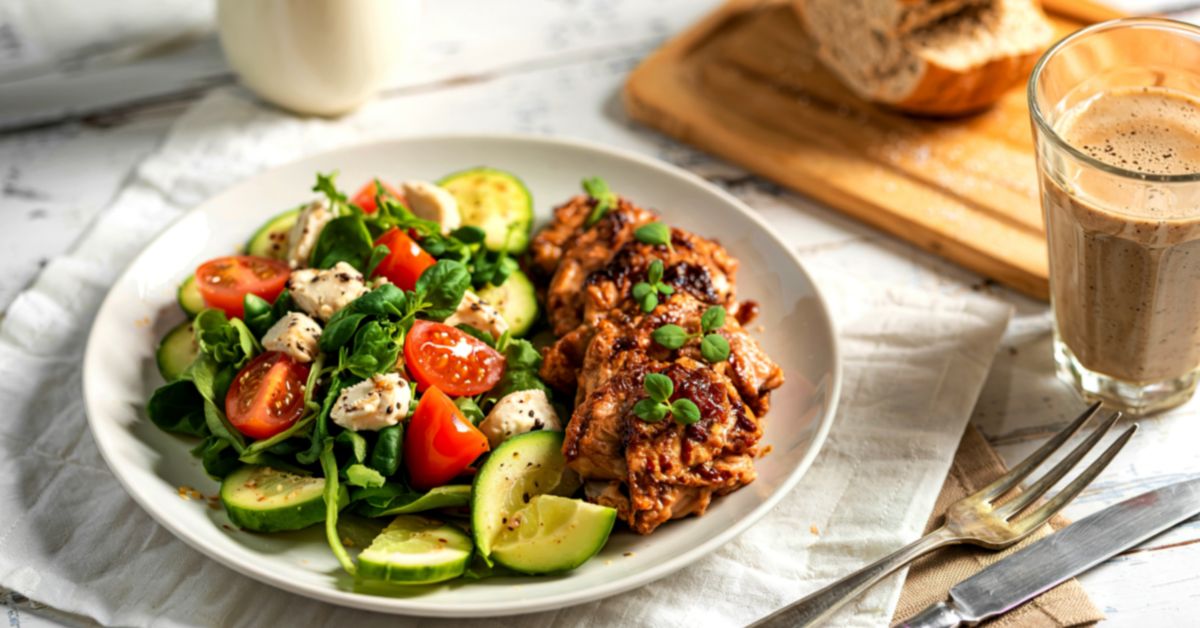
The practical target is 25 to 30 grams of protein at every meal, three times a day.
Most people get there at dinner. They get close at lunch. They fall short at breakfast — toast and coffee won't get you there.
Here's what 25 grams looks like:
- Three eggs and a slice of cheese on toast
- A small chicken breast (around 100 grams)
- A tin of tuna
- A bowl of Greek yogurt with a handful of nuts
- A protein shake with milk
On a GLP-1, solid protein-rich foods like meat can feel heavy because the drug slows your stomach. Greek yogurt, eggs, cottage cheese, and protein shakes are easier to tolerate. Protein shakes are a perfectly legitimate way to hit the target on tough days — not a cop-out.
If you eat plant-based, the same total amount of protein applies, but it takes a little more attention. Plants have less protein per gram of food. Your body absorbs plant protein slightly less efficiently. And most plants are short on one or two essential amino acids — grains tend to be low in one, beans in another. The fix is variety and quantity. Eat more, and eat more types of plants.
3. Creatine, 3 to 5 grams a day
Creatine is a natural compound that helps deliver energy to muscles during short, intense efforts. When you push hard in a strength session, creatine lets you do a couple more reps before the muscle fatigues. Over weeks and months, those extra reps add up to meaningfully more muscle and more strength. So it needs to be paired with strength training.
The evidence in older adults is strong: creatine plus resistance training adds roughly a kilogram of lean mass and meaningful strength on top of what training alone delivers.
Buy plain creatine monohydrate. Anything fancier — micronized, "absorption-enhanced," combined with other ingredients — is more expensive and not better supported. Three to five grams a day, every day. Timing doesn't matter. You don't need a loading phase.
And it's safe for healthy kidneys. The kidney concern people raise comes from a misunderstood blood test, not from actual harm. But if you have existing kidney disease, check with your doctor first.
What Happens When You Stop the Drug
There's one final, important consideration when it comes to muscle health on a GLP-1.
About half the people who start a GLP-1 stop within a year. Some can't tolerate it. Some can't afford it. Some hit their goal and want off. When that happens, most people regain a large portion of the weight they lost — around two-thirds, on average, within a year.
And what you regain, is different to what you lost.
When you lose weight on a GLP-1, you lose mostly fat with some lean tissue. When you regain weight afterwards — without the drug, without a plan — the regain is mostly fat. Very little of the muscle comes back on its own. There's no built-in signal telling your body to rebuild muscle. That signal has to come from training.
Run that cycle once and you finish slightly worse than you started. Less muscle. More fat. Similar number on the scale. Run it two or three times over the years, and the gap widens.
This is why the plan above isn't just for while you're on the drug. It's the thing that protects you long after you've stopped.
The Bottom Line
The headline "40% of weight loss is muscle" overstates what's really happening. A meaningful part of that "lean tissue" is a shrinking liver and fat leaving the muscle itself — both genuinely good things. The actual skeletal muscle loss is closer to 20%, and the muscle that remains is healthier than what you started with.
The drug isn't doing anything special to your muscle. Eating less is. Same biology as fasting, same biology as dieting.
That doesn't mean muscle loss isn't worth taking seriously. It is. We already lose muscle quietly as we age, and these drugs accelerate that. But the plan to protect it is simple. Two short strength sessions a week. Twenty-five grams of protein at every meal. A few grams of creatine a day.
Get the weight off. Keep the muscle.
Ready to Build Health That Lasts?
You've just learned how to protect your muscle on a GLP-1. But this is one of nine principles that determine how you age — and the muscle question is just one piece of the bigger picture.
- The 9 highest-impact actions across Sleep, Nutrition, and Exercise
- Two-session-a-week strength training that fits a busy life
- The Build Good Habits framework to make changes stick
No spam. Unsubscribe anytime.
Frequently Asked Questions
Sources
- Jeromson S et al. (2025). Semaglutide impacts skeletal muscle to a similar extent as caloric restriction in mice with diet-induced obesity. Journal of Physiology. Wiley
- Karakasis P, Patoulias D, Fragakis N, Mantzoros CS. (2025). Effect of GLP-1 receptor agonists on body composition: a network meta-analysis. Metabolism. PubMed
- Neeland IJ et al. (2024). Muscle Mass and Glucagon-Like Peptide-1 Receptor Agonists: Adaptive or Maladaptive Response to Weight Loss? Circulation. AHA
- Langer H et al. (2026). Weight loss with GLP-1 medicines does not result in a disproportionate loss of muscle mass or function in obese mice and humans. Cell Reports Medicine. Cell
- Lundgren JR et al. (2021). Healthy weight loss maintenance with exercise, liraglutide, or both combined. New England Journal of Medicine. PubMed
- Chilibeck PD, Kaviani M, Candow DG, Zello GA. (2017). Effect of creatine supplementation during resistance training on lean tissue mass and muscular strength in older adults. Open Access Journal of Sports Medicine. PMC
- Mozaffarian D et al. (2025). Lifestyle and nutrition recommendations for adults using GLP-1 medications: joint advisory. American Journal of Clinical Nutrition. AJCN
Medical disclaimer
This content is for informational purposes only and is not intended as medical advice. Always consult your healthcare provider before making changes to your health routine. What works for one person may not work for another — this is a roadmap, not a prescription.
About Dr. Eoghan Colgan
Emergency medicine physician researching what actually works for longevity. I interview world-class experts in health and longevity and test everything personally. Everything I teach is what I'm implementing myself. More about me →

Related Articles
How to Calculate Protein Intake: A Doctor’s Simple Rule
How to Calculate Protein Intake: A Doctor’s Simple Rule Key Takeaways The simplest way to […]
Does Creatine Cause Hair Loss? What the Evidence Shows
Does Creatine Cause Hair Loss? What the Evidence Shows Key Takeaways No study has shown […]
Creatine Side Effects: What’s Real and What Isn’t
Creatine Side Effects: What’s Real and What Isn’t Key Takeaways Creatine is one of the […]