
Creatine Over 50: Who Should Take It (And Who Shouldn't)

Key Takeaways
- Creatine works — but mostly for one thing. It helps you build muscle and strength when paired with resistance training. The training does the work; creatine multiplies it. Without lifting, the muscle gains essentially aren't there.
- The brain claims are oversold. European and UK regulators rejected the cognitive health claim in 2024. There may be a real effect in older adults — but the evidence is preliminary.
- It's safe, simple, and cheap. Five grams of creatine monohydrate a day, taken indefinitely. No fancy version needed. Around £20 for several months' supply.
Creatine has become one of the most-talked-about supplements for adults in midlife. It's no longer just a supplement for young men in gyms — it's being marketed to women, to older adults worried about muscle loss, and to anyone hoping to keep their brain sharp.
There's quite a bit of confusion around it. Some of the claims are well-supported by the evidence. Others aren't.
The honest answer to whether creatine is worth taking after 50: it depends on whether you lift weights. If you do, the evidence is genuinely good — creatine roughly doubles the muscle you'd build from training alone. If you don't lift, the case is much weaker than the marketing suggests.
In this article, I'll walk you through what creatine actually does, what the evidence shows for muscle, brain, and bone, who should be cautious, and what to look for if you decide to take it. I'll also tell you when it's almost certainly a waste of money.
First, a quick primer on what creatine is.
What Creatine Actually Is
Creatine doesn't fuel your muscles. It recharges them.
Every time your muscles contract — every step, every lift, every time you stand up from a chair — they need energy. That energy comes from a molecule called ATP. Think of ATP as a tiny battery. When the muscle needs energy, a piece of the battery breaks off, energy is released, and the battery is flat.
The problem is your muscles only hold a few seconds' worth of charged ATP at any given moment. After that, your body has to regenerate it. There are several systems that can do this — burning glucose, burning fat — but they take 30 seconds or more to ramp up.
That's where creatine comes in.
Creatine sits inside your muscle holding a spare piece — a single phosphate molecule. The instant ATP loses its phosphate, creatine donates the one it has — and you've got a fully charged battery again. Then, during rest, the empty creatine picks up a fresh phosphate and gets ready for the next time.
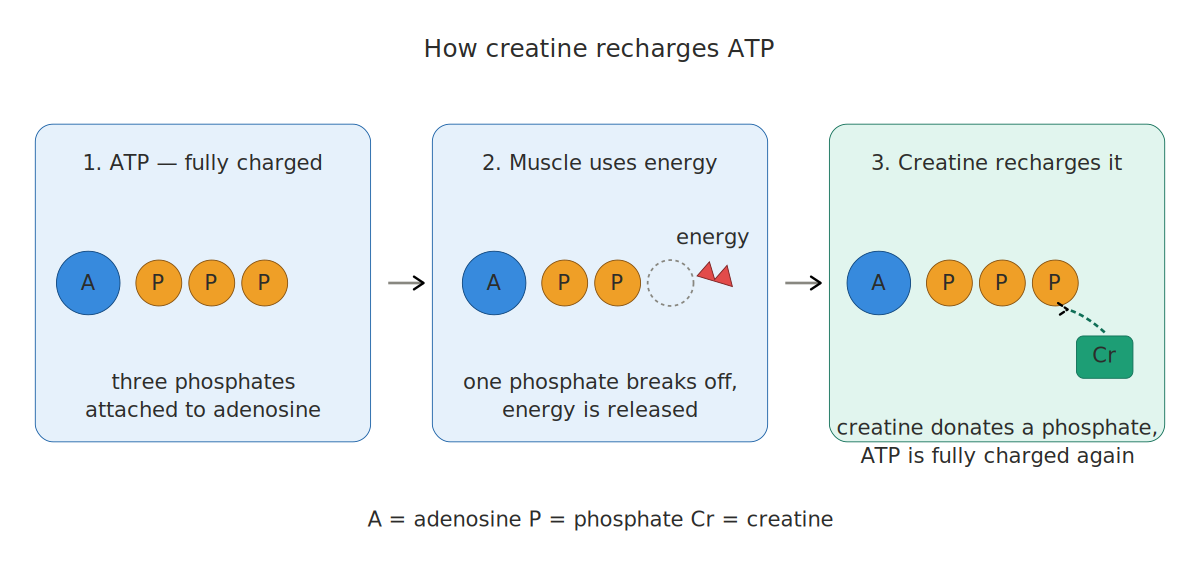
So creatine isn't fuel. It's the recharger that keeps your batteries topped up during short, hard efforts — sprinting for a bus, lifting something heavy, climbing stairs back-to-back. It's not what's powering you on a long walk or a steady run.
Most of your body's creatine — about 95% — sits in your skeletal muscles. A small amount is also in the brain, which is part of why some researchers wonder whether creatine might affect brain function too. We'll come back to that.
Some of the creatine you need is made by your body. Your liver and kidneys produce around a gram a day. The rest comes from food, mostly red meat and fish — chicken has less, plants have essentially none. Most adults eating a normal diet end up with their muscles only partly stocked with creatine — somewhere around 60-80% of the maximum they could hold. Supplementation simply tops them up.
Why It Matters More After 50
Why It Matters More After 50
The reason creatine matters at this stage of life is the same reason resistance training matters: muscle and strength.
You probably don't feel weaker than you did at 40. Most people don't — until they try to do something they used to and find it surprisingly challenging.
Muscle loss starts earlier than most people realise. From around 40, you lose roughly 0.5 to 1% of your muscle mass each year. It's invisible year-to-year. But by 50, you've quietly lost around 10% of what you had in your 30s. After 60, the rate accelerates.
The reason this matters has two parts.
The first is the part everyone broadly understands. Less muscle means less strength. Less strength means a higher risk of the things that quietly take independence away — falls, fractures, frailty, the slow drift toward needing help with everyday tasks. In older adults, how strong you are — measured by something as simple as your grip — is one of the most reliable predictors of how long you'll live. The cost of losing strength isn't aesthetic. It's the difference between staying in your own home and not.
The second part is less talked about. Muscle isn't just there to move your body around — it's one of the most metabolically active organs you have. Skeletal muscle is the largest site of glucose uptake in the body. The more muscle you carry, the better your body handles sugar, the more sensitive you are to insulin, and the lower your risk of type 2 diabetes, metabolic syndrome, and cardiovascular disease. As muscle declines, that protective layer thins. Blood sugar becomes harder to manage. Body composition shifts. Metabolic disease becomes more likely.
So muscle matters for two distinct reasons. It keeps you physically capable — getting up from the floor, carrying shopping, not falling. And it keeps you metabolically resilient — protecting you from the chronic diseases that quietly accumulate in midlife.
The intervention that supports both is well established: resistance training, two to three times a week, with enough protein. Older adults who lift get stronger, gain muscle, and reduce their risk of nearly everything that goes wrong in later life.
The interesting question is whether creatine helps you build and maintain muscle on top of this. It does — but with a critical caveat.
I also cover this topic in a video on my YouTube channel - https://www.youtube.com/@stressfreelongevity
Does It Build Muscle? Yes — But Only If You Lift
This is where creatine has the strongest evidence behind it.
When older adults add creatine to a resistance training programme, they gain meaningfully more muscle and strength than from training alone. The largest meta-analysis to date — covering more than 700 adults aged 57 and over — found an extra 1.37 kilograms of lean mass on top of what training delivered, plus significant gains in upper- and lower-body strength. That's roughly double what training produces by itself.
There's a critical caveat, though.
Without resistance training, creatine alone does almost nothing. The same body of research that shows the muscle gains with training shows essentially zero gain without it — 0.03 kilograms of lean mass across more than a thousand participants. A 2025 trial confirmed that the small short-term gains people sometimes see from creatine alone are mostly water moving into the muscle cell, not new muscle protein.
So creatine doesn't build muscle directly. It lets you push slightly harder — an extra rep or two before fatigue sets in. Over weeks and months, those extra reps add up to more total training, and the training is what builds the muscle.
If you do resistance training — even gentle, twice-weekly sessions — creatine is one of the best-supported interventions you can add.
If you don't lift, the muscle gains aren't there. So what about all the other claims you'll see — for the brain, for the bones, for general wellbeing? That's where it gets more complicated.
What About the Brain?
The other big claim about creatine is for the brain. Some people report improved memory, better focus, brighter mood. Others have suggested it might help prevent cognitive decline.
The biology is plausible. Creatine is present in the brain, and brain cells, like muscle cells, sometimes need fast energy. So more creatine should mean better brain function, especially under stress. That's the theory.
The evidence is mixed.
The single largest cognitive trial — 123 healthy adults given 5 grams of creatine a day for six weeks, tested across ten different cognitive measures — found no benefit on any of them.
There's a smaller German trial from 2024 that's often cited as evidence creatine helps the brain. Fifteen people were kept awake all night, given a single 25-gram dose of creatine — five times the normal daily amount — and tested on cognitive performance. The creatine group did better than placebo. But the sample was tiny, the conditions were artificial, and the dose isn't recommended for everyday use. Even the authors said so.
There's one positive signal worth knowing about. A separate analysis pooling memory studies found that creatine produced a small improvement in memory — and the effect was larger in older adults than in younger ones. So creatine may genuinely help memory, particularly in people whose baseline stores are low. But the trials are small, and the effect is preliminary.
Weighing all of this, in 2024 the European Food Safety Authority reviewed the available research and concluded that a cause-and-effect relationship between creatine and improved cognition has not been established. The proposed health claim was rejected. The UK Nutrition and Health Claims Committee reached the same conclusion.
So the picture is this: at typical doses, in healthy adults, the brain claims aren't well-supported. There's a hint of benefit for memory in older adults, which is interesting but preliminary. If you're already taking creatine for muscle reasons, that's a possible bonus. But if your reason for considering creatine is the brain alone, the evidence isn't there yet.
Want the complete framework?
Get "The Vital 3 Method" free guide — the system I use to build sustainable strength training, nutrition, and sleep habits across midlife.
What About Bones?
There's also been interest in whether creatine might help preserve bone, particularly in postmenopausal women. The hypothesis seemed reasonable — bone responds to mechanical loading, and if creatine helps you train harder, perhaps that translates into stronger bones too.
Smaller earlier trials had suggested a benefit. But the largest and longest study to date — 237 postmenopausal women, two years of creatine plus supervised resistance training — found no effect on bone density at the hip, femoral neck, or lumbar spine. A 2025 review concluded there's currently insufficient evidence to recommend creatine for bone health.
So if bones are your concern, the standard interventions still apply: resistance training, weight-bearing activity, adequate calcium and vitamin D, and where indicated, prescription medication. Creatine isn't the answer here.
Is It Safe? And Who Should Be Cautious?
For healthy adults at 3-5 grams a day, creatine has one of the cleanest long-term safety records of any supplement studied. Trials up to five years have shown no negative effects. A 2025 pooled safety review found no new signals of harm.
But there's a persistent myth worth addressing.
The kidney myth. Creatine breaks down into a molecule called creatinine, which is what doctors measure to monitor kidney function. So people taking creatine show higher creatinine on a blood test. For decades, this has been mistaken for kidney damage. It's not — there's just more substrate in the body to begin with. When kidney function is measured by other methods (cystatin C, or direct GFR), creatine causes no harm in healthy adults.
If your doctor flags a slightly raised creatinine and you're taking the supplement, mention it. The fix is a cystatin C test, not stopping creatine.
If you have established kidney disease, the data are limited. Discuss it with your doctor first. It's probably fine. But worth clearing.
Beyond the kidney question, there are a few other groups who should think carefully before starting.
The bipolar caution. Two trials testing creatine for depression saw patients with bipolar disorder tip into mania or hypomania within the first few weeks. Bipolar disorder is increasingly understood as a disorder of brain energy regulation, so boosting cerebral energy availability may push an already-unstable system the wrong way.
If you have bipolar I or II, or a strong personal or family history of manic episodes, don't add creatine without talking to your psychiatrist. It's a real signal.
Pregnancy and breastfeeding. There is no proven harm, but the human trials are insufficient. Don't start a new supplement during pregnancy or while breastfeeding without obstetric input.
GLP-1 medications — Ozempic, Wegovy, Mounjaro. This is increasingly relevant for the over-50 audience, and the framing here is different. These medications cause meaningful muscle loss alongside fat loss — 25 to 40% of total weight lost is lean tissue. Starting from an already-lower baseline of muscle in midlife, that's a significant concern.
There's no interaction between creatine and GLP-1 drugs. And the case for combining creatine with resistance training while on a GLP-1 is strong: the medication creates the calorie deficit, training preserves the muscle, creatine supports the training. A UK consensus paper in late 2025 endorsed resistance training and adequate protein as the primary muscle-preservation strategy for GLP-1 users, with creatine as a reasonable adjunct.
If you're on a GLP-1, talk to your doctor — but the answer is unlikely to be no.

If You Decide to Take It
The practical advice is simple. I started taking it myself recently — here's what I'd suggest.
The form to buy is creatine monohydrate. Nothing else has been shown to work better, and most alternatives are more expensive. The premium versions you'll see — hydrochloride, ethyl ester, buffered "Kre-Alkalyn" — are marketing, not science. Monohydrate is what every meta-analysis cited above used.
The dose is 5 grams a day, taken every day. Training days, non-training days, weekends, holidays. Daily consistency matters more than anything else.
You'll see advice to take 20 grams a day for a week to "saturate" your muscles faster — what's called a loading phase. It works, but it's optional. Without loading, you reach the same saturation in about a month. Skip it.
Timing doesn't matter much either. Pre-workout, post-workout, with food, without — the differences are too small to be reliable. Pair it with something you'll already remember: morning coffee, a daily smoothie, evening dinner. Whatever sticks.
Cost-wise, creatine is one of the cheapest supplements you can buy. I recently picked up a packet of around 200 doses for about £21 — that's roughly 8 months at 5 grams a day, working out to under £3 a month. Anyone paying significantly more than that is paying for branding rather than better creatine.
And check for quality labels if they exist where you live. The supplement industry isn't tightly regulated, so the certification is worth a small premium for peace of mind.
And finally, give it time. At least four weeks before judging the effect, ideally eight to twelve. The first signs are subtle — an extra rep on a familiar exercise, slightly less drained after a hard session. The bigger gains in muscle and strength build over months, alongside the training.
The Bottom Line
Creatine works. But for one specific use.
If you do resistance training, creatine adds a real, measurable benefit on top of the training. It's safe. It's cheap. It's almost certainly worth taking.
If you don't lift, creatine isn't worth the money. The muscle gains aren't there without the training. The brain claims aren't well-supported. The bone claims don't hold up. You'd be paying for a recharger you're not plugging in.
And if you don't lift and you're over 50, the more important conversation isn't about the supplement. It's about the training. Strength is the single best predictor of how long and how independently you'll live. Two sessions a week, thirty to forty-five minutes each, is enough to change the trajectory.
If you already lift, add creatine. If you don't lift yet, the place to start isn't the supplement aisle — it's the gym.
Ready to Build the Strength That Actually Matters?
Creatine works because of the training. The training is what changes your trajectory.
- The 9 highest-impact actions across Sleep, Nutrition, and Exercise
- Two-session-a-week strength training that fits a busy life
- The Build Good Habits framework to make changes stick
No spam. Unsubscribe anytime.
Frequently Asked Questions
Sources
- Kreider RB et al. (2017). International Society of Sports Nutrition position stand: safety and efficacy of creatine supplementation. Journal of the International Society of Sports Nutrition. PubMed
- Chilibeck PD et al. (2017). Effect of creatine supplementation during resistance training on lean tissue mass and muscular strength in older adults: a meta-analysis. Open Access Journal of Sports Medicine. PubMed
- Delpino FM et al. (2022). Influence of age, sex, and type of exercise on the efficacy of creatine supplementation on lean body mass: a systematic review and meta-analysis. Nutrition. PubMed
- EFSA NDA Panel (2024). Creatine and improvement in cognitive function: evaluation of a health claim. EFSA Journal. EFSA
- Sandkühler JF et al. (2023). The effects of creatine supplementation on cognitive performance — a randomised controlled study. BMC Medicine. PMC
- Prokopidis K et al. (2023). Effects of creatine supplementation on memory in healthy individuals: a systematic review and meta-analysis. Nutrition Reviews. PubMed
- Chilibeck PD et al. (2023). A 2-year randomized controlled trial on creatine supplementation during exercise for postmenopausal bone health. Medicine & Science in Sports & Exercise. PubMed
- Antonio J et al. (2025). Common questions and misconceptions about creatine supplementation: Part II. Journal of the International Society of Sports Nutrition. PubMed
Medical disclaimer
This content is for informational purposes only and is not intended as medical advice. Always consult your healthcare provider before making changes to your health routine. What works for one person may not work for another — this is a roadmap, not a prescription.
About Dr. Eoghan Colgan
Emergency medicine physician researching what actually works for longevity. I interview world-class experts in health and longevity and test everything personally. Everything I teach is what I'm implementing myself. More about me →

Related Articles

How to Calculate Protein Intake: A Doctor’s Simple Rule
How to Calculate Protein Intake: A Doctor’s Simple Rule Key Takeaways The simplest way to […]

Does Creatine Cause Hair Loss? What the Evidence Shows
Does Creatine Cause Hair Loss? What the Evidence Shows Key Takeaways No study has shown […]
Creatine Side Effects: What’s Real and What Isn’t
Creatine Side Effects: What’s Real and What Isn’t Key Takeaways Creatine is one of the […]