
VO2 Max by Age: What Your Number Means — and Why It Matters

Key Takeaways
- VO2 max is the single strongest predictor of how long you'll live — stronger than your cholesterol, blood pressure, or blood sugar.
- The same score means something very different at 45 than at 65 — always compare within your age group and sex.
- Most of the decline that comes with age is caused by inactivity, not ageing. That means most of it is reversible.
There are plenty of ways to measure fitness. Resting heart rate. Heart rate variability. Recovery speed. Each tells you something.
But the gold-standard - as a measure of fitness and as a predictor of how long you'll live - is called VO2 max.
Most doctors don't consider it. Yet the American Heart Association has called for it to be treated as a clinical vital sign. And you already have access to an estimate of it on your smartwatch.
In this article I'll explain what it is, why it matters so much, what the numbers look like by age and sex, and what you can realistically do about yours.
What Is VO2 Max?
VO2 max is the maximum amount of oxygen your body can use during hard exercise. It sets the ceiling on your aerobic capacity — how much your heart, lungs, and muscles can sustain before they give up.
It's measured in millilitres of oxygen per kilogram of body weight per minute — mL/kg/min. The higher the number, the more your body can do before it hits that ceiling.
Two things drive it most.
Your heart. A fitter heart pumps more oxygen per beat — so it doesn't have to beat as often to meet demand. Over time, regular aerobic exercise makes the heart stronger and more efficient. That's the most important adaptation.
Your muscles. Exercise causes muscle cells to create more mitochondria — the tiny structures that convert oxygen into energy. More mitochondria means more oxygen used, more energy produced, and a higher VO2 max.
How it's measured
The gold standard is a lab test — you exercise at increasing intensity wearing a mask that measures the oxygen going in and carbon dioxide coming out. When oxygen consumption stops rising no matter how hard you push, that's your VO2 max. Accurate, but not widely accessible.
Smartwatches estimate it by tracking how your heart rate responds to exercise. A fitter heart beats less often to deliver the same oxygen — and the watch infers fitness from that relationship. Independent studies put the typical error at around 5–6 mL/kg/min compared to a lab test. Not perfect. But the trend over months is reliable — and that trend is what matters most.

Why This Number Matters More Than Almost Anything Your Doctor Measures
Your VO2 max is the single strongest predictor we have of how long you're likely to live.
In 2018, researchers at the Cleveland Clinic published a study of 122,007 patients followed over eight years. They compared how different health factors predicted death — all in the same population, on the same scale.
Smoking increased mortality risk by 41%. Diabetes by 40%. Heart disease by 29%.
Being in the bottom 25% for fitness carried five times the mortality risk of elite fitness.
That gap was larger than any other factor they measured — including every traditional risk factor your doctor already checks.
In 2016, the American Heart Association formally recommended that VO2 max be treated as a clinical vital sign — alongside blood pressure and cholesterol. They called it a potentially stronger predictor of mortality than smoking, hypertension, high cholesterol, and type 2 diabetes.
Almost no doctor routinely measures it.
The protection extends well beyond the heart. Higher VO2 max is associated with meaningfully lower risk of cancer, dementia, and serious surgical complications. In a study of over 48,000 COVID patients, physical inactivity was the third strongest risk factor for dying — behind only advanced age and organ transplant status. Not obesity. Not diabetes. Inactivity.
One Danish study, following men for 46 years, found that each 1 mL/kg/min improvement in VO2 max was associated with around 45 additional days of life expectancy. Across a meaningful improvement, that adds up to years.
No medication delivers that return.
Want the complete framework?
Get "The Vital 3 Method" free guide — the system I use to build sustainable health habits across Sleep, Nutrition, and Exercise.
VO2 Max by Age: The Charts
The tables below use Cooper Institute data — the most widely cited reference standard, and what Garmin and most fitness apps draw from. Find your age group and sex.
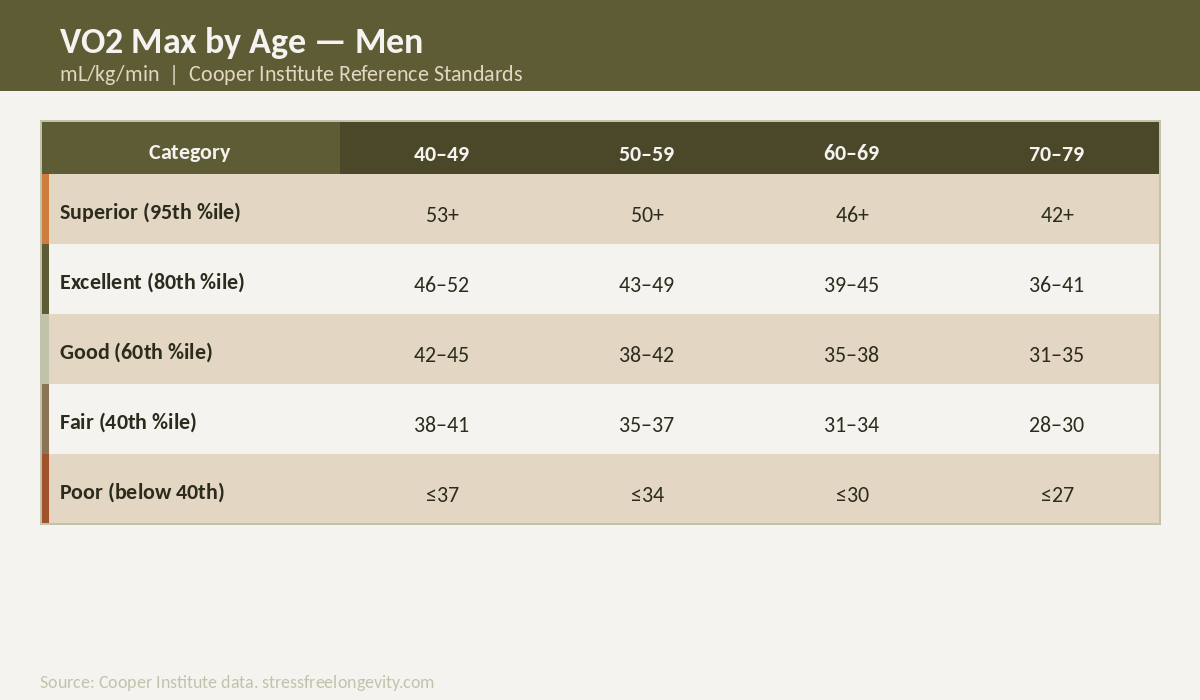
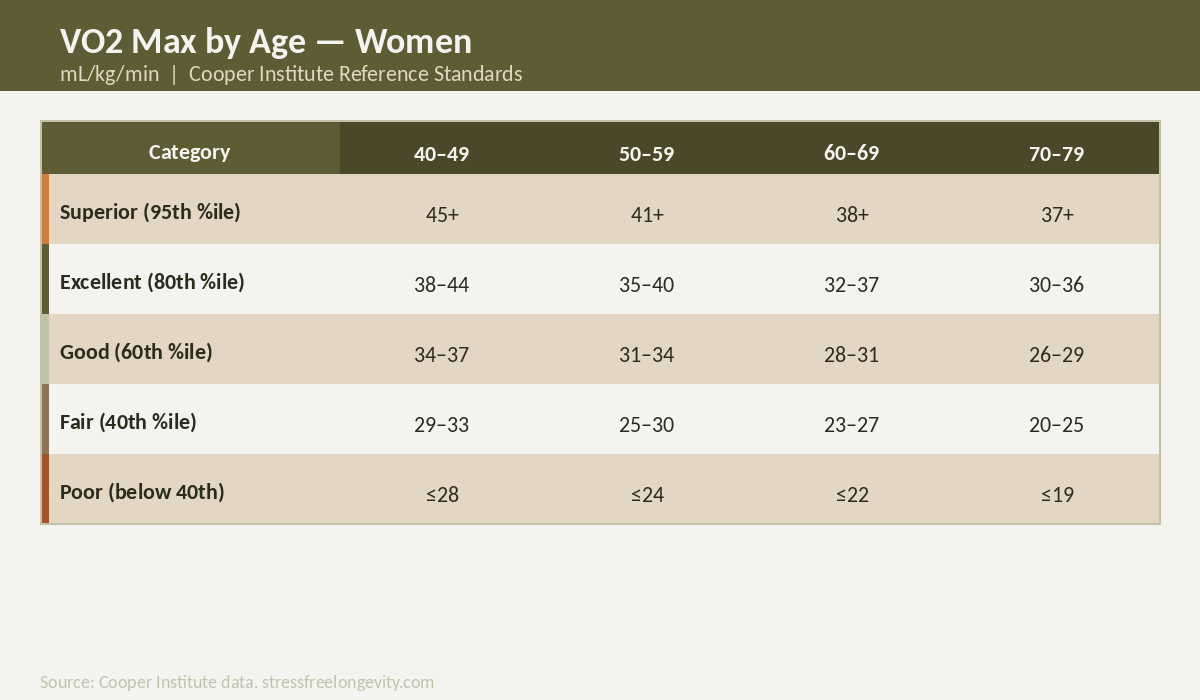
These are estimates, not precise measurements. Several things affect where your number lands — your device, your weight, even what type of exercise generated the reading. Apple Watch calls this metric "Cardio Fitness" rather than VO2 max, but it's the same thing. But, If you take beta-blockers, enable the medications toggle in your Health settings or your reading could be significantly off.
Use your number as a useful starting point. The category you're in matters more than the exact figure. And your trend over months matters more than either.
I also cover this topic in a video on my YouTube channel - https://www.youtube.com/@stressfreelongevity
The Decline — and How Much of It Is Preventable
VO2 max peaks in your mid-to-late 20s. After that, it falls.
For most people, the decline happens quietly. Life gets busier. You move a little less each year. It's gradual enough that you don't notice — until one day climbing the stairs feels harder than it used to, or a walk that was easy leaves you more breathless than expected.
That's the tipping point. And it arrives earlier than most people realise.
The commonly cited figure for declining fitness is around 10% per decade. But that's an average — and it understates what actually happens, because the decline accelerates with age.
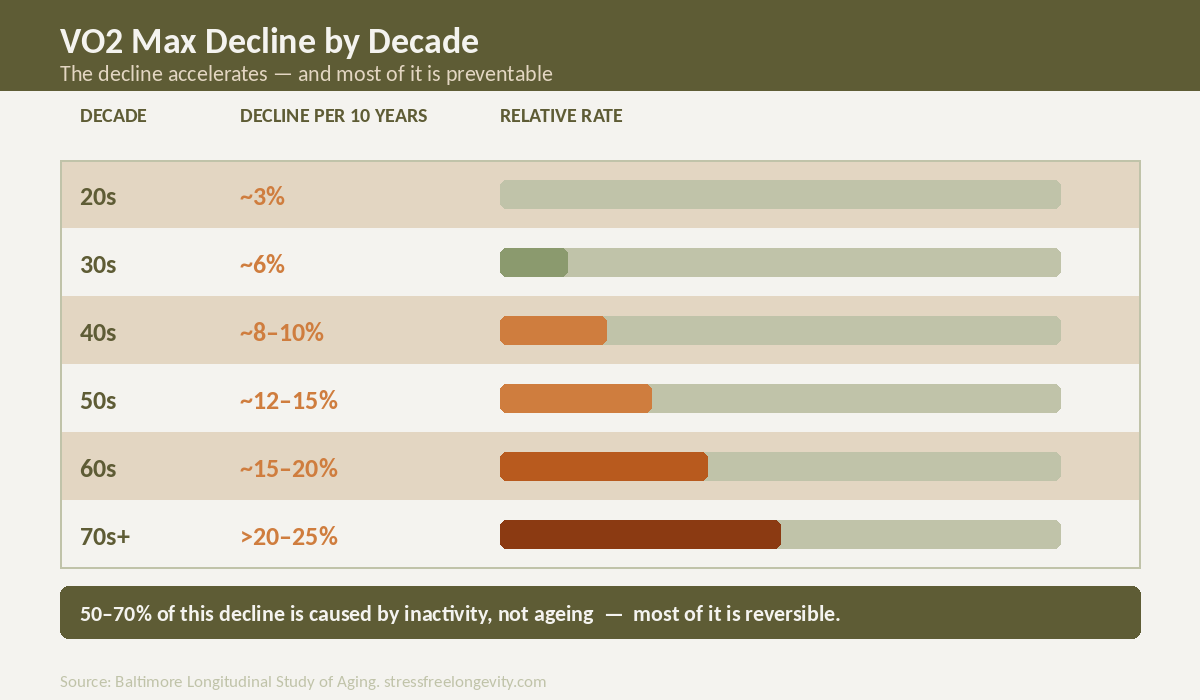
Through middle age the main driver is a gradual fall in maximum heart rate. After 60, muscle loss and declining mitochondrial function increasingly take over.
But here's what changes how you think about this: around 50–70% of this decline is caused by inactivity, not ageing.
Your body is efficient. If it doesn't think you need a high-powered aerobic engine, it downregulates. It reduces what it doesn't use. The decline isn't inevitable — it's largely a response to how much you ask of it.
The clearest evidence for this comes from the Dallas Bed Rest Study. Five healthy 20-year-olds spent three weeks in bed. Their VO2 max dropped by 27% — more than 30 years of normal ageing would have caused.
The same men were retested 30 years later. Six months of training at age 50 fully reversed the decline — returning their VO2 max to their original 20-year-old baseline.
Inactivity ages you faster than time does.
People who keep exercising consistently throughout their lives decline at roughly half the rate of those who don't — around 5–6% per decade rather than 12%.
What to Aim For
Most people's instinct is to aim for "average for my age." That sounds reasonable. But the reference population is mostly sedentary. Average means tracking toward average outcomes — and average outcomes in your late 70s aren't good.
A 50-year-old man at the 50th percentile has a VO2 max of around 35–37. With the accelerating decline through his 50s and 60s, he'll land around 22–24 by his late 70s — barely above the threshold at which daily independence becomes difficult.
That threshold sits at around 18 mL/kg/min. Below it, activities like climbing stairs or carrying shopping become genuinely hard. Not occasionally — every day.
Longevity researcher Peter Attia puts it plainly in Outlive: "If you have the aspiration of kicking ass when you're 85, you can't afford to be average when you're 50."
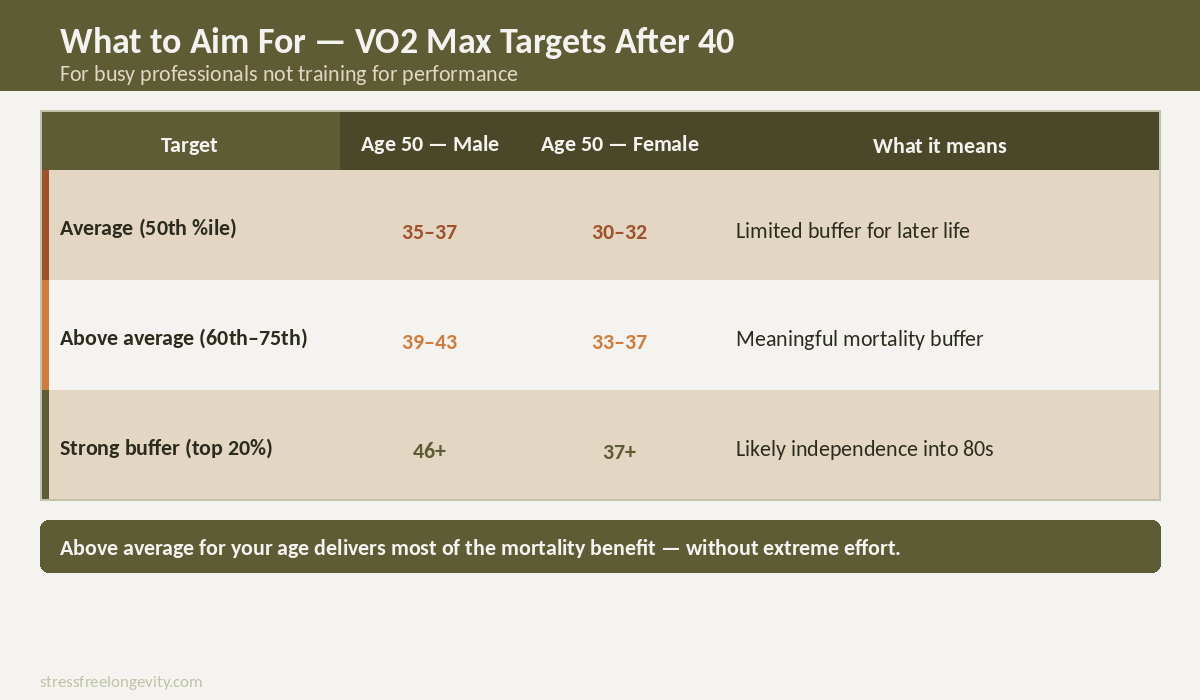
Above average — the 60th to 75th percentile for your age — is the right goal for most people. It delivers most of the mortality benefit and puts real distance between you and the independence threshold.
The work starts now. Not because it's urgent in a frightening way — but because the decisions you make in your 40s and 50s determine where you land in your 70s and 80s.
How to Improve It
VO2 max responds well to training at any age. Studies in adults over 60 consistently show 15–20% improvements with consistent aerobic exercise over three to six months. The capacity for improvement at 60 or 70 is similar to that at 30.
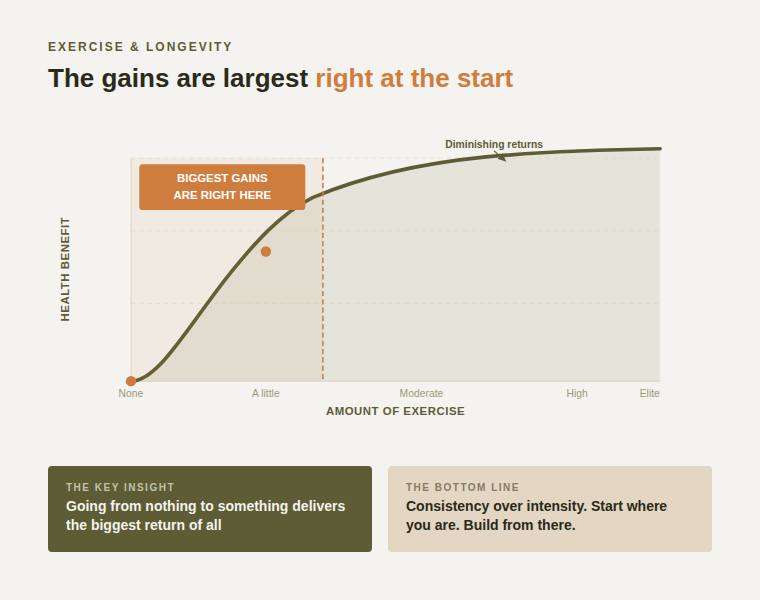
And here's more great news: the benefits are largest right at the start.
The relationship between exercise and health isn't linear — it's a curve. Going from nothing to a little delivers a far bigger return than going from moderate to high. The steepest part of the curve is at the bottom. If you're currently doing very little, even small, consistent efforts will produce meaningful gains.
Three things move the number.
Consistent aerobic exercise. Any activity that raises your heart rate and keeps it there — walking briskly, cycling, swimming, hiking. The body responds to the demand, not the specific activity. Consistency matters more than what you choose.
Some intensity. Comfortable exercise builds a base and is genuinely beneficial. But for most people it isn't enough on its own to drive meaningful VO2 max gains. Adding one or two sessions a week where conversation becomes genuinely difficult is what drives the bigger improvements. Add some speed and incline so you feel the extra effort.
Gradual progression. Start from where you are. Brisk daily walks will move the number if you're starting from very little. As those get easier, adding incline, pace, or short hard efforts pushes adaptation further.
If you want a structured protocol, the most evidence-backed is the Norwegian 4×4: four minutes of hard effort at around 85–90% of your maximum heart rate, three minutes easy recovery, repeated four times. Once or twice a week alongside regular lower-intensity movement is enough to see real change.
For more on the science of exercise for longevity, explore my exercise content.

Should You Track It?
Honestly — it depends on what you'll do with it.
If watching a number trend upward over months motivates you to keep going, track it. It's one of the more meaningful long-term signals a wearable offers.
If it becomes another source of daily anxiety, it isn't helping you.
If you do track it: follow the monthly trend, not individual readings. Short-term fluctuations are normal — illness, poor sleep, and dehydration can all move a wearable estimate by several points without reflecting any real change in fitness. Give any change in your training at least six to eight weeks before expecting a shift in the number.
Personally, I keep a loose eye on mine. What I pay more attention to is whether I'm consistently doing the things that move it — because those things matter for your health whether you look at the number or not.
The Bottom Line
VO2 max is more than a fitness metric. It's a measure of how much reserve you're carrying into the decades ahead.
The decline is real. But most of it is disuse, not destiny.
Even modest improvements from a low starting point make a meaningful difference. Going from the bottom quarter to just below average cuts your mortality risk roughly in half. That return is available to almost everyone, at any age, without extreme effort.
Find your number. Understand what it's telling you. Then do the things that move it.
Ready to Build the Fitness That Actually Matters?
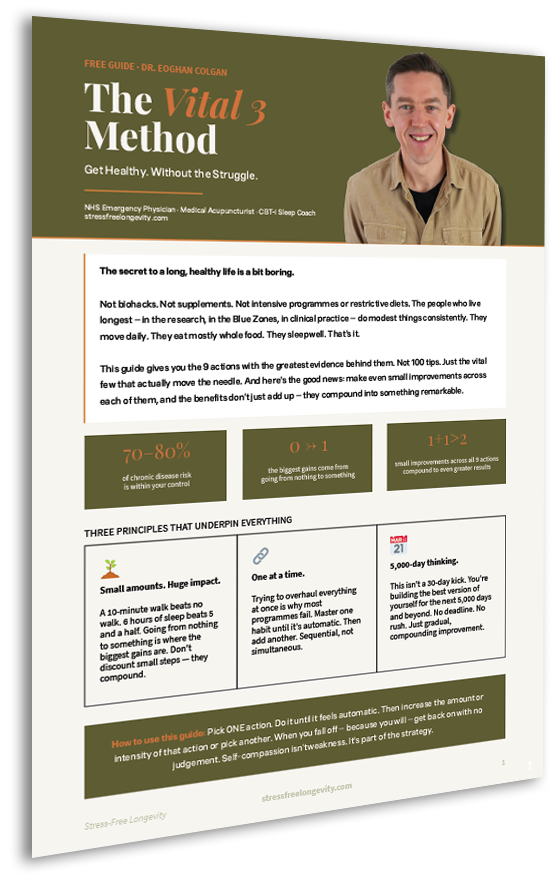
VO2 max improves when sleep, nutrition, and consistent exercise work together. That's the framework I use myself — and it's what moved my own number from 41 to 59 over the past year, without a gym or extreme protocols.
Get the complete Vital 3 Method guide — free:
- The 3 highest-impact changes for each pillar (9 total)
- The Build Good Habits framework to make them stick
- Start with one, build from there — no overhaul required
No spam. Unsubscribe anytime.
Frequently Asked Questions
Sources
Mandsager K et al. (2018). Association of Cardiorespiratory Fitness With Long-term Mortality Among Adults Undergoing Exercise Treadmill Testing. JAMA Network Open. https://jamanetwork.com/journals/jamanetworkopen/fullarticle/2707428
Kaminsky LA et al. (2015). Reference Standards for Cardiorespiratory Fitness Measured With Cardiopulmonary Exercise Testing. Mayo Clinic Proceedings. https://doi.org/10.1016/j.mayocp.2015.07.026
Ross R et al. (2016). Importance of Assessing Cardiorespiratory Fitness in Clinical Practice. Circulation. https://doi.org/10.1161/CIR.0000000000000461
Fleg JL et al. (2005). Accelerated Longitudinal Decline of Aerobic Capacity in Healthy Older Adults. Circulation. https://doi.org/10.1161/CIRCULATIONAHA.105.545459
McGuire DK et al. (2001). A 30-Year Follow-Up of the Dallas Bedrest and Training Study. Circulation. https://doi.org/10.1161/circ.104.12.1350
Medical disclaimer
This content is for informational purposes only and is not intended as medical advice. Always consult your healthcare provider before making changes to your health routine. What works for one person may not work for another — this is a roadmap, not a prescription.
About Dr. Eoghan Colgan
Emergency medicine physician researching what actually works for longevity. I interview world-class experts in health and longevity and test everything personally. Everything I teach is what I'm implementing myself. More about me →

Related Articles

Creatine Side Effects: What’s Real and What Isn’t
Creatine Side Effects: What’s Real and What Isn’t Key Takeaways Creatine is one of the […]
Grip Strength Chart by Age: What Your Number Means
Grip Strength Chart by Age: What Your Number Means Key Takeaways Grip strength is used […]

The Sitting-Rising Test: What Your Score Actually Means
The Sitting-Rising Test: What Your Score Actually Means Key Takeaways A score of 8 or […]