

Key takeaways
- Average walking speed is about 2.6 mph between 40 and 60, and 2.2 to 2.4 mph between 70 and 80. 3 mph is a brisk walk.
- If it takes you more than 5 seconds to walk 4 metres at your normal pace, that’s slow at any age. It’s worth a word with your doctor.
- Stronger legs are what speed up your walking most, and you can build them at any age.
Walking speed is getting a lot more attention. Doctors and researchers increasingly use it as a quick health check, and your phone or smartwatch may already be tracking yours.
There’s a good reason for that. After 65, how fast you walk predicts the years ahead about as well as your blood pressure, weight and medical history put together.
The good news is that it’s easy to check at home, and you can improve it at any age.
I’m an emergency medicine doctor. In this article I’ll show you the average walking speed by age, how to test yours, what your result means, and what to do if it’s slower than you’d like.
Why Does Your Walking Speed Matter?
Your walking speed reflects three things: the strength in your legs, your balance, and how well your heart and lungs can keep up.
When any of them starts to slip, your pace drops. Often the first thing you notice is that the people you’re walking with keep getting ahead of you.
After 65, that makes walking speed one of the best guides to how well you’ll stay independent. In one large study, about 1 in 10 of the very slowest-walking men needed help washing or dressing within three years. Among the fastest walkers, it was 1 in 100.
It also says a lot about how well you’d bounce back from an illness. A Yale study followed people over 70 who were living independently, and looked at what happened after a stay in hospital. Among men under 85 in otherwise reasonable health, 35 in 100 of the slow walkers needed help washing, dressing or getting around the house within a month. Among the faster walkers, it was 5 in 100.
That’s because a slow walk often means there’s little in reserve: not much spare strength or fitness beyond what everyday life needs. When an illness or a fall comes along, that spare capacity is what gets you through it.
Under 65, there’s less research. But in one study that has followed people since birth, the slower walkers at 45 were already showing signs of faster ageing in their bodies and brains. So it’s worth knowing your number well before 65.
Watch the video
After 65, You Lose Your Independence in Weeks, Not Years
Average Walking Speed by Age (Chart)
So what’s a normal walking speed for your age?
These averages come from a US study that timed 1,320 adults walking 4 metres at their normal pace. You can do the same test at home, so you’re comparing like with like.
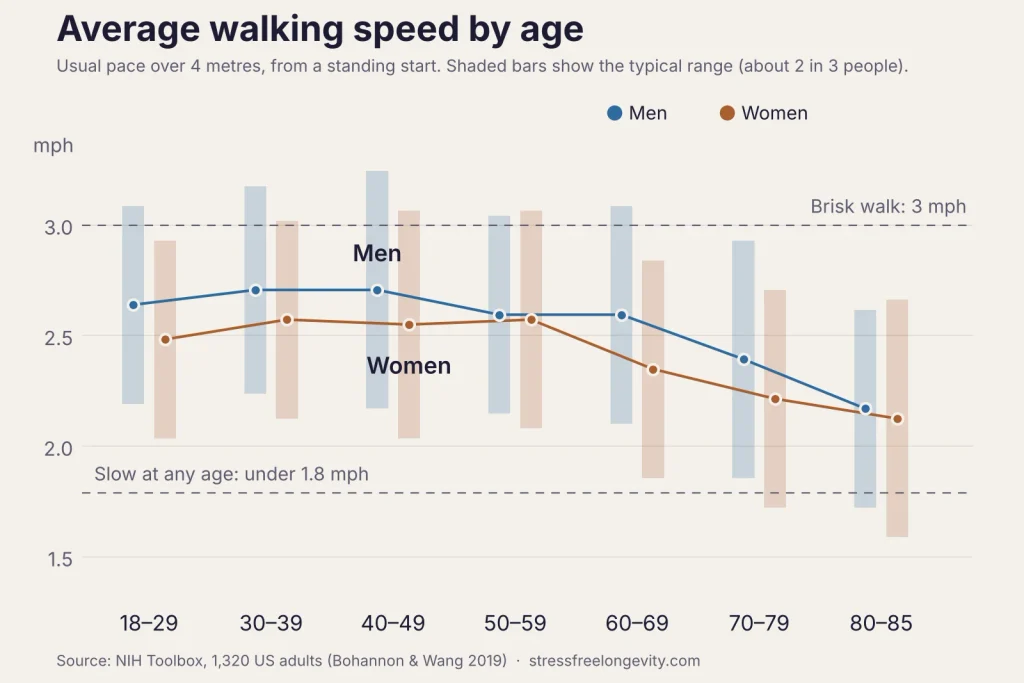
Men
| Age | Average speed | Typical range | Average time for 4 metres |
|---|---|---|---|
| 18–29 | 2.6 mph | 2.2–3.1 mph | 3.4 seconds |
| 30–39 | 2.7 mph | 2.2–3.2 mph | 3.3 seconds |
| 40–49 | 2.7 mph | 2.2–3.2 mph | 3.3 seconds |
| 50–59 | 2.6 mph | 2.1–3.0 mph | 3.4 seconds |
| 60–69 | 2.6 mph | 2.1–3.1 mph | 3.4 seconds |
| 70–79 | 2.4 mph | 1.9–2.9 mph | 3.7 seconds |
| 80–85 | 2.2 mph | 1.7–2.6 mph | 4.1 seconds |
Women
| Age | Average speed | Typical range | Average time for 4 metres |
|---|---|---|---|
| 18–29 | 2.5 mph | 2.0–2.9 mph | 3.6 seconds |
| 30–39 | 2.6 mph | 2.1–3.0 mph | 3.5 seconds |
| 40–49 | 2.6 mph | 2.0–3.1 mph | 3.5 seconds |
| 50–59 | 2.6 mph | 2.1–3.1 mph | 3.5 seconds |
| 60–69 | 2.3 mph | 1.9–2.8 mph | 3.8 seconds |
| 70–79 | 2.2 mph | 1.7–2.7 mph | 4.0 seconds |
| 80–85 | 2.1 mph | 1.6–2.7 mph | 4.2 seconds |
Full data: metres per second, mph and km/h
Men
| Age | m/s (± SD) | mph | km/h |
|---|---|---|---|
| 18–29 | 1.18 ± 0.20 | 2.6 | 4.2 |
| 30–39 | 1.21 ± 0.21 | 2.7 | 4.4 |
| 40–49 | 1.21 ± 0.24 | 2.7 | 4.4 |
| 50–59 | 1.16 ± 0.20 | 2.6 | 4.2 |
| 60–69 | 1.16 ± 0.22 | 2.6 | 4.2 |
| 70–79 | 1.07 ± 0.24 | 2.4 | 3.9 |
| 80–85 | 0.97 ± 0.20 | 2.2 | 3.5 |
Women
| Age | m/s (± SD) | mph | km/h |
|---|---|---|---|
| 18–29 | 1.11 ± 0.20 | 2.5 | 4.0 |
| 30–39 | 1.15 ± 0.20 | 2.6 | 4.1 |
| 40–49 | 1.14 ± 0.23 | 2.6 | 4.1 |
| 50–59 | 1.15 ± 0.22 | 2.6 | 4.1 |
| 60–69 | 1.05 ± 0.22 | 2.3 | 3.8 |
| 70–79 | 0.99 ± 0.22 | 2.2 | 3.6 |
| 80–85 | 0.95 ± 0.24 | 2.1 | 3.4 |
Source: NIH Toolbox, 1,320 US adults tested in 2011; 4 metres, standing start, one timed walk at usual pace, stopwatch. Typical range = average ± 1 standard deviation.
The typical range is where about two in three people of that age walk. So if you’re anywhere in it, you’re walking at a common pace for your age.
Walking speed holds steady until around 60. After that it slowly falls, and by 80 it’s about half a mile an hour slower. At every age, the average is slower than the 3 mph you’ll often see quoted. 3 mph is actually a brisk walk.
How to Test Your Walking Speed (The 4-Metre Gait Speed Test)
All you need is a tape measure, the stopwatch on your phone and someone to time you.
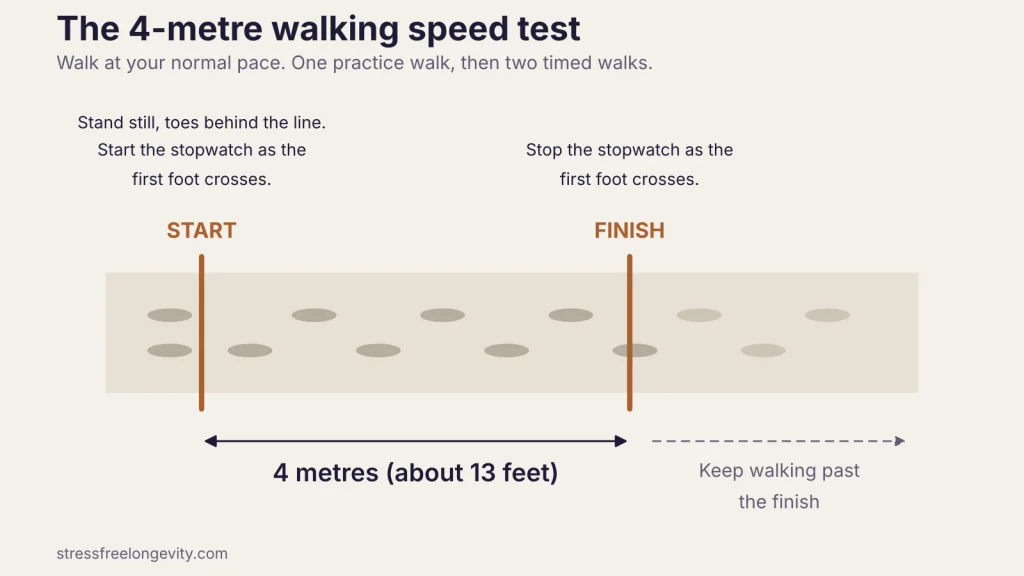
- Mark a start line and a finish line 4 metres (about 13 feet) apart on a flat floor. Leave some clear space beyond the finish.
- Stand still with your toes just behind the start line.
- Walk at your normal pace, as if you were walking to the shop, and keep going past the finish line.
- The person timing you starts the stopwatch as your first foot crosses the start line, and stops it as your first foot crosses the finish.
- Have a practice walk, then two timed walks. Pop both times into the calculator below.
Wear your everyday shoes, and use your stick if you normally do. If you’re testing a parent, walk beside them.
How accurate is a home test?
Accurate enough to tell you roughly where you stand. A stopwatch can be out by a fraction of a second, so the calculator shows your result as a range rather than one exact number. For the best reading, repeat the test on another day and check you get a similar result.
Why is it different from my smartwatch?
They measure slightly different things. This test starts from standing still and covers a short distance. Your watch measures you over longer distances, once you’re already moving, so its reading will naturally be a bit faster. Use this test to compare yourself with the chart. Your watch is still useful for spotting a trend: if your walking speed keeps falling over a few months, do the 4-metre test.
Check your walking speed
Do the 4-metre walk above, then enter your age and your two times. Your result updates as you type.
Example shown. Enter your own details.Compared with 1,320 US adults who did the same 4-metre walk from a standing start, at their usual pace (NIH Toolbox, Bohannon & Wang 2019). For information only, not a diagnosis.
What Does Your Walking Speed Mean?
The calculator compares you with people your age and sex. Here’s what each result means:
| Your result | What it means |
|---|---|
| Above average for your age | A good sign. Your legs, balance and fitness are serving you well. |
| In the typical range | A common pace for your age, with room to improve. |
| Slower than most people your age | Your legs, balance or fitness may be starting to slip. This is worth acting on now. |
| Slower than ideal (more than 5 seconds for 4 metres) | Slow, at any age. Doctors use this line to flag weak muscles and a higher risk of falls. Test again on another day, and if it’s still over 5 seconds, mention it to your doctor. |
After 70, some people in the typical range take more than 5 seconds. Being common doesn’t make it healthy, so the 5-second line still applies.
And if you’re over 65, walking the 4 metres in 4 seconds or less is a particularly good sign. People who walk at this pace tend to live longer than average.
Whatever your result, the way to keep it or improve it is the same.
Can You Improve Your Walking Speed?
Yes. And the thing that helps most is stronger legs.
Most of the push that carries you forward comes from your calves and hips. When they weaken, your steps get shorter and your pace drops.
In trials of older adults, strength training sped people up by about 0.3 mph. That’s enough to take someone from just over the 5-second line to comfortably under it. It worked in frail people and fitter people alike.
Two or three short sessions a week is plenty, and you can do them at home. Focus on your legs: standing up from a chair without using your hands, step-ups, calf raises, and lunges if you can manage them. And include the rest of your body too. A routine that works all your main muscle groups is the one to aim for.
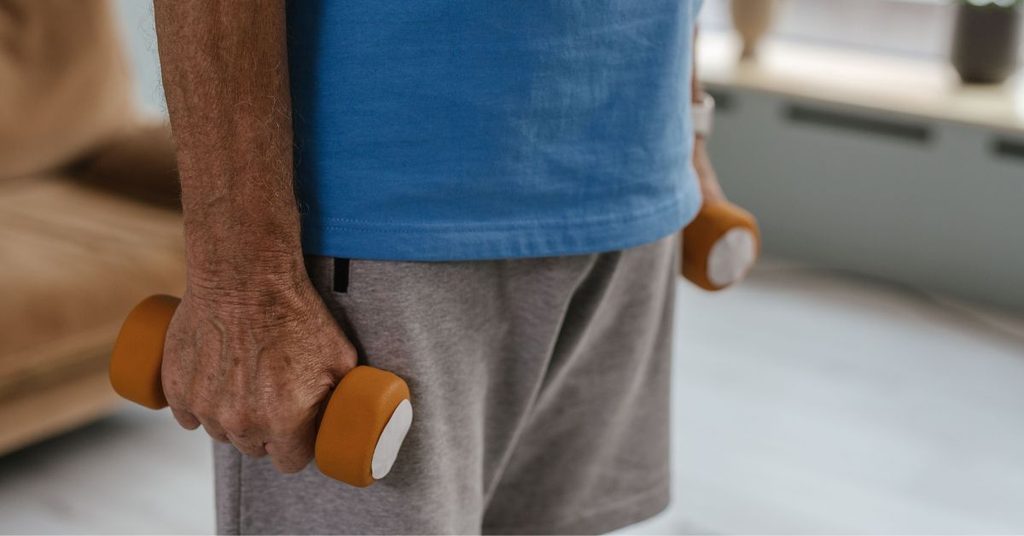
Brisk walking helps too. Brisk means you can talk but not sing. Over 70, that may well be slower than 3 mph, and that’s fine. It’s the effort that counts.
But remember, it’s not the number itself that matters. It’s what sits behind it: the strength in your muscles, your balance and your fitness. Those are what keep you independent as you get older, whatever your result today.
So use your number as a nudge to do what we should all be doing anyway: keep your muscles strong and active. Do that, and the speed tends to follow.
When Should a Slow Walking Speed Worry You?
Usually, a slow walk just means weaker legs, and the steps above will help. But see your doctor if:
- It takes you more than 5 seconds to walk 4 metres, on two different days.
- You’ve slowed down noticeably over the past year, or others have commented on it.
- You’ve had a fall and feel unsteady.
- Walking hurts, rather than just feeling hard.
And if your walking changes suddenly, such as new weakness on one side or a foot that drags, get help the same day.
The Bottom Line
The average adult walks at about 2.6 mph through midlife, and a little slower after 70. 3 mph is a brisk walk.
Your pace reflects how your muscles, balance and fitness are doing. So find out where you stand: four metres, a stopwatch and someone to time you.
Then, whatever your number, focus on what sits behind it. Work on your leg strength, alongside your other muscle groups, two or three times a week.
The stronger you keep your muscles now, the longer you’ll stay active and independent.
Your one small step
Time your walk this week
Mark out 4 metres, ask someone to time you, and put your two times into the calculator above. Write your number down, then test again in three months to see how it changes.
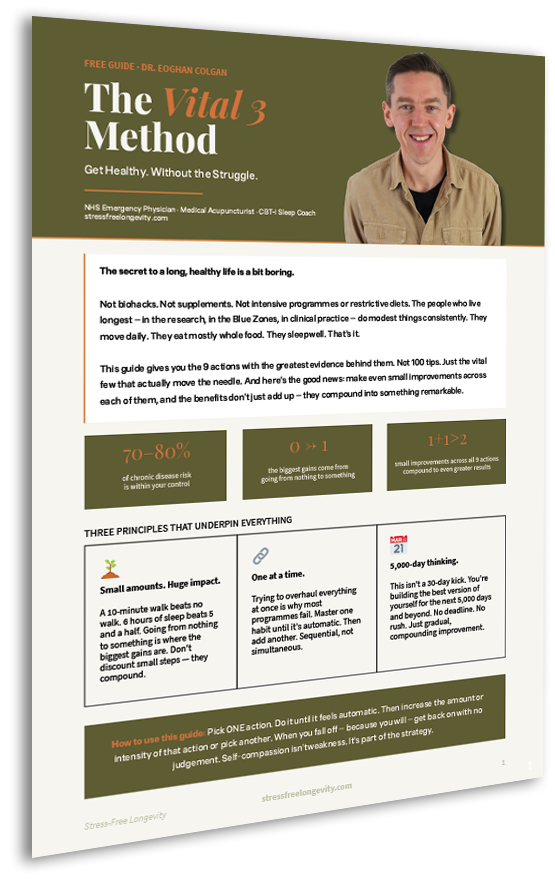
Free guide · The Vital 3 Method
Strong legs come from small, regular habits
Leg strength is one part of staying active and independent. My free guide shows you the few actions that make the biggest difference to your health, and how to build them into everyday life so they stick.
Frequently Asked Questions
Is slow walking a sign of dementia?
It can be one sign among several, but on its own it isn’t a diagnosis. In large studies, people who walk slowly in later life are roughly one and a half to two times as likely to develop dementia. A speed that’s falling is a stronger signal than one that’s simply slow. If your walking has slowed and you’ve noticed changes in your memory or thinking too, mention both to your doctor.
What’s the ten-second walking test?
It’s the test used in the Yale study above. You walk 10 feet out and back, as fast as you safely can. Taking more than 10 seconds counted as slow. Because it’s a fast walk with a turn, it can’t be compared with the chart, so use the 4-metre test for that. I go through the ten-second test, and what the Yale study found, in this video →
Should I time my fastest walk too?
You can, and it’s useful to track. But don’t do it on your own if you’ve fallen in the past year, use a walking aid, get dizzy, get chest pain or breathlessness when you exert yourself, or have recently been in hospital. The fast-walk averages are also different, so don’t compare a fast time with the chart above.
Does height affect walking speed?
A little. Taller people take longer strides, which is part of why men walk slightly faster than women on average. But it’s a small effect next to age and fitness, and the chart already splits men and women, which takes care of most of it.
How often should I check my walking speed?
Every three to six months is plenty. Use the same course, the same shoes and a similar time of day, so you’re comparing like with like. Small differences from one test to the next are normal. A real change is one you see on two separate days, of about a fifth of a mile an hour or more.
Sources (6)
- Bohannon RW, Wang YC (2019). Four-meter gait speed: normative values and reliability determined for adults participating in the NIH Toolbox Study. Archives of Physical Medicine and Rehabilitation. Read the study ↗
- Studenski S, Perera S, Patel K, et al. (2011). Gait speed and survival in older adults. JAMA. Read the study ↗
- Perera S, Patel KV, Rosano C, et al. (2016). Gait speed predicts incident disability: a pooled analysis. Journals of Gerontology Series A. Read the study ↗
- Van Abbema R, De Greef M, Crajé C, et al. (2015). What type, or combination of exercise can improve preferred gait speed in older adults? A meta-analysis. BMC Geriatrics. Read the study ↗
- Rasmussen LJH, Caspi A, Ambler A, et al. (2019). Association of neurocognitive and physical function with gait speed in midlife. JAMA Network Open. Read the study ↗
- Gill TM, Allore HG, Gahbauer EA, Murphy TE (2010). Change in disability after hospitalization or restricted activity in older persons. JAMA. Read the study ↗
Medical disclaimer. This article is general information, not medical advice. It can’t take account of your health or your medicines, so talk to your own doctor before making big changes.