
Grip Strength Chart by Age: What Your Number Means
Key Takeaways
- Grip strength is used as a quick marker of your overall strength and physical condition.
- It predicts both becoming seriously ill and surviving it — but surviving about twice as strongly.
- So don't train your grip to improve it. Train your whole body, and the number follows.
So you've got a grip strength number. Whether it's any good depends on your age and sex — and the chart below will tell you where you sit. Skip straight to it →
Before you do, one thing changes how you should read it.
Grip strength is one of the most studied measurements in medicine, and one of the most predictive. It's linked to how long people live and how well they recover from serious illness. But a strong grip isn't what's keeping those people alive. It's a marker of something else that is — and that changes what you should do if your number comes out low.
I'm an emergency medicine doctor. I take this measurement seriously, and I also think it's widely oversold. Here's what the chart says, what your number is really telling you, and what's worth doing about it.
What Grip Strength Is Actually Telling You
When grip strength first made headlines, a lot of people took the wrong message from it — that there was something powerful about hand strength itself, and that squeezing a gripper might make you healthier.
Most people have moved past that. The usual understanding now is that grip is a simple stand-in for overall body strength. That's closer, but it isn't quite right either.
The link to whole-body strength is looser than you'd expect. Grip and leg strength correlate only moderately — you can have a solid squeeze and weak legs, or the other way round. So it's a rough guide to how strong you are, not a precise one.
What it does better is reflect your general physical condition. Squeezing hard draws on your muscles, your nerve signalling, your circulation and your capacity to generate effort, all at once. When any of those start slipping, the number tends to slip with them.
Add to that: the test takes ten seconds, costs almost nothing and needs no laboratory. That combination is why grip has ended up in hundreds of large studies — and why we now know a great deal about what it predicts.
Video: I demonstrate this test, and four other tests of physical function, on my YouTube channel →
What Your Grip Strength Predicts
The largest study followed nearly 140,000 people across 17 countries.
Weaker grip predicted two things: who went on to develop cardiovascular disease, and who died from it. Both links were real, but they weren't equal. The link with dying from it was about twice as strong.
UK Biobank found the same pattern in half a million people. There, every 5kg drop in grip strength came with roughly a 20% higher risk of dying from cardiovascular disease.
The first study also tracked what happened to people after they became ill — not just with heart disease, but with stroke, cancer and pneumonia too. Across all of them, the pattern held: those with the weakest grip were the least likely to survive.
So your grip does say something about your chances of becoming ill. It says considerably more about how you'd come through it.
Why? Nobody knows for certain.
The leading explanation is reserve, and it's worth understanding what that means. Muscle isn't just for moving — it's the body's largest store of protein. When you're seriously ill, your body breaks muscle down to release amino acids, which it uses to fuel immune cells, repair tissue and generate energy at a point when you're eating almost nothing. Someone who starts with more muscle has more to draw on before that process reaches a critical point.
It fits the evidence well. It hasn't been proven. Nobody has yet run the trial that would settle it — take a group of people, build their strength, and see whether they survive illness better.
And part of the link almost certainly runs the other way. A low reading can be an early sign of illness that hasn't declared itself yet, rather than a lack of protection against it.
What Happens If It Drops Too Far
Everyone loses strength with age. That part isn't the problem.
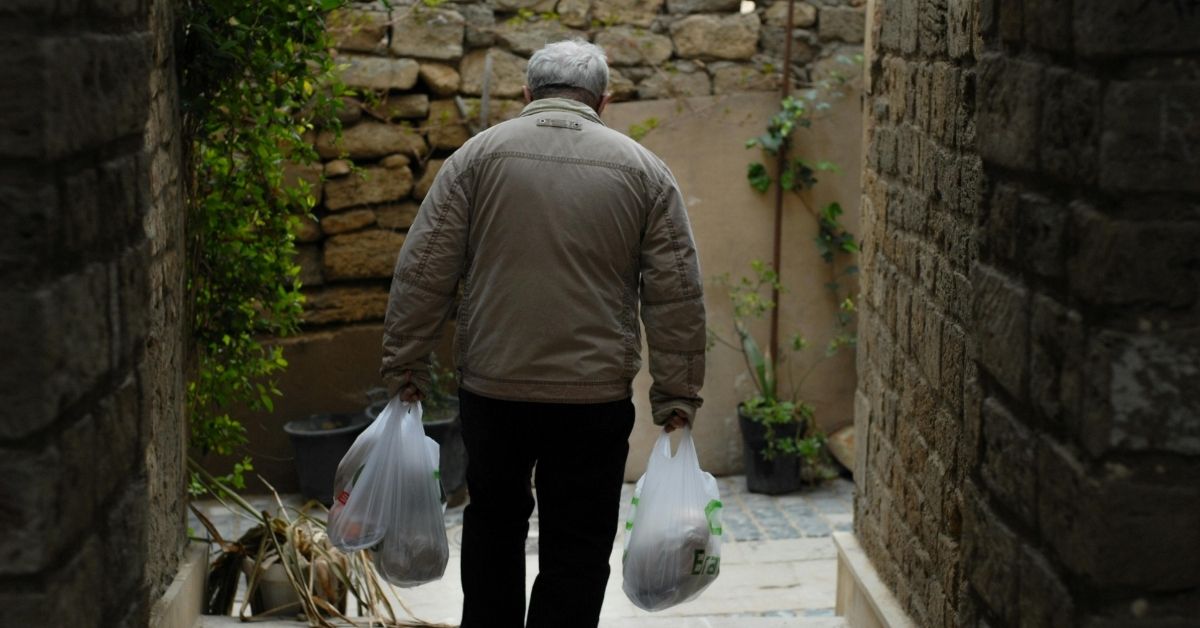
The problem is what happens if you drop below the level ordinary life requires. Rising from a chair without using your arms. Climbing a flight of stairs. Carrying shopping in from the car. Getting up off the floor.
Below a certain point, those things stop being automatic — and independence goes with them. This is what separates people who stay in their own homes into their eighties from people who don't.
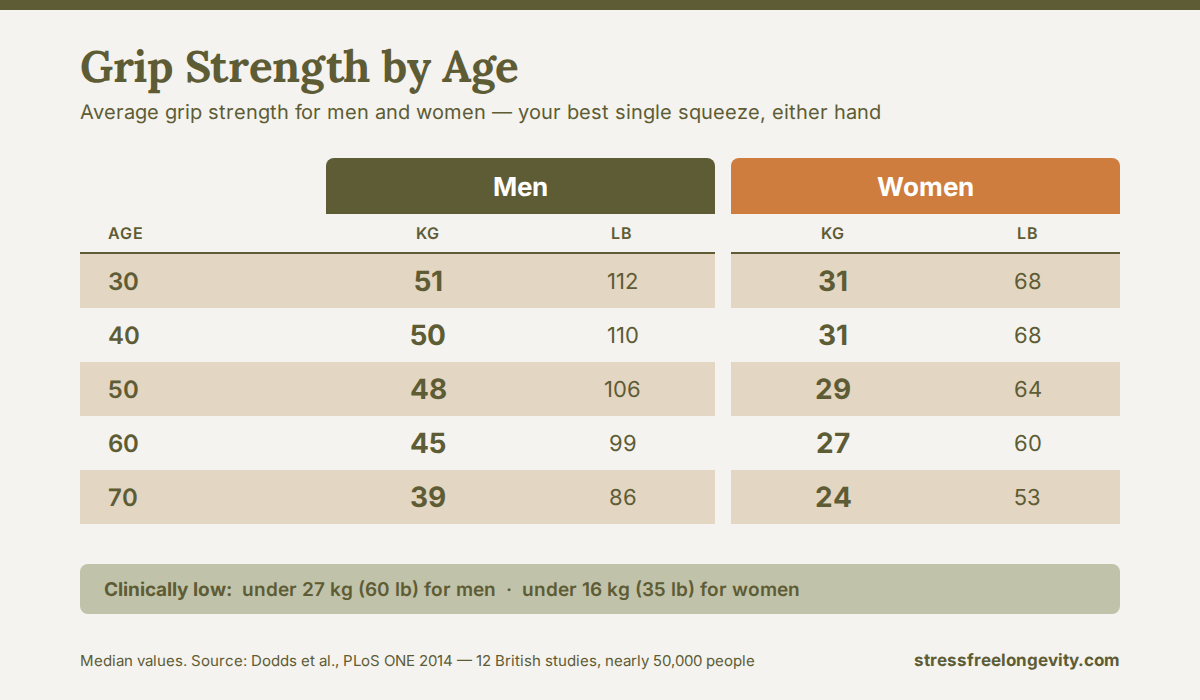
Doctors have a number for the bottom of that range. Under 27kg for men, under 16kg for women is classed as low grip strength, and it forms part of how sarcopenia — the age-related loss of muscle strength — is diagnosed.
Most people reading this will be comfortably above it. That's the point. The useful question isn't whether you're below the line today. It's how much distance you have between you and it, and how quickly you're closing that gap.
A man at 50kg in his forties has decades of margin. A man at 32kg has far less, even though nobody would call him weak today.
That's the way to read the chart.
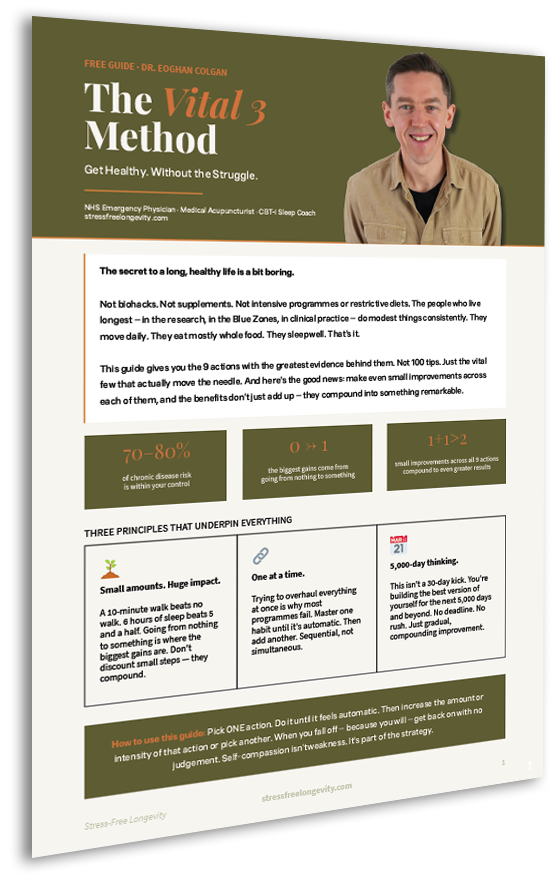
Want the complete framework?
Get "The Vital 3 Method" free guide — nine evidence-based principles across Sleep, Nutrition and Exercise that keep you strong whether you ever test your grip or not.
Before You Read the Chart
A few things affect the number you get. Worth knowing before you compare yourself to anything.
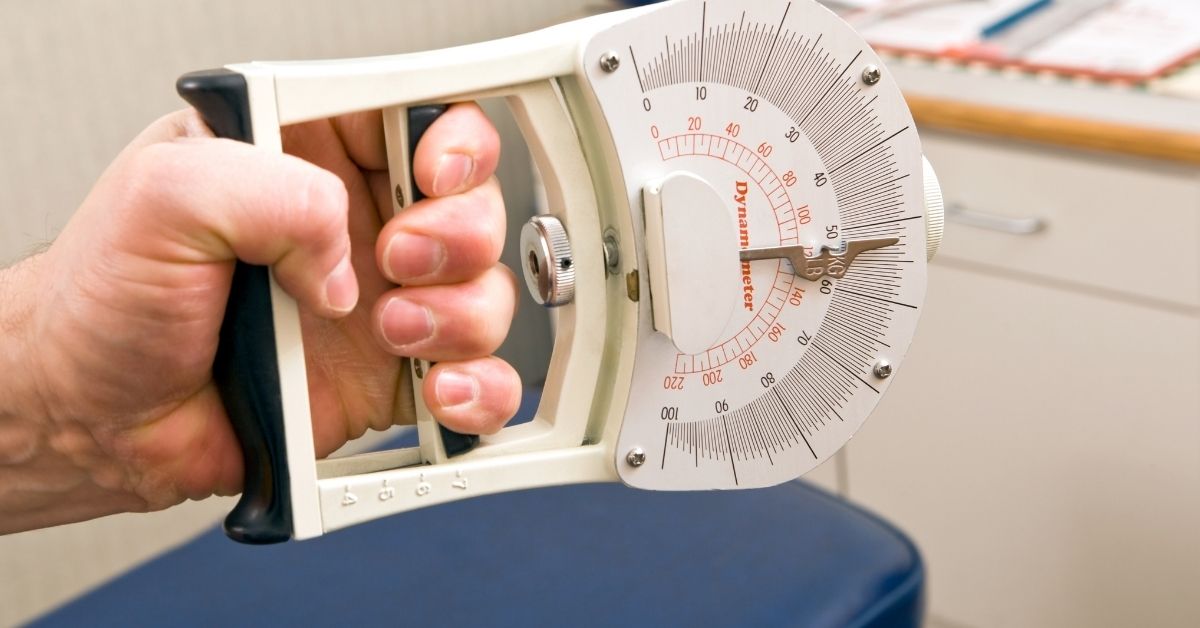
How you tested. Sit down, elbow bent at 90 degrees and tucked in at your side, wrist neutral with your thumb up. Squeeze as hard as you can for about five seconds. Three attempts per hand, 30 seconds' rest between each. Take your single best reading from either hand. If you've already tested, check you did it roughly this way — posture changes the number more than you'd think.
Testing alone reads low. In clinical settings someone shouts encouragement, which lifts scores by around 5–8%. If you land a kilo or two under where you expected, that may be the whole explanation.
Which hand. If you're right-handed, your dominant hand is typically about 10% stronger. If you're left-handed, that rule doesn't apply — your hands are usually about equal.
Body size. Taller, heavier people grip harder. The chart isn't adjusted for height, so if you're notably tall or short, expect to sit above or below your age band.
Your device. Cheap digital dynamometers track the clinical ones closely on average, but any individual reading can be a few kilos out either way. Fine for placing yourself on the chart. Not fine for comparing against a friend using a different model. One costs around $30 in the US, £25–40 in the UK.
The day itself. A hard workout, a bad night's sleep, morning versus evening — all of it shifts the number.
One last thing. The test isn't precise enough to pick up small changes. If you get 38kg today and 41kg in three months, you haven't got stronger — a gap that size sits inside the error of the test. Only treat a difference of 5kg or more as real.
Grip Strength by Age
These figures come from twelve British studies pooled together, covering nearly 50,000 people — the largest set of normative data available.
The number shown is the median: the middle of the range, so roughly the average for your age and sex.
What this means for you.
If you're above the average for your age, that's a good sign. You're carrying more strength than most people your age — and more importantly, more distance between yourself and the point where things get difficult.
If you're below, nothing is wrong. It means there's room to build, and that the work is worth starting now rather than later.
Now look at how the decline behaves. Between 30 and 50, men lose about 3kg. Between 60 and 70 alone, they lose 6kg. Women follow the same shape — 2kg across twenty years to age 50, then 3kg in the single decade after 60.
The loss isn't steady. It speeds up. Which is why the strength you build in your forties and fifties does more work than the same effort would later.
One caveat. This is a snapshot of different people at different ages, not the same people followed through their lives. It's ideal for telling you where you sit today. It's less reliable as a prediction of your own path.
When a Low Number Isn’t About Age
Before you conclude anything from a disappointing reading, consider whether something local is going on.
Hand and wrist arthritis is common after 40, and pain alone will suppress your grip. So will carpal tunnel syndrome, which peaks between 40 and 60 and is around three times more common in women. Nerve compression in the neck, peripheral neuropathy, an old wrist fracture that never fully healed — all of these pull the number down without telling you anything about your general health.
Thyroid problems, anaemia and low vitamin D can do it too, and all are easily checked.
The clearest clue is asymmetry. If one hand is markedly weaker than the other, beyond what handedness explains, that points to something local rather than something systemic.
So Should You Train Your Grip?
No.
Rock climbers have extraordinary grip strength. They don't live noticeably longer than anyone else.
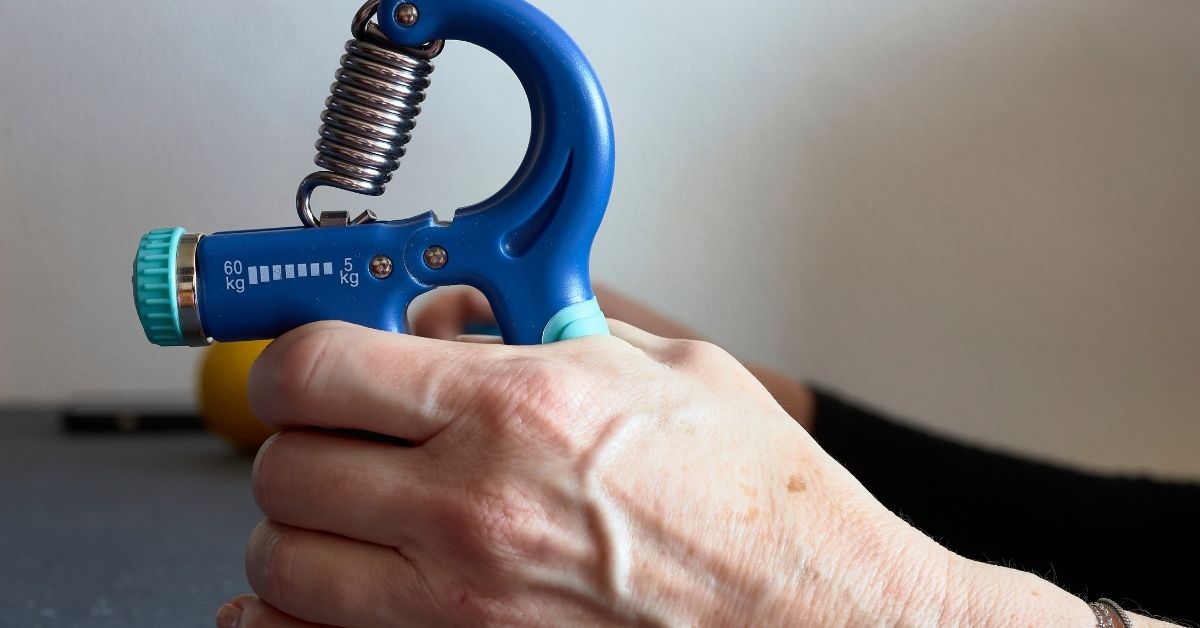
That's the whole point in one example. Grip is a marker of your overall condition, and it's what it marks that matters — not the marker. Squeeze a spring gripper every day and you'll raise your score without changing any of the things the score reflects. You'll just make your own reading less informative.
What raises grip usefully is whole-body strength training with plenty of pulling. Rows, carries, deadlift variations. Programmes that include pulling movements produce noticeably bigger grip gains than those that don't.
Even then, expect modest numbers. Pooled trial data puts the average gain at under 3kg — below the level at which you could reliably detect it on your own device.
Which is the honest reason to train. Not to shift a reading, but to keep the distance between you and that threshold as wide as possible for as long as possible. That benefit is well established, and it doesn't depend on any of the mortality research being causal. My exercise content → covers where to start.
When to See Your Doctor
Most low readings are nothing dramatic. A few are worth acting on.
Get urgent help if weakness comes on suddenly on one side, especially with facial drooping, slurred speech or vision changes. That's a stroke picture and it's an emergency.
Book an appointment if you notice weakness getting worse over weeks, numbness or tingling alongside it, a marked and persistent difference between your hands, or grip loss together with unexplained weight loss or fatigue.
Mention it if you're below 27kg as a man or 16kg as a woman. It's a reasonable prompt for checking thyroid function, iron and vitamin D before anyone puts it down to age.
The Bottom Line
Grip strength is a good measurement that gets oversold.
It predicts real things. People with weaker grip are more likely to become seriously ill, and more likely again not to come through it. Two of the largest studies ever run agree on that.
But it reflects your overall condition rather than creating it. Training your hands changes the reading without changing the thing that matters.
So find yourself on the chart, see how much room you have, and then go and do the things that would have put you high on it anyway.
Ready to Build What the Number Reflects?
Your grip reflects your sleep, your nutrition and how you move. Get those right and the number takes care of itself.
- The highest-impact actions across Sleep, Nutrition and Exercise
- The Build Good Habits framework to make changes stick
- Start with one, build from there — no overhaul required
No spam. Unsubscribe anytime.
Frequently Asked Questions
Sources
- Leong DP et al. (2015). Prognostic value of grip strength: findings from the Prospective Urban Rural Epidemiology (PURE) study. The Lancet. PubMed
- Celis-Morales CA et al. (2018). Associations of grip strength with cardiovascular, respiratory, and cancer outcomes and all cause mortality: prospective cohort study of half a million UK Biobank participants. BMJ. BMJ
- Dodds RM et al. (2014). Grip strength across the life course: normative data from twelve British studies. PLoS ONE. PMC
- Cruz-Jentoft AJ et al. (2019). Sarcopenia: revised European consensus on definition and diagnosis. Age and Ageing. PubMed
- Shen Y et al. (2023). Exercise for sarcopenia in older people: a systematic review and network meta-analysis. Journal of Cachexia, Sarcopenia and Muscle. PubMed
Medical Disclaimer
This content is for informational purposes only and is not intended as medical advice. Always consult your healthcare provider before making changes to your health routine. What works for one person may not work for another — this is a roadmap, not a prescription.
About Dr. Eoghan Colgan
Emergency medicine physician researching what actually works for longevity. I interview world-class experts in health and longevity and test everything personally. Everything I teach is what I'm implementing myself. More about me →

Related Articles
The Sitting-Rising Test: What Your Score Actually Means
The Sitting-Rising Test: What Your Score Actually Means Key Takeaways A score of 8 or […]
What Is a Good Waist-to-Height Ratio? (And How to Measure Yours)
What Is a Good Waist-to-Height Ratio? (And How to Measure Yours) Key Takeaways Keep your […]
How to Lower Blood Pressure Naturally: What Actually Works, Ranked by Evidence
How to Lower Blood Pressure Naturally: What Actually Works, Ranked by Evidence Key Takeaways The […]