
The Sitting-Rising Test: What Your Score Actually Means
Key Takeaways
- A score of 8 or above is considered normal.
- The score measures four things at once, which makes a single number harder to read than it looks.
- Nobody has shown a better score makes you healthier — but the things that improve it are worth doing anyway.
Simple tests that claim to show how well you're ageing are everywhere at the moment. Standing on one leg. Squeezing a grip gadget. Timing yourself walking down the hallway.
The sitting-rising test is the one getting the most attention. It's simple enough: you sit down on the floor, then stand back up again. You start with ten points and lose one every time you use a hand, an arm or a knee to help yourself.
It's a useful test. But it's tricky to do properly, and the hardest of them to read afterwards — because your score depends on several things at once: your flexibility, your strength, your balance and your build.
Across thousands of people the pattern is clear. For any one person, it takes a bit more unpicking.
I'm an emergency medicine doctor, and I've been working through these home tests one at a time to see which are worth doing. So here's the simple version: what your score means, what it doesn't, and what to do about it.
First, Check You Scored It Right
Of all these home tests, this is the one people most often score wrong. So it's worth a couple of minutes to get it right.
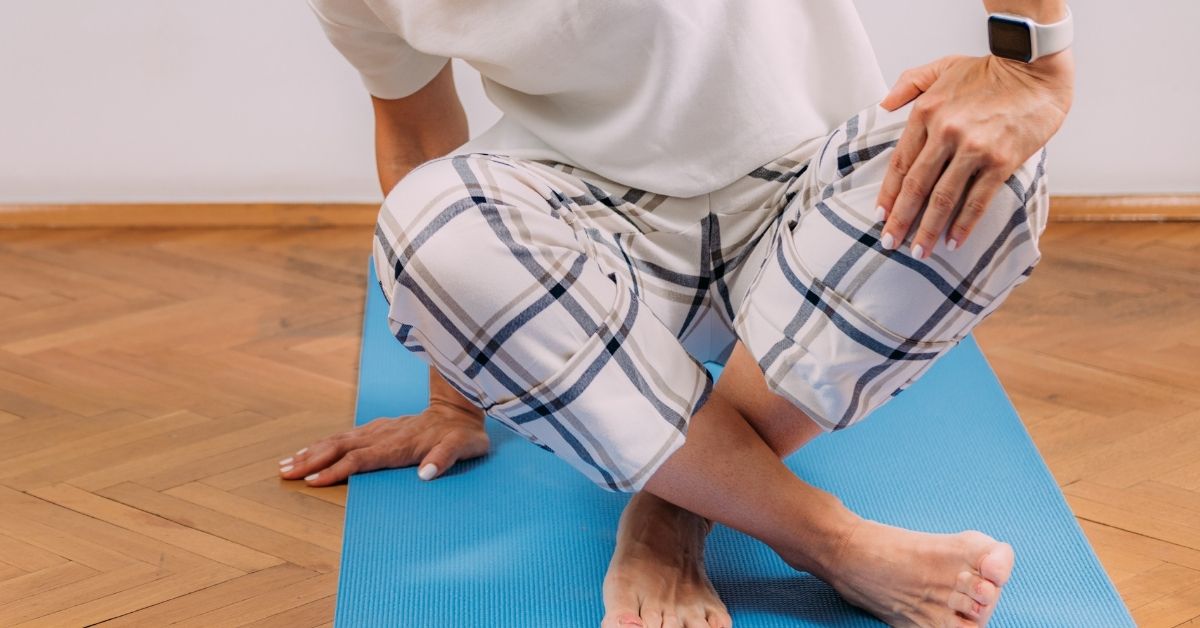
From standing, lower yourself down to sitting cross-legged on the floor. Then stand back up, using as little support as you can.
You start on 10 — five points for going down, five for coming up.
Take off a point every time you use a hand, a forearm, a knee, or the side of your leg. Half a point for a noticeable wobble.
For example: you put one hand down on the way to the floor, then need a hand and a knee to get back up. That's one point off going down and two off coming up. Seven out of ten.
Three things people get wrong:
Speed doesn't count. Take as long as you like. This isn't a race.
Furniture means zero. If you needed a chair, a wall or another person, that's a zero rather than a low score. The points only measure how much you leaned on your own body.
You can't really score yourself. The half-point wobbles are almost impossible to judge from the inside. Film yourself from the side, or ask someone to watch. Have two or three goes and take your best — the first attempt is usually the clumsiest, because you're still working out what you're doing.
Who should skip it. If you've had a hip or knee replacement, significant arthritis, osteoporosis, a recent fracture, or a fall in the last six months, don't attempt this one. There's a chair-based test further down that measures much the same thing far more safely. And whatever your situation, stay within reach of something solid.
Video: I demonstrate this test, and four others, in The 5 Home Tests That Show How Well You're Ageing → https://www.youtube.com/@stressfreelongevity
What Your Sitting-Rising Test Score Means
One thing before the numbers.
Almost everything we know about this test comes from a single clinic in Rio de Janeiro, run by the doctor who invented it. Other researchers are only now starting to look at it. So treat what follows as the best information we have currently.
The main study followed 4,282 adults aged 46 to 75 for twelve years. By the end, 42% of those scoring 4 or below had died, compared with 4% of those who scored a perfect 10.
Some of that is simply age. Older people score lower, and older people die sooner. So the researchers accounted for age, weight, and existing heart problems, diabetes and blood pressure. When they did, this is what remained.
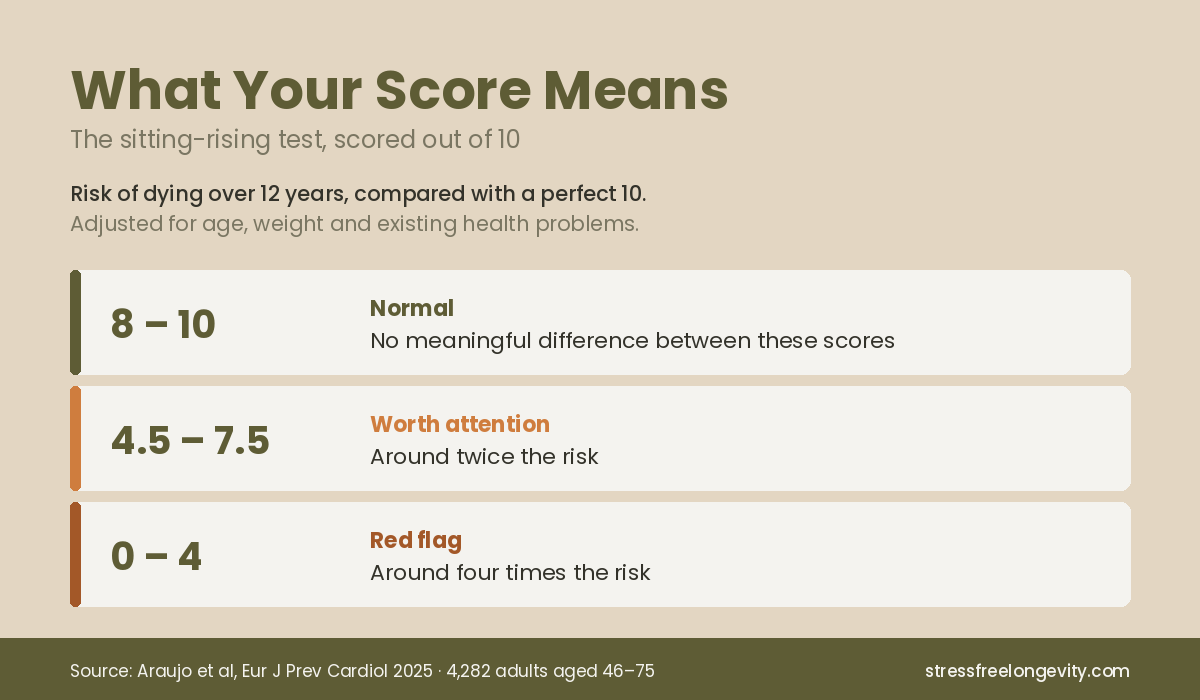
In summary:
Anything from 8 upwards is considered normal. An 8 is the most common score there is — more than a quarter of the people studied scored exactly that, while only one in ten managed a 10. There was no meaningful difference between them.
The risk sits below 8, and it grows the lower you go.
What the Test Is Measuring
Four things at once: leg strength, flexibility in your hips and ankles, balance, and how much weight you're carrying. You need all four, going down and coming up, to make the movement smooth.
Strength matters most on the way up. There's no getting your body weight off the floor without it.
But flexibility is the one that catches people out. To stand from cross-legged you have to get your feet underneath you and your weight over them — and if you can't get into that position, no amount of strength will help. It's a common reason otherwise fit, strong people don't manage a perfect ten. I don't manage one myself, and flexibility is my limit, not strength.
So it's worth thinking about where it went wrong for you:
- Couldn't fold down, or get your feet under you — flexibility.
- Got into position but couldn't drive up — strength.
- Got there, but wobbled — balance.
- Felt like your own body was in the way — weight.
That tells you where your effort will do the most good. Though as you'll see, the actions are worth doing whatever your score.
One last thing: this test is about physical function, not aerobic fitness — which is a separate but equally important part of your health. You can run half marathons and still score a 5.

So What Is It Actually For?
We measure blood pressure, cholesterol, blood sugar, weight. All worth knowing. But almost nobody measures how well their body actually works.
And physical function declines slowly. It's easy to ignore, because nothing in a normal day comes close to your limit — until one day something does.
This test is a snapshot of where yours sits right now. Not a prediction, and not a diagnosis. Mostly, it's a prompt.
For some people it's reassuring. You get down and back up cleanly and find you're in better shape than you'd feared. For others it's a nudge — something you assumed you could still do turns out to be harder than expected.
Both are worth knowing. And either way, what comes next is the same.
What to Do About It
If you've done the test and scored under 8, what do you do?
The honest bit first: nobody has shown that improving your score improves your health. No one has yet taken a group of people, raised their scores, and shown they went on to live longer. That doesn't mean it won't — the study simply hasn't been done.
So don't chase the number. Take a low score as motivation to work on all aspects of physical function, which is good practice for everyone regardless of their score.
Start with strength. Two or three sessions a week, thirty to sixty minutes in total, gets you most of the benefit — less than most people assume. You don't need a gym. Bodyweight and a couple of dumbbells at home will do. Pick a handful of exercises covering the key muscle groups: legs, back, chest, shoulders and arms.
Then flexibility and balance. These two overlap, and one class can cover both. Yoga, Pilates and tai chi all work, and tai chi has the strongest evidence behind it for preventing falls.
If classes aren't for you, do it at home. For balance, stand on one leg while you brush your teeth, both sides. For flexibility, spend a bit of time sitting cross-legged or in a deep squat — most of us stopped going down to the floor years ago, and the range quietly goes with it.
If you make those changes and want to see whether they've worked, try the test again in six months to a year. That's roughly how long real change takes, and any sooner mostly measures how well you've learnt the movement.
If the Floor Isn’t an Option
If you've had a joint replacement, if you've got significant arthritis or osteoporosis, or if you've fallen recently, this isn't the right test for you. The risk of doing it outweighs anything the score would tell you.
The 30-second chair stand is a good alternative. It tests leg strength and balance — though not flexibility — and it's what falls clinics use.
Here's how to do it. Sit in the middle of an armless chair with its back against a wall. Feet flat on the floor, arms crossed over your chest. Then stand fully up and sit fully down, as many times as you can in thirty seconds.
Then compare with the following:
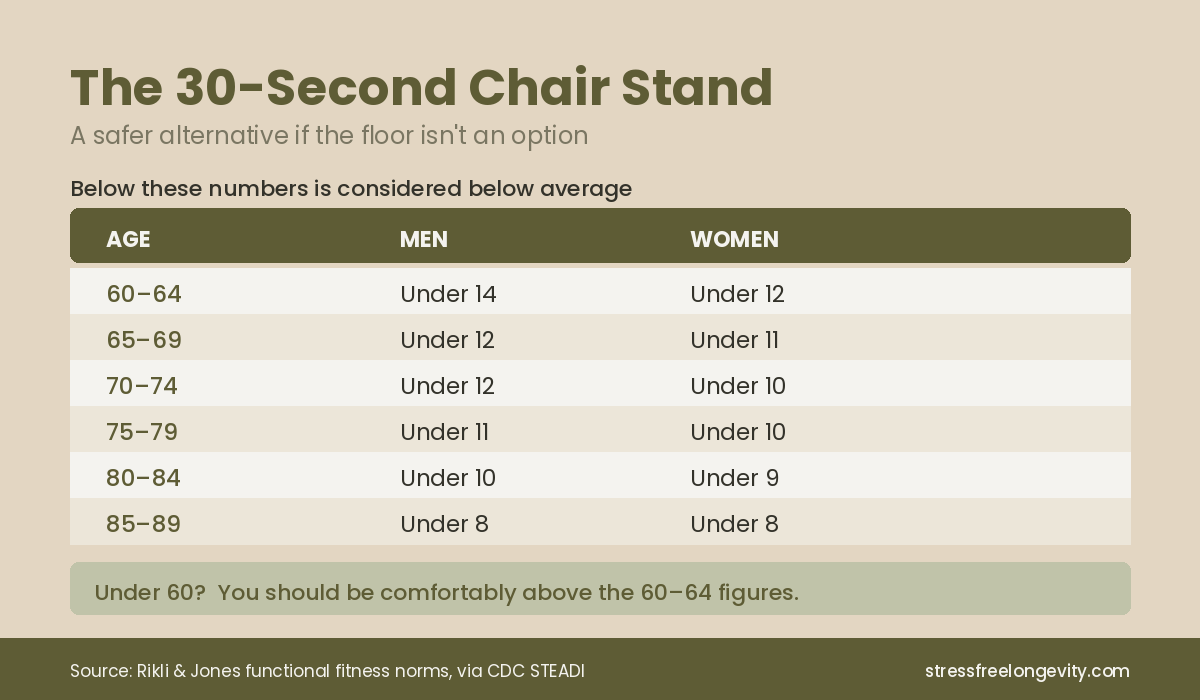
Under 60, you should be comfortably above the 60–64 figures.
If you're below the line for your age, the advice above still applies — strength two or three times a week, and work on your balance. And if pain or a stiff joint is what's holding you back, a physiotherapist is the person to see.
When to See Your Doctor
Most low scores come down to stiffness or weakness, and both respond well to the actions above. But the following are worth checking with your doctor:
- Your score has clearly dropped. If you could do this a year ago and can't now, the change matters more than the number.
- It hurts rather than just feels hard. Stiffness is one thing. Joint pain is another, and there's usually something that helps.
- Something else has changed too. Breathlessness, dizziness, weakness on one side, or repeated falls all deserve a proper look.
- You can't get up off the floor at all. Worth raising with your GP, and worth asking about physiotherapy. Getting up from the floor is a skill that can be taught and rebuilt, and it matters more than the score ever will — a third of people over 65 fall each year, and being able to get yourself back up changes how that goes.
The Bottom Line
The test measures something real — strength, flexibility and balance, rolled into one movement.
It's a useful snapshot of where your physical function sits today. And hopefully a reminder that function is worth preserving as you age, because the decline is slow and easy to ignore.
So move regularly. Work on your muscle strength. And put a little effort into your flexibility and balance.
Your future self will thank you.
Ready to Work on What the Score Reflects?
The number is a barometer. What moves it is strength, movement, and the habits that keep you using both.
- The highest-impact actions across Sleep, Nutrition and Exercise
- The Build Good Habits framework to make changes stick
- Start with one, build from there — no overhaul required
No spam. Unsubscribe anytime.
Frequently Asked Questions
Sources
- Araújo CGS, de Souza e Silva CG, Myers J, et al. (2025). Sitting–rising test scores predict natural and cardiovascular causes of deaths in middle-aged and older men and women. European Journal of Preventive Cardiology. PubMed
- Fiatarone MA, Marks EC, Ryan ND, et al. (1990). High-intensity strength training in nonagenarians. JAMA. PubMed
- Sherrington C, Fairhall NJ, Wallbank GK, et al. (2019). Exercise for preventing falls in older people living in the community. Cochrane Database of Systematic Reviews. PubMed
- Momma H, Kawakami R, Honda T, Sawada SS (2022). Muscle-strengthening activities are associated with lower risk and mortality in major non-communicable diseases. British Journal of Sports Medicine. PubMed
- Rikli RE, Jones CJ (1999). Development and validation of a functional fitness test for community-residing older adults. Journal of Aging and Physical Activity. (30-second chair stand norms, via CDC STEADI.) PubMed
Medical disclaimer
This content is for informational purposes only and is not intended as medical advice. Always consult your healthcare provider before making changes to your health routine. What works for one person may not work for another — this is a roadmap, not a prescription.
About Dr. Eoghan Colgan
Emergency medicine physician researching what actually works for longevity. I interview world-class experts in health and longevity and test everything personally. Everything I teach is what I'm implementing myself. More about me →

Related Articles
What Is a Good Waist-to-Height Ratio? (And How to Measure Yours)
What Is a Good Waist-to-Height Ratio? (And How to Measure Yours) Key Takeaways Keep your […]
How to Lower Blood Pressure Naturally: What Actually Works, Ranked by Evidence
How to Lower Blood Pressure Naturally: What Actually Works, Ranked by Evidence Key Takeaways The […]

Heart Rate vs VO2 Max vs HRV: Which Is the Most Useful?
Heart Rate vs VO2 Max vs HRV: Which Is the Most Useful? Key Takeaways VO2 […]