
How to Maintain Muscle After 40: What Actually Works

Key Takeaways
- Muscle loss after 40 has two components: a slow age-related drift, and short, sharp losses from illness or immobilisation. The sharp losses are where most of the preventable damage happens.
- It's never too late to build muscle. Even nursing-home residents in their nineties can make meaningful gains in eight weeks of strength training.
- Aim for 25g of protein at every meal. Most people get there at dinner, but fall short at breakfast.
Muscle loss after 40 has two parts.
There's the slow, gradual decline that happens as you age. That's real, and it's worth understanding. But there's a second part that has a much bigger impact than most realise — and it's the part even most doctors don't fully appreciate.
I'm Dr. Eoghan Colgan, an emergency medicine physician. I see the impact of muscle loss in my patients almost every shift — its effect on their health, on frailty, on their ability to recover from serious illness. The more I've looked into it, the clearer it's become how much of this is preventable.
In this article, I'll walk you through what actually causes muscle loss after 40, what to do about it, and the part that gets overlooked.
Why Muscle Matters More Than You Think
When you're young, muscle is mostly cosmetic. After 40, that changes.
Muscle has a major impact on your health in three key ways.
Muscle is metabolically active. Skeletal muscle is the largest organ in your body that takes up glucose, which means more muscle helps your body manage blood sugar and stay sensitive to insulin. Muscle also releases signalling molecules — called myokines — that calm inflammation, support your immune system, suppress tumour growth, and even promote brain regeneration. The more muscle you have, the more of this protective activity you carry around with you.
Muscle keeps you independent. Frailty isn't really a disease — it's the slow loss of muscle until simple tasks become hard. Climbing stairs. Getting up off the floor. Carrying shopping. People rarely notice it happening because it happens slowly, but at some point they realise their world has started to shrink.
Muscle helps you survive serious illness. When something serious hits — pneumonia, a fall, surgery, cancer — people with more muscle do better. They survive at higher rates and recover faster. The hip fracture in older patients is the textbook example: nearly one in four people who break a hip will die within a year, in part because they don't have the strength to recover from the injury and the bed rest that follows.
This is why you might hear things like grip strength predicts how long you'll live. The UK Biobank followed half a million adults: every five kilograms of grip strength you lose predicts a sixteen percent higher risk of dying — from anything. It's not the grip itself that matters. Strong grip just means you have good muscle overall, which tends to mean you're in good health overall.
The decline starts somewhere in your forties. You won't notice it for a long time. That's part of the problem.
The Two Ways You Lose Muscle After 40
There's a slow, steady decline that adds up over decades. And there's a faster, sharper kind of loss from illness and immobility — the part that's underappreciated, even within healthcare.
Both share a common cause. Your body is constantly adjusting to what it thinks you need. If you use your muscles less — whether through years of gradually doing less, or a few weeks of being too sick to move — your body assumes you don't need them and quietly takes them away.
Let's look at each.
The slow drift
From your forties onwards, you start losing about one percent of your muscle each year. The rate accelerates after 60.
Several things drive it. As estrogen falls in women and testosterone gradually declines in men, the body's signals to maintain muscle weaken. Your muscles also become less responsive to protein — they need a bigger dose to trigger the same growth response, a phenomenon called anabolic resistance. And life simply changes. You sit more. Your sport drops away. Your protein intake quietly drifts down. The signals telling your body to keep muscle get fainter, and the body responds by letting some go.
Strength fades faster than muscle mass — and power, which is strength used quickly, fades faster still. So the muscle in your thigh might still look fine, but standing up from a chair feels harder than it used to. That's not your imagination. The mass is largely there. The strength to use it is going first.
The sharp losses
Here's something that's less well known, even within healthcare.
Your muscle is in constant turnover. Every day, about one to two percent of the protein in your muscles is broken down and rebuilt. Within two or three months, much of your muscle is essentially new tissue.
This is what makes muscle so adaptable. It's why training works at any age, why injuries heal, and why someone in their 80s can still build new muscle.
But the same fast turnover that lets muscle adapt also makes it vulnerable when something goes wrong. When you stop using your muscles — even for a few days — your body decides you don't need them and breaks them down quickly.
The numbers are striking:
- Two days of bed rest — measurable muscle loss begins.
- Seven days of bed rest — about five percent muscle loss.
- Ten days of bed rest in older adults — around a kilogram of leg muscle gone, alongside a sixteen percent drop in leg strength.
- Ten days in intensive care — losing around eighteen percent of one of your major thigh muscles. The inflammation of serious illness compounds the disuse, and muscle dissolves at a rate that matches decades of normal aging.
Now here's the part that really matters. Without active rehabilitation, you don't get all of it back. A young adult immobilised for two weeks can return to baseline with two weeks of normal retraining. An older adult often won't — not because their body can't recover, but because the structured rehabilitation needed to drive that recovery rarely happens. They get most of it back, but not all. Each illness episode leaves a small permanent loss.
So a sedentary 70-year-old struggling to get up from a chair isn't simply experiencing aging. Some of it is. But a large part is twenty years of slow drift plus three or four illness episodes — none of them properly rehabilitated — quietly stacked on top of one another.
This is the part healthcare systems still don't fully appreciate. Strength is rarely measured before, during, or after a hospital stay. Protein intake during admission is dramatically lower than what's recommended — research across the UK, Netherlands, Italy, Denmark, and Australia consistently finds older patients consuming around 0.65 grams of protein per kilogram per day, less than half what's needed during recovery. Hospital food often isn't appealing, patients aren't hungry, and nobody intervenes.
The good news is there's a lot you can do about both halves of this picture — the slow drift and the sharp losses. That's what the rest of this article is about.
I also cover this topic in a video on my YouTube channel - https://www.youtube.com/@stressfreelongevity
What To Actually Do
Three things. They work together.
1. Eat enough protein
For healthy adults over 40, the consensus from every major geriatric nutrition body is around 1.0 to 1.2 grams of protein per kilogram of body weight per day. If you're training hard or recovering from illness, push that to 1.2 to 1.5 g/kg.
Numbers like that aren't very useful on their own. I recently interviewed Professor Luc van Loon, one of the world's leading protein researchers. His practical translation: aim for 25g of protein at every meal.
Most people get there at dinner. They get close at lunch. They fall short at breakfast.
Toast and coffee won't get you to 25g. But it doesn't take much to fix — Greek yogurt with nuts, two eggs on toast, or a protein shake takes you from five grams to thirty in one swap.
Here's what 25g of protein actually looks like:
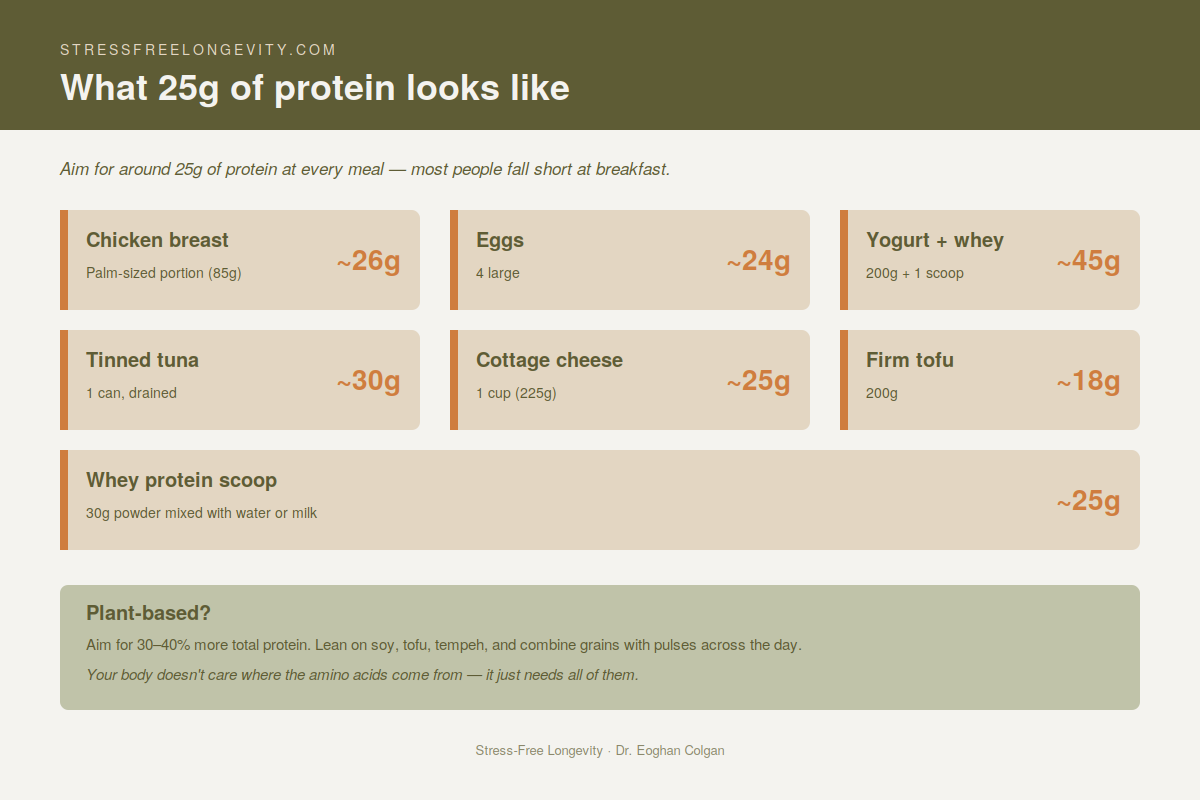
If you eat plant-based, you can absolutely build and maintain muscle — but it takes a little more attention. Three reasons. Plants have less protein per gram of food, so you need to eat more of it. Your body absorbs plant protein slightly less efficiently than animal protein. And while plants do contain all the essential amino acids, most plants are low in one or two of them — grains tend to be low in one, beans in another. The fix is variety and quantity. Eat more, and eat more types — beans, lentils, soy, nuts, grains. Your body doesn't care where the amino acids come from. It just needs all of them.
2. Do some strength training
Protein gives your body the building blocks. Strength training is the signal that tells your body to actually use them — to keep the muscle you have, and ideally build a little more. Without that signal, your body assumes you don't need the muscle and lets it slip away.
The good news is this doesn't need to be elaborate. The benefit curve is steepest at the start — going from nothing to something is where you make the biggest gains. Two short sessions a week, working the major muscle groups hard enough that the last few reps are genuinely difficult, is enough to maintain and even build muscle.
It also doesn't have to be heavy weights, or in a gym. Light weights, bodyweight squats, push-ups, resistance bands all work — as long as you're working close to the point where you couldn't do another rep with good form. The signal is effort, not load.
Start lighter than you think you need to. Get the movement right first. Add weight gradually. Done this way, the injury risk is genuinely tiny — much lower than the risks of not training, which include falls, fractures and frailty.
I'll be honest, I don't love strength training. But I know it's good for me, and I know I won't keep it up if it's long or unpleasant. So I do ten exercises covering the main muscle groups, one set of each to failure, with dumbbells at home. About sixteen minutes, twice a week. It's less than the textbook minimum dose, but I've found it's enough to make a real difference — and crucially, it's something I'll actually keep doing for the rest of my life.
If you can't make it enjoyable, make it easy.
3. Manage illness well
This is the part where most preventable muscle is lost. If you've been doing the protein and the training, you'll arrive at any illness with reserves to draw on. But how you handle the illness itself matters too.
When you're unwell, you need more protein, not less. The body is breaking muscle down rapidly during illness, and the only way to slow that is to give it more raw material to work with. Aim for 1.2 to 1.5 g/kg if you're recovering from anything significant. If you or someone you love is admitted to hospital, this won't happen automatically. The food often isn't enough, and nobody is checking. Bring high-protein snacks. Drink the supplement shakes. Advocate for adequate intake.
The second piece is movement. Get moving as soon as you can — even before you feel completely ready. Short walks. Sitting up rather than lying down. Light resistance work. A small amount of movement during recovery does far more to preserve muscle than people expect, because it sends the signal to your body that you still need the muscle. Without that signal, your body assumes the inactivity is permanent and accelerates the breakdown.
Once you're properly back on your feet, returning to your normal protein and strength training will rebuild what was lost and get you back to where you were.
Want the complete framework?
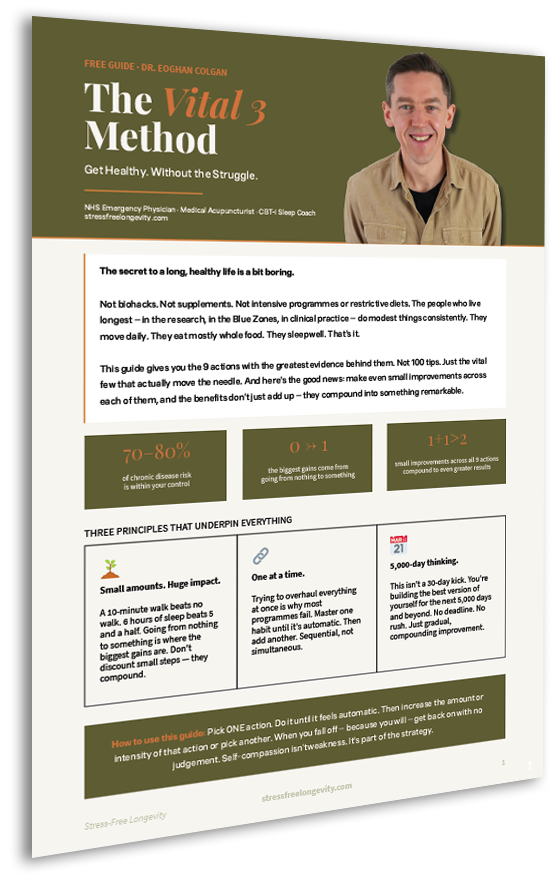
Get "The Vital 3 Method" free guide — the system I use to build sustainable strength training, nutrition, and sleep habits across midlife.
Yes, You Can Build Muscle at Any Age
One thing worth saying clearly: it's never too late to start.
The most striking study on this took ten frail nursing-home residents — average age 90 — and put them through eight weeks of strength training. Not gentle stretching. Actual weight-bearing exercise.
Strength increased by 174 percent. Mid-thigh muscle area increased by nine percent. Walking speed improved by 48 percent.
In ten people whose average age was ninety.
The study has been replicated and refined many times since. The training response to strength work doesn't disappear with age. It changes a little — older adults need slightly more recovery, slightly more protein, slightly more consistency — but the fundamental machinery still works.
You don't need to be impressive. You just need to start.
A Few Things Worth Flagging
Creatine. Worth taking, if you also lift. Creatine monohydrate at 3-5g per day adds meaningful muscle and strength on top of resistance training in older adults — roughly an extra kilogram of lean tissue over a few months, plus measurable strength gains. Without the training, the gains aren't there. It's safe for healthy kidneys. The cognitive benefits people talk about are real but mostly seen under stress or sleep deprivation. Buy plain creatine monohydrate. Anything fancier is marketing. (I started taking it myself recently — there's a separate article on it if you want the deeper read.)
GLP-1 medications (Ozempic, Wegovy, Mounjaro). These are remarkable medications that are helping people lose substantial amounts of weight. But a significant portion of that weight loss is muscle — up to 40 percent in some studies. The long-term consequences aren't fully understood, and there's genuine concern that this may be harmful, particularly in older adults already starting from a low baseline of muscle. If you're taking one, the priorities are clear: hit a higher protein target of 1.4 to 1.6 g/kg per day, and do strength training two to three times a week. These aren't optional.
Walking. Walking is wonderful for cardiovascular and metabolic health. But on its own, it won't preserve muscle. The signal to maintain muscle is resistance, not steps. Walk for everything else — but if muscle is the goal, you need to add something that actually loads the muscle. Bodyweight squats while the kettle boils count. Push-ups against the kitchen counter count. The threshold is lower than people think.
When to See Your Doctor
Most muscle loss after 40 is the slow drift and the sharp losses described above — and it's something you can work on yourself. But some patterns warrant a medical opinion: unexplained weight loss of more than 5% over six months, sudden weakness on one side or in specific muscles, profound fatigue, muscle pain on statin medication, or recurrent falls. A simple blood test rules out most of the common medical causes. Don't assume profound fatigue or weakness is just aging.
The Bottom Line
Most muscle loss after 40 is preventable. The slow drift can be largely countered by eating enough protein and doing some strength training. The sharp losses from illness can be largely protected against by eating more protein during recovery and getting moving sooner than feels comfortable.
The decline has already started. You won't feel it for a long time. Which is exactly why the work has to start now, when nothing seems wrong.
Ready to Build Health That Lasts?
You've just learned how to protect your muscle through the next forty years. But muscle is one of nine principles that determine how you age.
- The 9 highest-impact actions across Sleep, Nutrition, and Exercise
- Two-session-a-week strength training that fits a busy life
- The Build Good Habits framework to make changes stick
No spam. Unsubscribe anytime.
Frequently Asked Questions
Sources
- Celis-Morales CA et al. (2018). Associations of grip strength with cardiovascular, respiratory, and cancer outcomes and all cause mortality: prospective cohort study of half a million UK Biobank participants. BMJ. BMJ
- Kortebein P et al. (2007). Effect of 10 days of bed rest on skeletal muscle in healthy older adults. JAMA. PubMed
- Puthucheary ZA et al. (2013). Acute skeletal muscle wasting in critical illness. JAMA. PubMed
- Fiatarone MA et al. (1990). High-intensity strength training in nonagenarians. JAMA. PubMed
- Bauer J et al. (2013). Evidence-based recommendations for optimal dietary protein intake in older people: a position paper from the PROT-AGE Study Group. J Am Med Dir Assoc. PubMed
- Weijzen MEG et al. (2020). Protein intake falls below 0.6 g/kg/day in healthy older patients admitted for elective hip or knee arthroplasty. Nutr Clin Pract. PubMed
- Borde R et al. (2015). Dose-response relationships of resistance training in healthy old adults: a systematic review and meta-analysis. Sports Med. PMC
- Chilibeck PD et al. (2017). Effect of creatine supplementation during resistance training on lean tissue mass and muscular strength in older adults: a meta-analysis. Open Access J Sports Med. PMC
Medical disclaimer
This content is for informational purposes only and is not intended as medical advice. Always consult your healthcare provider before making changes to your health routine. What works for one person may not work for another — this is a roadmap, not a prescription.
About Dr. Eoghan Colgan
Emergency medicine physician researching what actually works for longevity. I interview world-class experts in health and longevity and test everything personally. Everything I teach is what I'm implementing myself. More about me →

Related Articles

How to Calculate Protein Intake: A Doctor’s Simple Rule
How to Calculate Protein Intake: A Doctor’s Simple Rule Key Takeaways The simplest way to […]

Does Creatine Cause Hair Loss? What the Evidence Shows
Does Creatine Cause Hair Loss? What the Evidence Shows Key Takeaways No study has shown […]
Creatine Side Effects: What’s Real and What Isn’t
Creatine Side Effects: What’s Real and What Isn’t Key Takeaways Creatine is one of the […]