
Best Exercise to Live Longer: What the Research Actually Shows

Key Takeaways
- Your body needs three types of physical stress — aerobic, strength, and daily movement. Combining even modest amounts of each cuts mortality risk by 40–50%
- You need less than you think. Eleven minutes of brisk walking a day reduces early death risk by 23%. Thirty minutes of strength training a week cuts it further
- The first steps are worth the most. Going from inactive to lightly active is the single largest mortality reduction in all of exercise research
If you're looking for the best exercise to live longer, you probably want a straight answer. Running? Swimming? Weights? Walking?
Here's the truth: there is no single perfect exercise for longevity. If there were, we'd all be doing it.
The best exercise to live longer is the one you'll do consistently — for the rest of your life. Preferably something you enjoy, or at least don't find unpleasant, so you'll keep showing up. The more you do, the greater the benefit. That's the honest answer.
But there is a lot of fascinating research on how to get the most from exercise — with some genuinely good news about how little you actually need. If you'd like to know the optimal approach, read on.
Why Exercise Works
For millions of years, humans never exercised. Not in the way we think of it. Our ancestors didn't go for a jog or book a gym session. They were simply active — walking, carrying, building, hunting — throughout the day. Their bodies adapted to that life, and it kept them healthy.
But we modern humans have engineered movement out of our lives — cars, desk jobs, home deliveries — and then created artificial ways to put it back in. 'Exercise' is really an invention of the past 50 years in an attempt to replicate the physical demands our bodies evolved expecting.
And here's what matters: your body doesn't know what you're doing. It doesn't care if you are on a treadmill, or in a swimming pool or on a tennis court. It recognises the effort. When you get out of breath, your body registers that your tissues are demanding oxygen and energy faster than usual — so it builds a stronger heart, better blood vessels, more efficient metabolism to make it easier in the future. When you load your muscles, your body over time builds them stronger.
In effect, your body adapts to give you what it thinks you need. And the opposite is true. If your body does need think you need an optimal machine, muscle breaks down, cardiovascular capacity drops, metabolic health declines. Not because something went wrong — because the body is doing exactly what it's designed to do. It's efficient. If you're not using it, it assumes you don't need it.
This is why exercise matters so much for longevity. Every body declines with age — that's unavoidable. But how fast it declines depends on what you've been asking it to do. If your heart, lungs, and muscles are weak and underused in middle age, they'll deteriorate quickly as you get older. If they're strong and well-maintained, the decline is slower — and you retain far more capacity into your seventies, eighties, and beyond.
That's what exercise really is. Not punishment. Not a weight-loss tool. It's maintenance of the machine you'll need for the decades ahead.
Three Types of Exercise, Three Separate Benefits
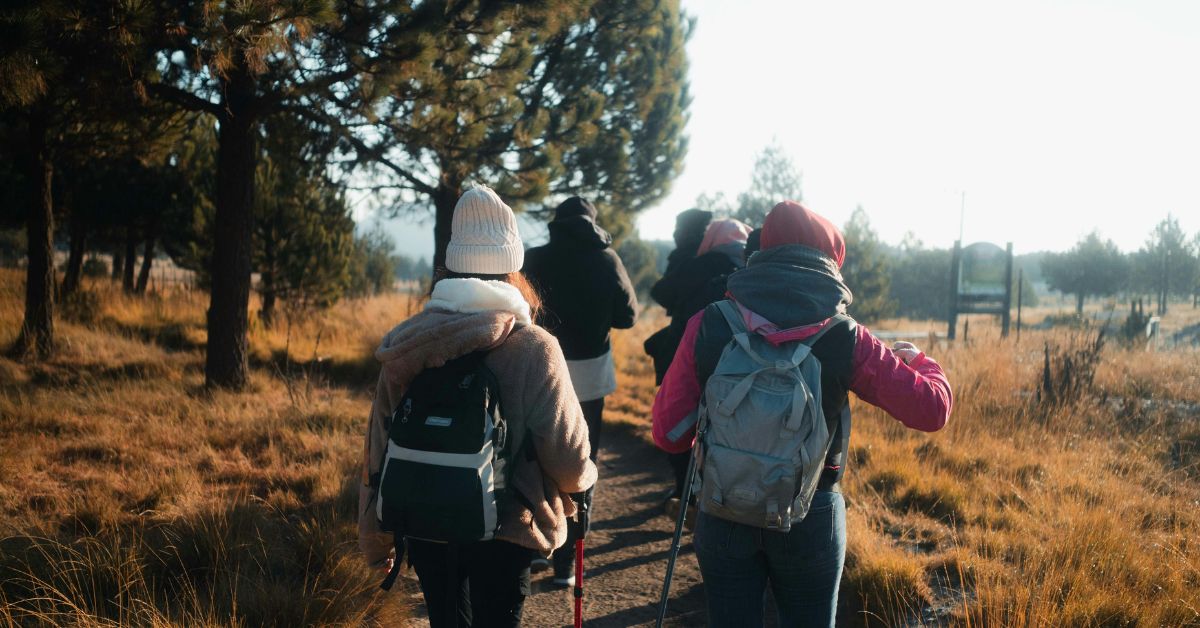
There are many ways to move your body. But there are three broad categories of movement, and for optimal health, try to do some of each.
Aerobic exercise — getting out of breath
This is any movement that raises your heart rate and makes you breathe harder. Walking briskly, cycling, swimming, dancing, running up stairs. Your body doesn't care what it is. What matters is that your heart and lungs are working hard enough and triggering those healthy adaptations.
When you do this regularly, your heart gets stronger and pumps more blood per beat. Your muscles build more mitochondria — the structures that convert oxygen into energy. Your blood vessels become more flexible. The result is a higher VO2 max — your body's capacity to use oxygen — which is the single strongest predictor of how long you'll live.
A study of 122,007 patients found that people with low cardiovascular fitness had five times the mortality risk of the fittest group. That gap is larger than the gap between smokers and non-smokers. And a study of 750,302 veterans found that every incremental improvement in fitness reduced mortality by 13–15%, with no upper limit. The more fit you are, the better.
Strength training — loading your muscles
After about 40, you lose muscle every year if you don't actively work against it. Roughly 0.5–1% per year at first, accelerating as you age. By 80, the average person has lost around 30-40% of their muscle mass.
This matters far more than most people realise. Weaker muscles don't just mean frailty — they mean a body less equipped to handle what life throws at it. Surgery, illness, cancer treatment, a fall — your muscle mass and strength determine how well you cope and how quickly you recover.
Beyond that, active muscle is a powerful health asset in its own right. Every time your muscles contract, they release signalling molecules that reduce inflammation, improve how your body handles blood sugar and fat, support immune function, and protect your brain. The more muscle you maintain and use, the more of these benefits you get.
What preserves and builds muscle is resistance — working your muscles against load. Weights, bands, bodyweight exercises, heavy gardening. The body registers the effort and builds them stronger. And it works at any age. Studies in adults in their eighties and nineties have shown significant muscle and strength gains from resistance training. It's never too late to start. Explore my exercise content → for more on getting started.
The dose is remarkably low. Any amount of resistance training reduces all-cause mortality by 15%. The optimal benefit comes from just 30 to 60 minutes per week — one or two short sessions. More than that doesn't add much.
Regular movement — avoiding prolonged stillness
This is the one most people miss. Your body has systems that only stay active when you move regularly throughout the day — enzymes that clear fat from your blood, processes that regulate blood sugar, signalling molecules released by contracting muscles.
When you sit for hours without interruption, these systems shut down. Prolonged sitting is associated with a 91% increase in type 2 diabetes risk, and mortality risk starts climbing meaningfully above about seven hours of sitting a day. That's total time sittig, including at your desk, on the commute, watching TV in the evening.
And this happens regardless of whether you exercise. Meeting the recommended 150 minutes of weekly exercise still leaves you at elevated risk if you're sitting for eight or more hours a day. Both exercise and regular movement are needed — one doesn't replace the other.
But you don't need to be on your feet all day. Interrupting long periods of stillness — a short walk, taking the stairs, standing during a phone call — keeps these systems running. Even 1-2 minutes every hour is associated with a 33% lower risk of dying.
The combination — and why variety helps
But here's an important takeaway point - combining these three types of exercise is dramatically more effective than doing just one, and is optimal for health. A study of nearly 480,000 adults found that aerobic exercise alone reduced mortality by 29%. Strength training alone: 11%. Both combined: 40%.
And a 2026 Harvard study of 111,000 adults, followed for over 30 years, found that exercise variety — doing different types of activity — reduced mortality by a further 19%, independent of total exercise volume. The likely reason: different activities stress different muscles, movement patterns, and energy systems. The body adapts to each one separately, so variety produces a broader range of adaptations than repeating the same thing.
More ways of challenging the body means more ways the body improves.
Want the complete framework?
Get "The Vital 3 Method" free guide — the system I use to build sustainable health habits across Sleep, Nutrition, and Exercise.
If You Could Only Pick One
If you genuinely can only do one type of exercise, the evidence favours aerobic exercise— anything that gets you out of breath. It has the broadest disease-risk reduction and the strongest mortality data of any single exercise type. The measure of aerobic fitness — VO2 max — is the single strongest predictor of how long you'll live. I cover this in detail in my VO2 max video →.
Walking is the most accessible way to do this. Every extra 1,000 steps per day is associated with a 15% reduction in mortality. People who walk 8,000 steps a day live nearly 12 years longer than those walking fewer than 4,000. Make sure you add some speed or incline occasionally to get the aerobic benefit, And if you spread your steps throughout the day rather than taking them all in one go, you're getting the regular movement benefit as well. Two of the three types, from one activity.
But strength training does things aerobic exercise cannot. It preserves muscle mass, prevents falls, protects metabolic health — and those benefits become increasingly important as you age. You can build cardiovascular fitness through walking. You cannot easily build strength without resistance.
The honest answer: start with whichever one you'll actually do. Then add the others when you can.
How Much Is Enough
The reason to exercise is to reduce your chances of developing a life-limiting disease, and to increase your chances of a long, active, independent life. The more you do, the further those odds shift in your favour.
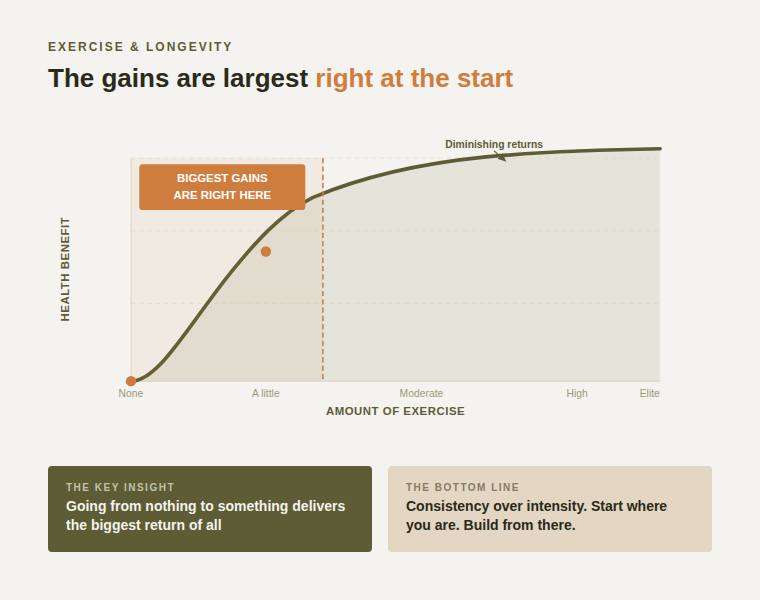
But the relationship between exercise and longevity isn't a straight line. It's a curve — steep at the start, flattening as you add more. See image below.
Going from nothing to something has the greatest benefit. Just 11 minutes of brisk walking per day reduces early death risk by 23%. If you do more, you get more benefit, but the curve flattens and the additional gains get smaller. 150 minutes per week of moderate activity = 31% lower mortality. Double that = 37%. Add strength training = 40%.
That's not a reason to do less — do as much as you can. But if you can only do a little, that is where the most profound benefits happen. Always do something if you can.
Start with whatever you'll stick to. Add more when you're ready. Every addition shifts the odds further in your favour.
What Else Makes a Difference?
Moving throughout the day, getting out of breath sometimes, and doing some strength work a couple of times a week — that's the formula for optimal health. But two additional things are worth mentioning, because they amplify the benefits.
Make it enjoyable.
The key to health and longevity isn't a perfect programme — it's staying active for the rest of your life. So the activity you choose matters less than whether you'll keep doing it. Find something you enjoy, or at least something you don't dread. Pair it with something you like — music, a podcast, a friend. The easier it is to show up, the more likely you will.
Make it social.
The Copenhagen City Heart Study followed 8,577 people for 25 years and found that social sports were associated with dramatically longer lives than solo exercise. Tennis added 9.7 years of life expectancy. Badminton: 6.2. Soccer: 4.7. Health club activities — despite the most total exercise time — added just 1.5 years. Social connection, enjoyment, and cognitive engagement appear to compound the physical benefits. If you can find an activity that involves other people, you may be getting more than exercise.

The Bottom Line
There is no single best exercise to live longer. Your body doesn't care what you do — it cares that you do it.
Move throughout the day. Get out of breath a few times a week. Do some strength work. If you can only do one, start with whatever you'll stick to — walking is a great place to begin. Then add more when you're ready.
The biggest gains come from starting. Every bit you add shifts the odds in your favour. And the odds keep improving the more you do — but the first step is worth the most.
Find something you enjoy. Do it with other people if you can. And keep doing it.
Ready to Put This Into Practice?
Exercise is one of three pillars that determine your long-term health. Sleep and nutrition are the other two — and they amplify each other.
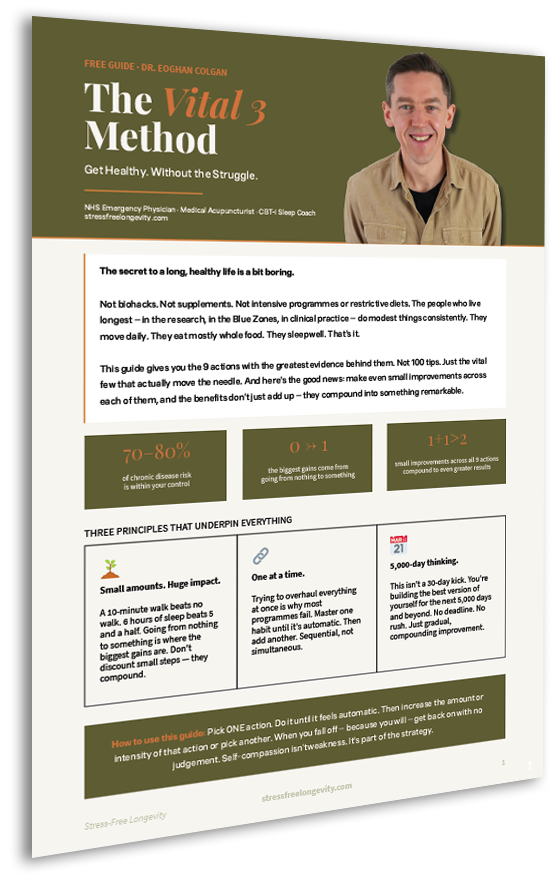
Get the complete Vital 3 Method guide — free:
- The 3 highest-impact changes for each pillar (9 total)
- The Build Good Habits framework to make them stick
- Start with one, build from there — no overhaul required
No spam. Unsubscribe anytime.
Frequently Asked Questions
Sources
- Mandsager K et al. (2018). Association of Cardiorespiratory Fitness With Long-term Mortality Among Adults Undergoing Exercise Treadmill Testing. JAMA Network Open. PubMed
- Kokkinos P et al. (2022). Cardiorespiratory Fitness and Mortality Risk Across the Spectra of Age, Race, and Sex. Journal of the American College of Cardiology. PubMed
- Arem H et al. (2015). Leisure Time Physical Activity and Mortality: A Detailed Pooled Analysis of the Dose-Response Relationship. JAMA Internal Medicine. PubMed
- Zhao M et al. (2020). Recommended physical activity and all cause and cause specific mortality in US adults. BMJ. PubMed
- Shailendra P et al. (2022). Resistance Training and Mortality Risk: A Systematic Review and Meta-Analysis. American Journal of Preventive Medicine. PubMed
- Momma H et al. (2022). Muscle-strengthening activities are associated with lower risk and mortality in major non-communicable diseases. British Journal of Sports Medicine. PubMed
- Biswas A et al. (2015). Sedentary Time and Its Association With Risk for Disease Incidence, Mortality, and Hospitalization in Adults. Annals of Internal Medicine. PubMed
- Han H et al. (2026). Physical Activity Types, Variety, and Mortality: Results from Two Prospective Cohort Studies. BMJ Medicine. PubMed
- Schnohr P et al. (2018). Various Leisure-Time Physical Activities Associated With Widely Divergent Life Expectancies. Mayo Clinic Proceedings. PubMed
- Garcia L et al. (2023). Non-occupational physical activity and risk of cardiovascular disease, cancer and mortality outcomes. British Journal of Sports Medicine. DOI: 10.1136/bjsports-2022-105669
- Banach M et al. (2023). The association between daily step count and all-cause and cardiovascular mortality. European Journal of Preventive Cardiology. PubMed
- Paluch AE et al. (2022). Daily steps and all-cause mortality: a meta-analysis of 15 international cohorts. The Lancet Public Health. PubMed
- Diaz KM et al. (2017). Patterns of Sedentary Behavior and Mortality in U.S. Middle-Aged and Older Adults. Annals of Internal Medicine. PubMed
- Fleg JL et al. (2005). Accelerated Longitudinal Decline of Aerobic Capacity in Healthy Older Adults. Circulation. PubMed
Medical disclaimer
This content is for informational purposes only and is not intended as medical advice. Always consult your healthcare provider before making changes to your health routine. What works for one person may not work for another — this is a roadmap, not a prescription.
About Dr. Eoghan Colgan
Emergency medicine physician researching what actually works for longevity. I interview world-class experts in health and longevity and test everything personally. Everything I teach is what I'm implementing myself. More about me →

Related Articles
VO2 Max by Age: What Your Number Means and Why It Matters
VO2 Max by Age: What Your Number Means – and Why It Matters Key Takeaways […]

Healthy Aging Tips: What the Evidence Shows and How to Start
Healthy Aging Tips: What the Evidence Shows and How to Start Key Takeaways What you […]
What Is a Good HRV? (And How to Improve Yours)
What Is a Good HRV? (And How to Improve Yours) Key Takeaways Your trend matters […]