

Key takeaways
- You need both: cardio does more to help you live longer, strength training more to keep you strong and independent.
- If you only have time for one, choose cardio, then add strength training when you can.
- A small amount of each brings most of the benefit, and it’s never too late to start.
For years, the advice on exercise was simple: do your cardio. Walk, run, cycle, swim. Now strength training is getting far more attention, and for good reason.
So when it comes to strength training vs cardio, does one matter more as you get older?
The short answer is that both are important, because they do different jobs. But if you only have time for one, choose cardio. But the best news of all, you don’t need much of either to get most of the benefit.
I’m an emergency medicine doctor. In this article I’ll walk you through what each one does, why you need both, how much you need, and how to get started.
What Are You Exercising For?
There are really two reasons to exercise as you get older.
The first is to avoid, or at least delay, the diseases that shorten life: heart disease, stroke, type 2 diabetes and some cancers. That’s your lifespan.
The second is to stay strong and full of energy for as long as you can, so you can keep living the life you want: travelling, playing with your grandchildren, getting the most out of every year. That’s your healthspan.
And the gap between the two is wide. On average, people in the US now spend around 12 years of their life in poor health. In the UK, it’s about 11.
Cardio and strength training help with both. But cardio does more for the first, and strength training more for the second.
What Does Cardio Actually Do?
Cardio is any activity that raises your heart rate and breathing for a sustained period: brisk walking, cycling, swimming, running, dancing.
When you move, your muscles need more oxygen. So you breathe faster to take more in, and your heart beats faster to pump it to them.
Do this regularly and your body adapts. Your heart grows bigger and stronger, pumping more blood with each beat, so it doesn’t need to beat as often. Your muscles grow more of the tiny blood vessels that feed them, and more mitochondria, the parts of each cell that turn fuel into energy. So the same effort, over time, takes less out of you. That’s why the stairs start to feel easier after a few months of regular walking.
The same changes bring your blood pressure down and help your muscles take sugar out of your blood, which is why regular cardio lowers your risk of heart disease, stroke and type 2 diabetes.
How fit your heart and lungs are is one of the strongest predictors of how long you’ll live. In a study of 122,000 people who did a treadmill test, the least fit were five times more likely to die during the study than the fittest.
And you don’t need to run to get the benefits. Walking counts, as long as it’s brisk: you can talk, but you couldn’t sing. That’s roughly 100 steps a minute. I’ve written more about finding the right pace here.
What Does Strength Training Do That Cardio Can’t?
Strength training is any exercise where your muscles work against resistance: weights, machines, resistance bands or your own body weight. Any of them counts, as long as the last few repetitions are hard.
That hard effort is what makes the difference. When you push a muscle close to its limit, it adapts by getting stronger and, over time, bigger. Cardio doesn’t load your muscles enough to do that.
And muscle does far more than move you around.
It controls your blood sugar. Muscle is the main place sugar goes after a meal. The more muscle you have, and the more you use it, the more sugar it pulls out of your blood. That helps protect you from type 2 diabetes.
It acts like an organ. When muscle contracts, it releases chemicals called myokines. These appear to lower inflammation across the body and help keep your brain and other organs healthy.
It’s your reserve when you get ill. When you’re seriously ill or recovering from surgery, your body breaks down your muscle for the protein it needs to fight infection and repair itself. The more you’ve built, the more you have to draw on.
That’s why losing it matters. From around 50, muscle loss becomes noticeable. And strength falls two to five times faster than the muscle itself.
The first fibres to go are the fast ones, which produce force quickly. They’re what get you out of a chair in one go, or catch you when you trip. Walking barely uses them, because your body only calls on them when the load is heavy. So lift something heavy, or stand up from a chair over and over, and they have to work. That’s what keeps them.
The good news is that muscle responds to training at any age. In one well-known study, people with an average age of 90 did eight weeks of strength training and nearly tripled their strength.
Strength Training vs Cardio: Do You Really Need Both?
In short, yes. The two barely overlap, and together they add up.
The clearest evidence comes from a trial in Iowa. Researchers took 406 inactive adults who were overweight, with an average age of 50, and split them at random into four groups for a year: cardio, strength training, half and half, or no exercise. Each exercise group trained for an hour, three times a week. Here’s what changed, compared with the people who didn’t exercise:
| After one year | Cardio only | Strength only | Half and half |
|---|---|---|---|
| Fitness (heart and lungs) | Improved | Little change | Improved |
| Strength | No change | Improved most | Improved |
| Muscle | No change | Gained 1.2 kg (2.6 lb) | No clear change |
| Heart-risk score* | Improved | No change | Improved |
In other words, each type did its own job. Only the half-and-half group improved both fitness and strength, and it matched the cardio group on heart risk without spending any more time exercising.
They did half as much strength training as the strength-only group, and gained roughly half as much strength. They may have gained a little muscle too, but not enough to be sure of in a year.
But what about living longer? For that, the best evidence comes from following large groups of people for many years.
A US study followed nearly 100,000 people, with an average age of 71, for about ten years. Among those who did neither type of exercise, around a third died. In comparison, the death rate was 32% lower in people who did cardio alone, 20% lower with strength training alone, and 41% lower with both.
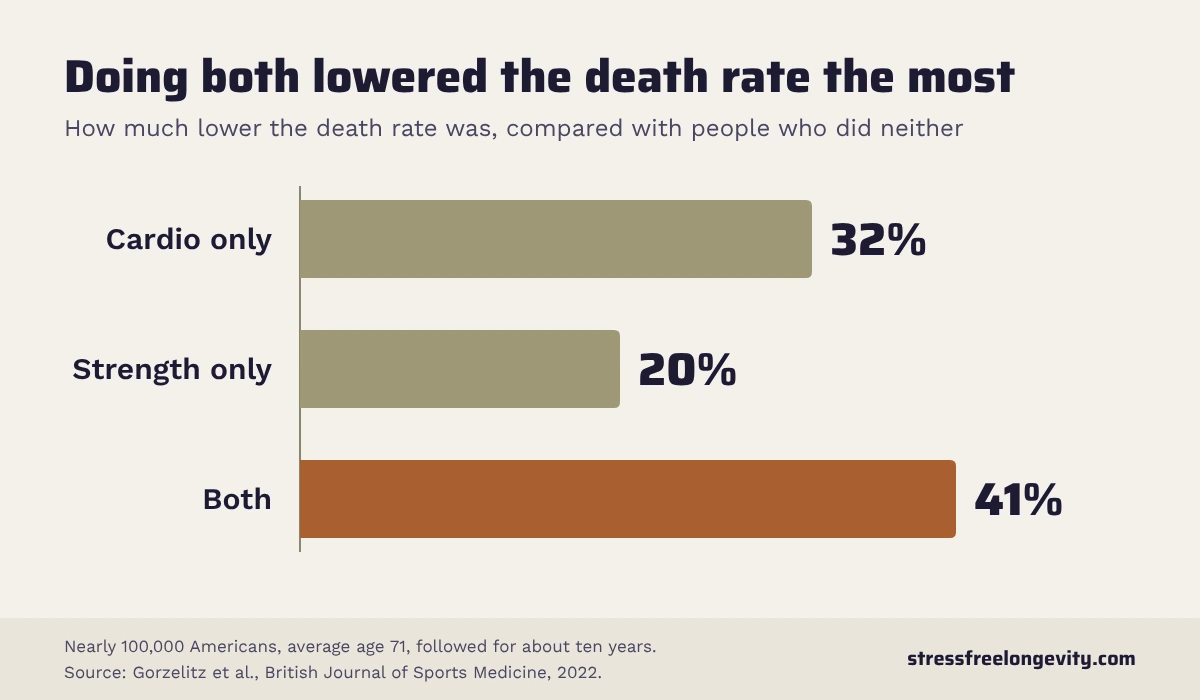
A 2026 Harvard study of nearly 150,000 people, followed for up to 30 years, found the same pattern. Each type on its own was linked to a lower death rate, but the drop was bigger with cardio, and biggest of all with both.
These long-term studies follow people who chose to exercise, and people who exercise tend to be healthier in other ways too. So the exact percentages are likely to be generous. But the trials, where people are split at random, back up the main point: each type does a job the other can’t.
If You Only Have Time for One, Which Should It Be?
If you can only fit one in, make it cardio.
That’s what the large studies above found: cardio on its own made the bigger difference. A study of 216,000 older Americans fits the same picture. Lifting weights without any cardio wasn’t linked to living longer at all.
Cardio helps with everyday tasks too, even though it doesn’t build muscle. In a trial of older adults who were losing weight, cardio alone improved things like rising from a chair and climbing stairs just as much as strength training alone. Tasks like these depend on your heart and lungs as well as your legs. Both together did best.
Watch the video
VIDEO TITLE – replace with the exact YouTube title
Any walking is better than none, but to get the most from it, add some speed. Interval walking is one well-tested way: three minutes fast, then three minutes at an easy pace, repeated five times. In a Japanese trial of 246 people with an average age of 63, five months of interval walking improved fitness more than steady walking did, and increased thigh strength by 13 to 17%. It won’t replace lifting, but it gives your legs more work than a steady walk.
My free guide shows the simple changes that made the biggest difference for me.
So why not do both? For most people, the answer is time. But there’s good news: you need far less than you might think.
How Much Do You Actually Need?
The official advice in both the US and the UK is at least 150 minutes of moderate cardio a week, plus strength training on two or more days. But most of the benefit comes well before you reach that.
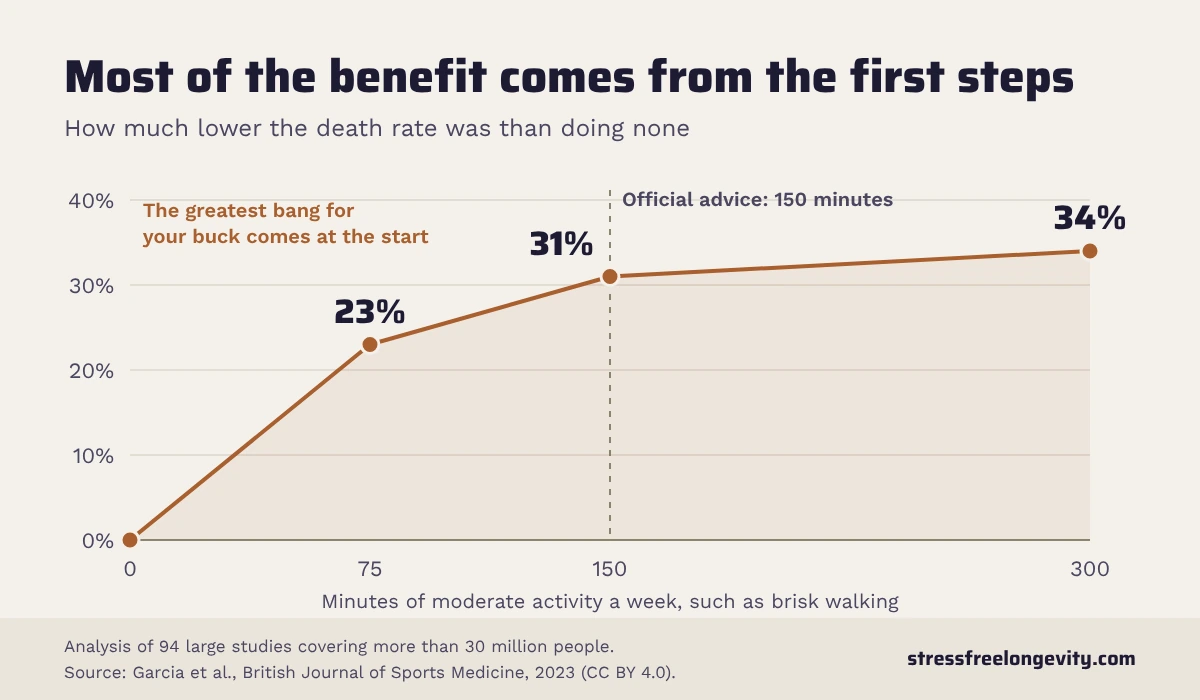
That’s because the benefit doesn’t build in a straight line. It rises steeply at first, then levels off. A 2023 analysis of 94 large studies, covering more than 30 million people, found this for cardio:
| Moderate activity per week (such as brisk walking) | Lower death rate than doing none |
|---|---|
| 75 minutes | 23% |
| 150 minutes | 31% |
| 300 minutes | 34% |
In other words, the more exercise you do, the greater the benefit, but with diminishing returns. The greatest bang for your buck comes at the start. Going from little (or none) to a little more. Do not discount the benefits of doing a small amount.
Strength training follows the same curve. Most of the benefit comes from the first 30 to 60 minutes a week. It rises a little more up to about two hours, then flattens out.
And more good news: it’s also never too late to start. In a US study of more than 300,000 people, those who were inactive as young adults but became active between 40 and 61 had a 35% lower death rate than those who stayed inactive. That’s almost exactly the same as people who’d been active all their lives.
And it doesn’t seem to matter much how you spread it out. People who fit most of their exercise into one or two days a week do about as well as those who exercise more often, for the same total.
Is Either One Risky?
For most people, the risks are small, and much smaller than the risks of doing nothing.
The main risk with cardio is a heart problem during hard exercise. It’s rare. In a study of more than 21,000 male doctors followed for 12 years, there was one sudden death for every 1.5 million sessions of vigorous exercise.
The risk is highest in people who don’t usually exercise. In one study, people who exercised less than once a week had 107 times their usual risk of a heart attack in the hour after very hard exertion. For people who exercised five or more times a week, it was 2.4 times. Both are multiples of a very small risk.
With strength training, the injuries seen in studies of older adults are mostly strains and sore joints, and serious problems are rare.
When to check with your doctor
- If you’re starting out and have a significant illness, such as heart disease, diabetes or kidney disease, check with your doctor first.
- If you get chest pain, unusual breathlessness, dizziness or fainting when you exert yourself, stop and see your doctor.
- And if your blood pressure is high and not yet under control, get it treated before you start.
How Do You Start?
It’s best to start small and build up. Building a habit you can keep going is far more important than starting too hard and giving up after a few weeks.
Here’s how to build a week that covers both:
Cardio: start with 10 to 15 minutes of brisk walking a day, and add a few minutes each week. Work towards 150 minutes a week: 30 minutes on five days, or about 20 minutes every day. Build up how often you exercise before you build up how hard.
Strength: two sessions a week, 15 to 30 minutes each. Pick 6 to 10 exercises that work your legs, back, chest, shoulders and arms, such as sit-to-stands, step-ups, push-ups against a wall, rows with a band and calf raises.
Start gently: for the first few weeks, use a light weight and focus on learning the movements. That gives your muscles, tendons and joints time to get used to the work. Then build up the weight gradually. If you can, get someone to show you the movements before you begin.
How hard: once you’ve learned the movements, choose a weight or band you can move 8 to 15 times with good form, stopping one or two repetitions short of failure (your muscle can no longer do the movement). Lift briskly, lower slowly, and breathe out as you lift.
Over 60: add balance work on two days a week. Balance exercise is what has been shown to reduce falls. Strength training or walking on their own haven’t been. Standing on one leg while you brush your teeth is a good start, and tai chi counts too.
What you can skip. You don’t need a gym or a complicated programme. Bands, bodyweight or a pair of dumbbells at home work well. You don’t need multiple sets either: one hard set of each exercise gives you most of the benefit. And more than about two hours of strength training a week doesn’t seem to add anything for your health. I’ve written more about how much strength training you need here.
What I do
In my first year, I walked for 30 minutes a day on a treadmill. I gradually turned up the speed and incline, then walked for longer, up to around 60 minutes a day. The focus was to build the habit with a small amount, and add more as it became natural.
For strength, I used dumbbells at home: two 15-minute sessions a week, ten exercises, one set each to failure.
I also made a few simple changes to what I ate. Nothing drastic: I still had three good-sized meals a day, plus snacks. I share those changes in my free guide.
Over that year, I lost 20 kg (44 lb), my BMI dropped by 6 points, and my VO2 max, a measure of heart and lung fitness, rose by 20 points (an Apple Watch estimate). I gained strength and muscle too.
Today I walk for 60 to 90 minutes a day, and I’ve recently added a third strength session.
The Bottom Line
Cardio and strength training do different jobs. Cardio does more to help you live longer, and strength training does more to keep you strong and independent through those years. You need both.
If you only have time for one, walk, and walk briskly. When you can, add two short strength sessions a week.
It doesn’t have to be perfect. Start with ten minutes this week, and build from there.
Your one small step
Start with ten minutes
Walk briskly for ten minutes a day this week. Next week, add a few minutes.
Free guide · The Vital 3 Method
Start Small, Build Both
The highest-impact actions across Sleep, Nutrition and Exercise, and the Build Good Habits framework to make it stick.
Frequently Asked Questions
Is cardio or weights better for weight loss?
Cardio, if you mean the number on the scales. In an eight-month trial, people doing cardio lost more weight and fat than people lifting weights, who didn’t lose weight but gained muscle. Doing both gave the best overall change, but took twice as long. If you’re over 60 and dieting, keep some strength training in: when older adults lose weight with cardio alone, more of what they lose is muscle.
Should I do cardio or weights first?
For general health, it doesn’t make much difference. Doing both in the same session doesn’t meaningfully reduce the benefit of either. So pick the order you’re most likely to stick with. If building strength is your priority, lifting first, while you’re fresh, makes sense.
Does strength training count as cardio?
Only a little. Lifting does raise your fitness, but by about half as much as cardio. A set of 8 to 12 repetitions doesn’t keep your heart working hard for long enough to train it.
Is it different for men and women?
The broad pattern is the same. One difference: in two large US studies, strength training’s link with living longer was stronger in women. In men, once cardio was taken into account, lifting barely changed the death rate. But the benefits for muscle, strength and independence apply to both.
Can you do too much strength training?
Not in a way that should worry you. In the largest study, the benefit stopped growing at around two hours a week. But doing more didn’t raise the risk either.
Does lifting weights boost your metabolism?
A little. In one study, six months of strength training raised men’s resting metabolic rate by 9%, about 140 calories a day. In women, the change was too small to be sure of. The “afterburn” after a workout adds very little. Lift for your muscles and strength, not for the calories.
Sources (17)
- Lee DC, Brellenthin AG, Lanningham-Foster LM, Kohut ML, Li Y (2024). Aerobic, resistance, or combined exercise training and cardiovascular risk profile in overweight or obese adults: the CardioRACE trial. European Heart Journal. Read the study ↗
- Gorzelitz J, Trabert B, Katki HA, et al. (2022). Independent and joint associations of weightlifting and aerobic activity with all-cause, cardiovascular disease and cancer mortality in the PLCO Cancer Screening Trial. British Journal of Sports Medicine. Read the study ↗
- Zhang Y, Lee DH, Rezende LFM, Ma Y, Giovannucci E (2026). Long-term resistance training with all-cause and cause-specific mortality: assessing dose-response and joint associations with aerobic physical activity. British Journal of Sports Medicine. Read the study ↗
- Garcia L, Pearce M, Abbas A, et al. (2023). Non-occupational physical activity and risk of cardiovascular disease, cancer and mortality outcomes: a dose–response meta-analysis of large prospective studies. British Journal of Sports Medicine. Read the study ↗
- Saint-Maurice PF, Coughlan D, Kelly SP, et al. (2019). Association of leisure-time physical activity across the adult life course with all-cause and cause-specific mortality. JAMA Network Open. Read the study ↗
- Mandsager K, Harb S, Cremer P, et al. (2018). Association of cardiorespiratory fitness with long-term mortality among adults undergoing exercise treadmill testing. JAMA Network Open.
- Shailendra P, Baldock KL, Li LSK, et al. (2024). Weight training and risk of all-cause, cardiovascular disease and cancer mortality among older adults. International Journal of Epidemiology. Read the study ↗
- Villareal DT, Aguirre L, Gurney AB, et al. (2017). Aerobic or resistance exercise, or both, in dieting obese older adults. New England Journal of Medicine.
- Nemoto K, Gen-no H, Masuki S, Okazaki K, Nose H (2007). Effects of high-intensity interval walking training on physical fitness and blood pressure in middle-aged and older people. Mayo Clinic Proceedings.
- Fiatarone MA, Marks EC, Ryan ND, et al. (1990). High-intensity strength training in nonagenarians. JAMA.
- Sherrington C, Fairhall NJ, Wallbank GK, et al. (2019). Exercise for preventing falls in older people living in the community. Cochrane Database of Systematic Reviews.
- Albert CM, Mittleman MA, Chae CU, et al. (2000). Triggering of sudden death from cardiac causes by vigorous exertion. New England Journal of Medicine.
- Mittleman MA, Maclure M, Tofler GH, et al. (1993). Triggering of acute myocardial infarction by heavy physical exertion. New England Journal of Medicine.
- dos Santos M, Ferrari G, Lee DH, et al. (2022). Association of the “weekend warrior” and other leisure-time physical activity patterns with all-cause and cause-specific mortality. JAMA Internal Medicine.
- Garmany A, Terzic A (2024). Global healthspan-lifespan gaps among 183 World Health Organization member states. JAMA Network Open.
- Currier BS, D’Souza AC, Fiatarone Singh MA, et al. (2026). Resistance training prescription for muscle function, hypertrophy, and physical performance in healthy adults: an overview of reviews. ACSM Position Stand. Medicine & Science in Sports & Exercise.
- UK Chief Medical Officers (2019). UK Chief Medical Officers’ Physical Activity Guidelines.
Medical disclaimer. This article is general information, not medical advice. It can’t take account of your health or your medicines, so talk to your own doctor before making big changes.