
Types of Magnesium: What Actually Works (and What Doesn't)
Key Takeaways
- The form on the bottle matters less than the marketing claims. No trial has ever shown one form works better than another for the outcome you care about.
- Stronger evidence for only two conditions: migraine prevention and constipation. For sleep, anxiety, and blood pressure, the effects are real but small.
- Cheap oxide has the strongest clinical evidence. The premium "brain" forms don't justify the price.
I'm an ER doctor who uses magnesium for life-threatening heart, lung and pregnancy issues. It's a genuinely important treatment. And over the past 10 years it's become hugely popular as a health and wellness supplement — for sleep, anxiety, migraines, menopause and more. Walk down any supplement aisle and you'll find ten different versions — citrate, glycinate, oxide, threonate, malate, taurate — each promising to be the one you need.
It would appear there is very little magnesium cannot do. But the science is more interesting than that. And the evidence supporting its use as a health and wellness supplement is less certain than the marketing would suggest.
In this article, I'll explain what magnesium is, why so many forms exist, and break its use down into three groups — conditions where it's genuinely helpful, worth a shot, and not worth the money.
Let's start with why it matters.
What Magnesium Actually Is
Magnesium is a mineral — a basic chemical element like iron or potassium. It comes from rocks and soil, gets taken up by plants, and reaches us through what we eat.
Your body holds about 25 grams of it. Most is locked away in your bones. Less than 1% circulates in your blood — and that's the bit your doctor measures when they test for it. A normal blood result doesn't rule out being low elsewhere in the body.
The reason it may have so many uses is that magnesium is involved in over 600 different chemical reactions in the body. Energy production. Muscle contraction. Blood pressure regulation.
And intake tends to be low. In the US, around half of adults don't get enough magnesium from food. UK figures are lower but still significant. Plus, as you age, you absorb less, your kidneys lose more, and medications like long-term acid reducers (PPIs) and water tablets (diuretics) deplete it further.
So the theory is that low magnesium may contribute to a range of health issues — and supplementation might be the fix.
I also cover this topic in a video on my YouTube channel - https://www.youtube.com/@stressfreelongevity
Why So Many Forms?
Magnesium on its own is too unstable to sit in a tablet. It has to be bonded to something. Glycinate is magnesium bonded to glycine, an amino acid. Citrate is bonded to citric acid. Oxide is bonded to oxygen.
These aren't different drugs. It's the same magnesium, but delivered in different vehicles.
The vehicles do behave a bit differently. Some absorb more efficiently. Some stay in the gut and act as a laxative. Some are gentler on the stomach. And so the supplement industry sells different forms for different conditions — glycinate for sleep, threonate for the brain, malate for energy.
But, interestingly, no trial has ever shown that one form produces a better outcome than another for the same condition. And studies that supposedly promote one type over another, are often based on small absorption studies in healthy volunteers - with differences smaller than the marketing would suggest.
So does magnesium work? And which type is best? Let's break magnesium supplements down into three groups, based on the evidence.

Where the Evidence Is Strong
Let's start with the strong evidence. Two conditions.
Migraine prevention
If you get recurrent migraines, magnesium is one of the cheapest, safest preventive options you have.
The pivotal trial was in 1996. Eighty-one people took 600 mg of elemental magnesium daily (as magnesium citrate) for twelve weeks. Attack frequency dropped 41.6%, compared with 15.8% on placebo. Various studies since have had mixed outcomes, but on review of all available data, the American Headache Society and the American Migraine Foundation both recommend magnesium for migraine prevention, citing a 2012 guideline that classified it as "probably effective" — a careful verdict from a committee that doesn't hand them out lightly.
Three things to know if you try it.
The dose is 400–600 mg of elemental magnesium daily. Elemental magnesium is the actual amount of magnesium in the tablet — different from the total weight. More on reading labels below.
It takes time. Give it three months before deciding whether it's working.
The forms used in successful trials are citrate and oxide — which are also the cheapest.
Chronic constipation
Magnesium oxide is poorly absorbed from the gut. For most conditions that's a problem. For constipation, it's the whole point.
When magnesium stays in the gut, it pulls water into the bowel and softens the stool. It's a laxative. A 2019 trial in 34 women with chronic constipation found magnesium oxide helped 70.6% of patients, compared with 25% on placebo.
This is a useful option for people on a GLP-1 medication — Ozempic, Wegovy, Mounjaro. Constipation affects 10–20% of users. Magnesium oxide at 200–400 mg before bed is a reasonable, cheap option alongside other laxatives. Other forms of magnesium are less effective here, as they absorb too readily.
Want the complete framework?
Get 'The Vital 3 Method' free guide — the system I use to build sustainable health habits across sleep, nutrition, and exercise.
Where the Evidence Is Modest
For three more conditions, magnesium probably helps — a little. The evidence suggests small beneficial effects, so it's worth a try, especially if you might be low to begin with. But don't expect a transformation.
Sleep
Sleep is probably the most common reason people take magnesium. The evidence is weaker than the marketing suggests.
The most thorough review found magnesium added about 16 minutes of total sleep time compared with placebo — and even that wasn't statistically significant. A 2025 trial in 155 people using bisglycinate found only a tiny effect.
It's more likely to help if your dietary intake is already low. And most sleep trials actually used magnesium oxide — not glycinate, the form everyone now recommends.
If you want to try it, glycinate is the gentlest. Take 200–300 mg in the evening for at least four weeks. If you notice nothing after a month, this isn't your fix. Poor sleep usually has other causes that no pill will solve — stress, an irregular schedule, alcohol, screens before bed.
Anxiety
The evidence here is similar to sleep. The biggest review described it as "suggestive but the quality is poor." The cleanest signal is in PMS (pre-menstrual syndrome), where small trials show improvements in mood. For diagnosed anxiety disorders, there's essentially no good data.
A four-week trial at 200–300 mg is reasonable if you have mild stress symptoms or PMS. It's not a treatment for an anxiety disorder.
Blood pressure
This one's more interesting. A 2025 meta-analysis pooled 38 trials and found magnesium reduced systolic blood pressure by about 3 mmHg on average — modest but real.
But in people with high blood pressure who were also magnesium-deficient, systolic pressure dropped by nearly 8 mmHg — clinically meaningful.
The people most likely to fit that group are those on long-term acid reducers, water tablets, or with poor diets. If that's you, magnesium is a reasonable addition to whatever your doctor has prescribed. Not a replacement.
Three hundred to four hundred milligrams of elemental magnesium daily, in a well-absorbed form like citrate, for at least eight weeks.

Where the Evidence is Weak
And finally, the conditions where the evidence doesn't support use. Three of magnesium's most popular uses have been tested properly — and the results were negative.
Nocturnal leg cramps
This is the single most common reason older adults take magnesium. And it's the use case where the evidence has most clearly failed.
In 2020, the Cochrane Collaboration — the highest tier of independent medical evidence — pooled the available trials of magnesium for leg cramps in older adults and concluded magnesium does not produce a meaningful reduction in cramp frequency. Translation: it doesn't work.
The reason is mechanistic. Most older adults with leg cramps have completely normal magnesium levels. The cramps don't come from low magnesium — they come from misfiring nerves in the spinal cord. No supplement is going to fix that.
What actually helps: stretching the affected muscle before bed, staying hydrated, and reviewing your medications. Statins and diuretics can make cramps worse.
Menopausal hot flushes
The menopause supplement market has gone hard on magnesium glycinate for hot flushes. But the evidence doesn't back it up.
A small early study suggested a benefit. When researchers ran a proper randomised trial in 289 postmenopausal women with hot flushes — high-dose magnesium oxide for eight weeks — there was no effect at all. The pilot finding didn't survive a real test.
What does work: hormone replacement therapy is the most effective by some distance, and it's safer than the early-2000s headlines suggested for most women. Some antidepressants help. There's good evidence for cognitive behavioural therapy designed for menopause. And cooling strategies — sleep environment, layered clothing, identifying triggers — make a real difference.
Magnesium L-threonate for "brain" health
This is the most expensive magnesium on the shelf — sometimes 30–50 times more per milligram than oxide. It's marketed as the form that crosses the blood-brain barrier to improve memory, cognition, and sleep.
But the science is nuanced.
The original mechanism study was in rats. The senior author founded the company that sells it. Every human trial showing benefit has been funded by that company or its commercial partners. The one fully independent trial — published in 2023 in 109 people — found no benefit on pain, mood, sleep, or cognition.
I'm not saying it definitely doesn't work. I'm saying the evidence is dominated by industry-funded trials, the only independent one was negative, and you're paying 30–50 times more for the privilege.
Until further independent trials show otherwise, if you want to invest in your brain, the evidence is much stronger for sleep, regular exercise, social connection, and learning new things than for any supplement on the shelf.
So Which Form Should You Take?
A quick summary of when to take magnesium and which form to use:
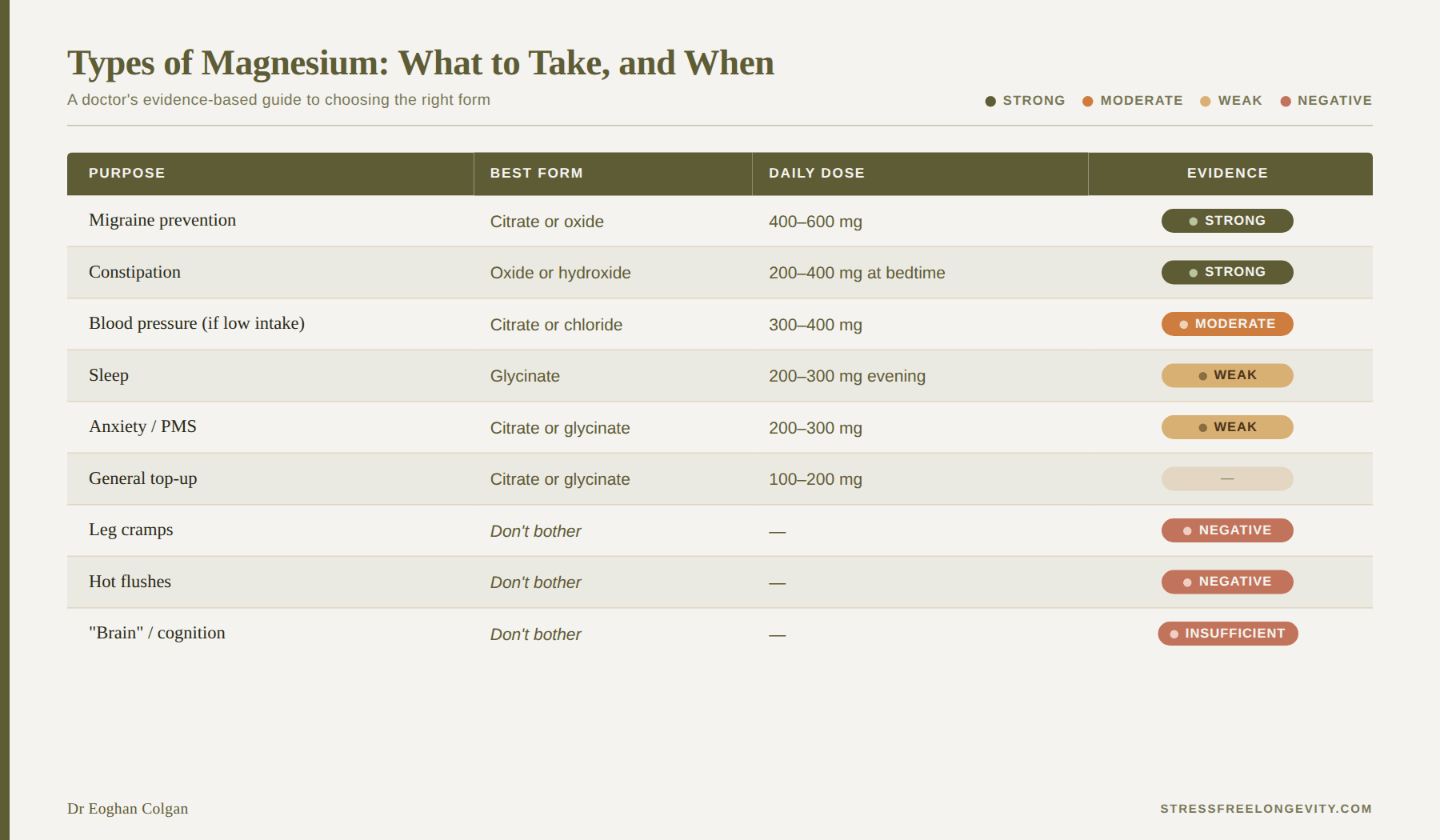
A note on labels. The big number on the front of the bottle is usually the total weight of the compound — the magnesium plus its carrier. The amount of actual magnesium is smaller, and it's listed on the supplement facts panel as elemental magnesium. That's the number that matters.
For example: a 2,000 mg L-threonate capsule contains only about 144 mg of actual magnesium. A 500 mg oxide tablet contains about 300 mg. A 1,000 mg citrate tablet contains about 160 mg.
For tolerability: oxide and citrate are most likely to cause loose stools. Glycinate is the gentlest. Take any form with food.
Getting Enough Magnesium from Your Diet
If you want to make sure your diet covers it, here are the richest sources. A few of these every day will get you there.
- Pumpkin seeds — 150 mg per small handful
- Spinach (cooked) — 80 mg per cup
- Almonds — 80 mg per ounce
- Black beans — 60 mg per half cup
- Dark chocolate (70%+) — 65 mg per ounce
- Oatmeal — 60 mg per cup
- Cashews — 75 mg per ounce
- Avocado — 60 mg per medium fruit
The foods richest in magnesium happen to be the foods of a Mediterranean-style diet — which also has the strongest evidence for longevity, heart disease, and dementia risk. Food beats a capsule on every metric that matters.

A Few Safety Points
Magnesium is one of the safest supplements you can buy. A few things worth flagging.
The recommended upper limit for supplemental magnesium is 350 mg per day in the US and 250 mg in Europe. Above that, the main side effect is loose stools — uncomfortable but not dangerous in healthy people. The doses used for migraine prevention go higher than this on purpose and are usually well tolerated.
Be cautious if you have kidney disease. Your kidneys clear magnesium. If they're not working well (eGFR below 30), speak to your doctor first.
Space magnesium from certain medications. Magnesium can interfere with absorption of other medications if taken at the same time:
- Thyroid medication (levothyroxine) — separate by 4 hours
- Bisphosphonates (alendronate, risedronate) — separate by 4 hours
- Certain antibiotics (doxycycline, ciprofloxacin) — separate by 2 hours
If you're on multiple medications and unsure, your pharmacist is the best resource.
The Bottom Line
Two solid uses: migraine prevention and chronic constipation. The cheap forms — citrate or oxide — are the ones with the evidence.
Three uses worth a try, more likely to help if you're low: sleep, mild anxiety, and blood pressure.
Three uses where the bottle promises more than the data delivers: leg cramps, hot flushes, and "brain" supplements. Save your money.
Magnesium is a genuinely important medicine — but it's not the wonder drug the supplement aisle suggests. For the right person, with the right indication, it's cheap, safe, and worth a try. For everyone else, the money is better invested in a good diet and proven alternatives.
Ready to Build Health That Lasts?
You've just learned that the foundations matter more than the supplement. The same is true for most health decisions.
- The 9 highest-impact actions across Sleep, Nutrition, and Exercise
- Two-session-a-week strength training that fits a busy life
- The Build Good Habits framework to make changes stick
No spam. Unsubscribe anytime.
Frequently Asked Questions
Sources
- Garrison SR et al. (2020). Magnesium for skeletal muscle cramps. Cochrane Database of Systematic Reviews. PubMed
- Peikert A et al. (1996). Prophylaxis of migraine with oral magnesium: results from a prospective, multi-center, placebo-controlled and double-blind randomized study. Cephalalgia. PubMed
- Mori S et al. (2019). A randomized double-blind placebo-controlled trial on the effect of magnesium oxide in patients with chronic constipation. Journal of Neurogastroenterology and Motility. PubMed
- Argeros Z et al. (2025). Magnesium Supplementation and Blood Pressure: A Systematic Review and Meta-Analysis of Randomized Controlled Trials. Hypertension. PubMed
- Schutten JC et al. (2022). Effects of Magnesium Citrate, Magnesium Oxide, and Magnesium Sulfate Supplementation on Arterial Stiffness. Journal of the American Heart Association. PubMed
- Park H et al. (2015). North Central Cancer Treatment Group N10C2 (Alliance): a double-blind placebo-controlled study of magnesium supplements to reduce menopausal hot flashes. Menopause. PubMed
- Ni Y et al. (2023). A Randomized, Double-Blind, Placebo-Controlled Trial to Evaluate the Therapeutic Effect of Magnesium-L-Threonate Supplementation for Persistent Pain After Breast Cancer Surgery. Breast Cancer: Targets and Therapy. PubMed
- NIH Office of Dietary Supplements (2022). Magnesium — Fact Sheet for Health Professionals. NIH ODS
Medical disclaimer
This content is for informational purposes only and is not intended as medical advice. Always consult your healthcare provider before making changes to your health routine. What works for one person may not work for another — this is a roadmap, not a prescription.
About Dr. Eoghan Colgan
Emergency medicine physician researching what actually works for longevity. I interview world-class experts in health and longevity and test everything personally. Everything I teach is what I'm implementing myself. More about me →

Related Articles

How to Calculate Protein Intake: A Doctor’s Simple Rule
How to Calculate Protein Intake: A Doctor’s Simple Rule Key Takeaways The simplest way to […]

Does Creatine Cause Hair Loss? What the Evidence Shows
Does Creatine Cause Hair Loss? What the Evidence Shows Key Takeaways No study has shown […]

Creatine Side Effects: What’s Real and What Isn’t
Creatine Side Effects: What’s Real and What Isn’t Key Takeaways Creatine is one of the […]