
The Safest Sleep Aid: What Works (And What to Stop)

Key Takeaways
- No pill solves a sleep problem. They sedate. The underlying cause stays where it was. Every major guideline agrees: sleep aids are short-term tools, not long-term solutions.
- Prolonged-release melatonin is the safest pill for most adults. The effect is modest — around seven extra minutes of sleep — but the safety profile is the cleanest.
- The pills most people reach for are the ones with the clearest signal for long-term brain harm. Diphenhydramine — found in Nytol, Benadryl PM, ZzzQuil, and hidden in Tylenol PM and Advil PM — is the most common, but the same applies to its cousins (doxylamine, promethazine, and low-dose amitriptyline).
For something so important, sleep is surprisingly easy to get wrong.
And the pills meant to make it better can quietly make it worse — fragmenting sleep, building dependence, and in some cases carrying real long-term health risks.
In this article I'll rank the safest sleep aids from cleanest to most concerning, cover the dementia link with some of the most common over-the-counter pills, and finish with what actually works to improve your sleep long-term. Because no pill on this list really solves a sleep problem.
I learned that the hard way during my years of night shifts. I tried various sleep aids with inconsistent results. What actually fixed my sleep was getting my schedule consistent and managing the stress that was keeping my mind awake.
Ranking the Safest Sleep Aids
A word before we get into the comparison. Every major guideline — the American Academy of Sleep Medicine, NICE in the UK, the European Insomnia Guideline — agrees that sleep aids are short-term tools, not long-term solutions. Used short-term, under two to four weeks, any of these pills is reasonable. The differences in safety emerge with longer use.
So this ranking matters most if you're already a nightly user, or close to becoming one. There are 4 tiers, from cleanest to most concerning. The names differ between the UK and US, so I've included both.
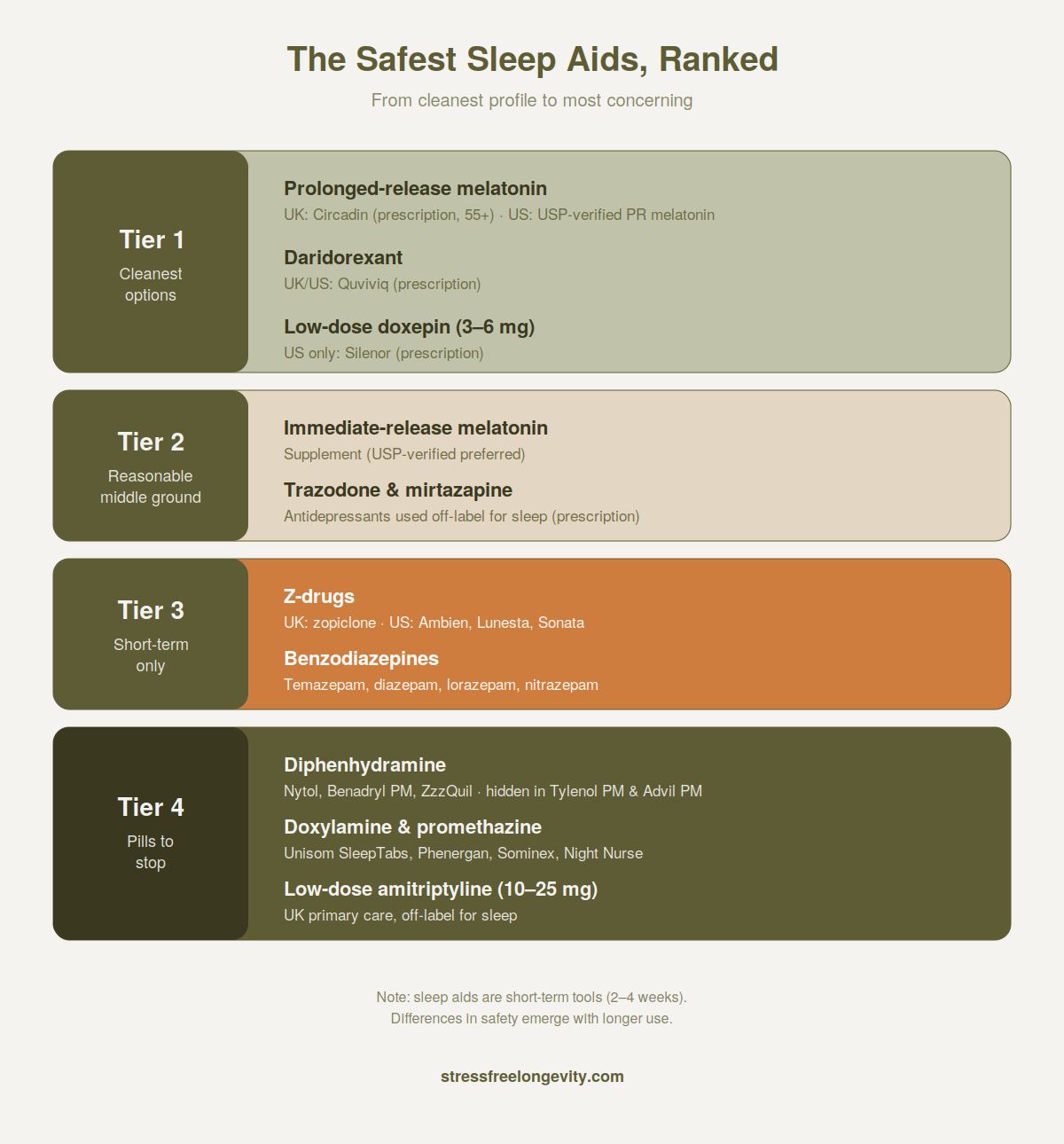
Let's walk through it.
Tier 1 — The Cleanest Options
Prolonged-release melatonin. In the UK, this is Circadin 2 mg, a prescription medication licensed for adults over 55. In the US, look for USP-verified pharmaceutical-grade prolonged-release melatonin — the supplement market is unregulated and supplements do not always contain what the label says!
Melatonin mimics the natural hormone your brain releases at night to signal sleep. It's not sedating. It nudges the system.
Honest verdict: the effect is modest. The best meta-analysis found around seven extra minutes of sleep onset and eight extra minutes of total sleep. That's small. But it's the cleanest profile of any sleep aid — no dependence, no anticholinergic effect, no fall risk, no rebound when you stop. For occasional use in adults over 40, this is the safest option.
Daridorexant (Quviviq). A newer prescription option. It blocks the wake-promoting orexin system rather than sedating you broadly. No dependence in trials, no rebound when stopping, no anticholinergic load. It's the first sleep medication NICE has recommended specifically for long-term use. The catch is cost and access — expensive in the US, and in the UK gated behind failed CBT-I.
Low-dose doxepin (Silenor, 3–6 mg). US-only, prescription. At these very low doses it acts as a clean antihistamine without the anticholinergic load it carries at higher antidepressant doses. FDA-approved for sleep maintenance, no demonstrated dependence, no next-morning impairment. The safest US prescription option for adults over 65 — but unavailable in the UK at these doses.
Tier 2 — Reasonable Middle Ground
Immediate-release melatonin. Same mechanism as prolonged-release, but the effect tails off quickly. Better for falling asleep than staying asleep. Buy USP-verified or don't bother.
Trazodone and mirtazapine. Both are antidepressants used off-label for sleep — trazodone more common in the US, mirtazapine more common in the UK. Both are useful when low mood sits alongside the insomnia. Lower anticholinergic load than older antidepressants. Practical concerns: orthostatic dizziness with trazodone, weight gain with mirtazapine.
Tier 3 — Short-Term Only
Z-drugs. Zopiclone in the UK, zolpidem (Ambien), eszopiclone (Lunesta), and zaleplon (Sonata) in the US. Effective in the short term. Tolerance builds within about four weeks of nightly use. They carry a clear fall risk in older adults — one analysis found nearly twice the rate of hip fracture in chronic users. The FDA issued a boxed warning in 2019 after reports of sleepwalking, sleep-driving, and sleep-eating leading to serious injuries.
Benzodiazepines. Temazepam, diazepam, lorazepam, nitrazepam. Useful in a genuine crisis. Dependence develops in two to four weeks of nightly use. They carry their own dementia signal — one large study found a 51% higher Alzheimer's risk with more than three months of use. Don't stop these suddenly after regular use — withdrawal can include seizures and needs a doctor-supervised taper.
Tier 4 — The Pills to Put Down
Sedating antihistamines. This is one entry covering three drugs that work the same way: diphenhydramine (in Nytol Original, Boots Sleepeaze, ZzzQuil, Benadryl PM, Unisom SleepGels), doxylamine (in Unisom SleepTabs and Dozile), and promethazine (in Phenergan, Sominex, Night Nurse).
Diphenhydramine is also hidden in Tylenol PM and Advil PM — many people don't know they're taking it. Check the label of any "PM" painkiller you've been using.
All three drugs block acetylcholine — the same chemical messenger your brain uses for memory and learning. Tolerance to the sedating effect develops within three or four nights. And as a class, these are the pills with the clearest signal for long-term brain harm. The dementia section below covers this.
Low-dose amitriptyline (10–25 mg). Widely prescribed in UK primary care for sleep, often off-label. Effective in the short term. But even at low doses, it retains substantial anticholinergic activity and sits on the same geriatric "avoid" list as the antihistamines above.
If you've been prescribed this for sleep alone, it's worth a conversation with your doctor. If you're taking it for chronic or nerve pain, that's a different conversation — the risk-benefit shifts and current guidance still supports it for pain.
Want the complete framework?
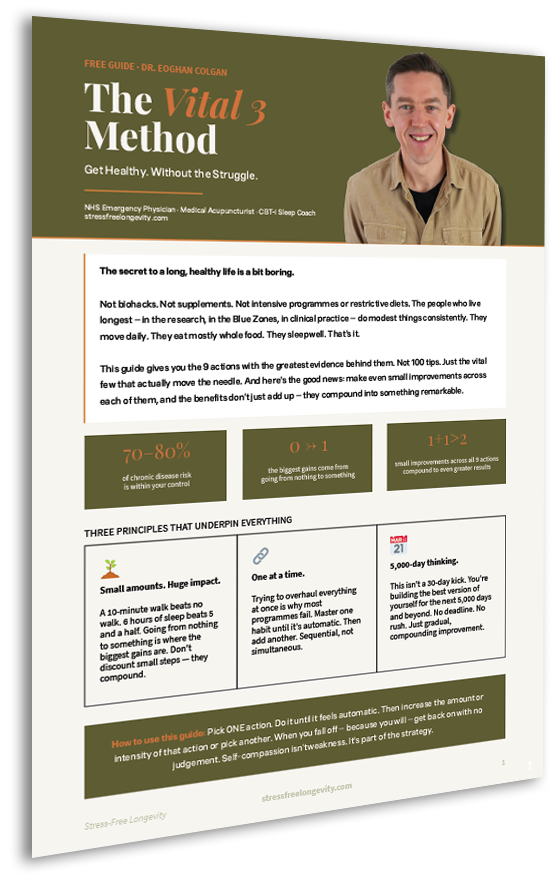
Get 'The Vital 3 Method' free guide — the system I use to build sustainable health habits across sleep, nutrition, and exercise.
The Dementia Link
The pills in Tier 4 work on two systems at once. They block histamine — that's what makes you drowsy. And they block acetylcholine — a chemical messenger your brain uses for memory, attention, and learning. That's what links them to dementia.
Three large studies tell a consistent story.
A US study published in 2015 followed over 3,400 adults for an average of seven years. People taking strong anticholinergic drugs nightly for three years or more had a 50% increased risk of developing dementia. A UK study in 2019 looked at nearly 60,000 people with dementia and 225,000 matched controls — and found the same dose-dependent pattern. A Cochrane review in 2021 pooled 25 studies and confirmed the signal.
The evidence is observational, not randomised — so causation isn't proven. But the dose-response is clear, the mechanism is plausible (anticholinergics do the opposite of what dementia drugs do), and the signal has held up across multiple cohorts.
What this means in practical terms: if you've been taking nightly Nytol or Benadryl for years, the risk is real but not definite. Many heavy users won't develop dementia. But do you want to take that risk? This is one of the more modifiable dementia risks we know about. You can stop taking them, and you probably should.
What About Supplements?
Many people searching for the safest sleep aid are really asking — is there something natural that works?
Magnesium has the most reasonable evidence. Modest improvements in sleep onset, particularly in older adults. Glycinate or citrate forms are gentler on the stomach than oxide.
Ashwagandha has the best evidence of any herbal sleep supplement. A meta-analysis of five trials found a meaningful effect on perceived sleep quality. Worth trying.
Valerian, L-theanine, glycine, chamomile, passionflower, tart cherry juice, CBD — the evidence is mostly weak. They're generally safe. The effects are small, and a fair amount of what you're paying for is probably placebo. None of them have very convincing benefit. But worth a try, and stick with whatever works for you.
For US readers: like I said previously, quality varies wildly between brands and even between batches. Stick to USP-verified products.

Why Pills Don’t Hold Up Over Time
Why do sleep specialists and major organisations all recommend pills for short-term use only? There are four key reasons.
Tolerance builds. Over time the effect weakens. With antihistamines, within three to four days. With Z-drugs, around four weeks. With benzodiazepines, two to four weeks. The pill that worked last month doesn't quite work as well this month.
The sleep itself gets worse. Most sedating drugs suppress the deep, restorative parts of sleep while making the experience feel like sleep. You're unconscious but not restored. You wake up tired, which makes the original problem worse.
The pill becomes the explanation. You start to believe you can't sleep without it. The skill of falling asleep on your own slowly gets unlearned.
And the underlying cause stays exactly where it was. Most people sleep badly for reasons pills don't address — a poor schedule, stress, too much alcohol or caffeine, a bedroom that doesn't suit sleep. The pill masks the real problem. The cause is still there in the morning.
What Actually Works Long-Term
So what actually works for sleep? There are many potential factors depending on the person, but here are three that will have the greatest impact for most people.
Sleep regularity is the strongest lever we have. It's widely considered the single most important factor by the world's leading sleep specialists. A UK study of nearly 61,000 adults found that the most regular sleepers had a 20–48% lower risk of dying from any cause over the next six years compared to the least regular. That's a stronger predictor than how long you sleep. In practice: keep your wake time consistent, within about 30 minutes, seven days a week. Bedtime can vary. Wake time should not.
Manage the stress that keeps your mind racing. The single biggest cause of "I can't sleep" in most adults isn't a deficiency in sleep chemistry — it's a mind that won't switch off. We tend to bring our daytime worries into bed with us. Useful things: a structured time during the day to address life's pressures (so they can be left in the daytime), putting the day to rest before bed, neatly separating the busy daytime from a calmer evening, and a wind-down of 30–60 minutes before sleep — engaging only in calming activities. No doom-scrolling. No late news.
CBT-I for chronic insomnia. If you've tried everything else and your insomnia has lasted three months or more, cognitive behavioural therapy for insomnia is the gold-standard treatment. It outperforms medication head-to-head, and the effects last after treatment ends. There are various options — books, apps, online courses. I will even guide you personally in my own CBT-i program.

When to See Your Doctor
A few patterns are worth getting checked.
Insomnia three or more nights a week for three months or more, with daytime impact. That's chronic insomnia, and CBT-I is the first-line treatment, not a pill.
Loud snoring, gasping, or waking unrefreshed despite enough time in bed. That could be sleep apnoea — common, undiagnosed, and worth ruling out before reaching for anything.
Insomnia alongside low mood, persistent anxiety, or loss of interest in things. Sleep is often the visible symptom of something underneath.
If you're already on a prescription sleep aid and want to stop, see your doctor first. Over-the-counter antihistamines you can stop tonight — expect three to seven nights of worse sleep, then it settles. But benzodiazepines, Z-drugs, and amitriptyline need a proper taper.
The Bottom Line
The safest pill, for an occasional bad night, is prolonged-release melatonin. The effect is modest. The profile is the cleanest of anything on the shelf.
The pills to stop, if you've been taking them long-term, are the sedating antihistamines — diphenhydramine (Nytol, Benadryl PM, ZzzQuil), doxylamine, promethazine, and low-dose amitriptyline. They carry the clearest signal for long-term brain harm. Check the label on anything marked "PM" while you're at it.
But the bigger point is the one most articles don't make: no pill on this list — not even the safest ones — can fix what's underneath a sleep problem. The pill helps you through a rough patch. It doesn't address the cause. For that, you need to look at the basics — your schedule, your stress, what's keeping you awake in the first place.
Ready to Build Health That Lasts?
The safest sleep aid is the one you don't need. Getting there starts with a few principles done well.
- The highest-impact actions across Sleep, Nutrition, and Exercise
- The Build Good Habits framework to make changes stick
- Start with one, build from there — no overhaul required
No spam. Unsubscribe anytime.
Frequently Asked Questions
Sources
- Gray SL et al. (2015). Cumulative Use of Strong Anticholinergics and Incident Dementia: A Prospective Cohort Study. JAMA Internal Medicine. PubMed
- Coupland CAC et al. (2019). Anticholinergic Drug Exposure and the Risk of Dementia. JAMA Internal Medicine. PubMed
- Trauer JM et al. (2015). Cognitive Behavioral Therapy for Chronic Insomnia: A Systematic Review and Meta-analysis. Annals of Internal Medicine. PubMed
- Windred DP et al. (2024). Sleep regularity is a stronger predictor of mortality risk than sleep duration. Sleep. PubMed
- Mignot E et al. (2022). Safety and efficacy of daridorexant in patients with insomnia disorder. Lancet Neurology. PubMed
Medical disclaimer
This content is for informational purposes only and is not intended as medical advice. Always consult your healthcare provider before making changes to your health routine. What works for one person may not work for another — this is a roadmap, not a prescription.
About Dr. Eoghan Colgan
Emergency medicine physician researching what actually works for longevity. I interview world-class experts in health and longevity and test everything personally. Everything I teach is what I'm implementing myself. More about me →

Related Articles

The Sitting-Rising Test: What Your Score Actually Means
The Sitting-Rising Test: What Your Score Actually Means Key Takeaways A score of 8 or […]

High Protein Foods for GLP-1: The Short List That Actually Works
High Protein Foods for GLP-1 (When You Can Barely Eat) Key Takeaways Aim for 25 […]
How to Sleep When Stressed: Why Trying Harder Fails
How to Sleep When Stressed: Why Trying Harder Fails Key Takeaways You can’t make yourself […]