
How Much Strength Training Do You Actually Need Per Week?

Key Takeaways
- Most of the benefit is banked early. Two short sessions a week — around 30 to 60 minutes total — captures the large majority of the longevity payoff. More helps a little. Far more adds almost nothing.
- Do your cardio too. In the largest study to date, aerobic exercise mattered even more than lifting — and the people who did both lived longest. Strength training is the other half, not a substitute.
- You don't need a gym or a punishing session. One hard set per movement, stopping a couple of reps short of your limit, with whatever equipment you'll actually use.
We all know exercise is good for us. The part that's far less clear is how much you actually need.
And that's the question that matters, because it's really about balance — enough to make a genuine difference, but not so much that it becomes impossible to sustain. Too little and you miss the benefit. Too much and you quietly give up in a few months. The sweet spot is somewhere in between.
Strength training is a good example. Its benefits have come to be much better understood over the last decade — it's no longer the poor relation of cardio. And just a few weeks ago, a large new study from Harvard gave us one of the clearest answers yet to the dose question.
So how much is enough? The answer is more reassuring than you'd think. Before we get to it, though, it's worth a quick reminder of why strength matters so much in the first place — because it explains why even a small amount goes a long way.
First, Why Strength Matters More Than You Think
We think of muscle as the thing that moves us around. It's far more than that. Here are some of the key health benefits of muscle.
It controls your blood sugar. Muscle is the biggest user of glucose in your body — it's the main place sugar goes after a meal. More muscle, used regularly, means more sugar pulled out of your bloodstream, so your blood sugar runs lower and steadier. That protects you from type 2 diabetes, and from the slow damage high blood sugar does to your arteries, nerves, and organs over time.
It acts like an organ. When muscle contracts, it releases signalling chemicals called myokines. These appear to lower inflammation across the body and help keep your brain and other organs healthy.
It's your reserve when you get ill. Muscle is your body's protein store. When you're seriously ill, injured, or recovering from surgery, your body strips amino acids out of your own muscle to fuel your immune system and repair tissue. In intensive care, patients can lose nearly 2% of their muscle a day. The more you've built, the bigger the reserve you draw on — and the better you tend to come through.
It keeps you off the floor. Strength, and the speed to use it, is what catches you when you trip. This isn't a small thing. In an older adult, a broken hip is genuinely dangerous — roughly one in five people don't survive the year after one. Staying strong is one of the most effective things you can do to avoid that path.
So strength training isn't really about how you look. It's steadying your blood sugar, lowering inflammation, building a reserve for illness, and protecting you from a fall that could change everything.
A quick word on grip strength. You may have heard that grip strength is one of the best predictors of how long you'll live. That's true — in one study of nearly 140,000 people, how hard you could squeeze predicted mortality better than your blood pressure did. But it's worth being clear about what that means. Grip strength isn't keeping you alive. It's a reflection of your whole-body strength — people who are strong all over tend to have a strong grip. Training your grip alone won't extend your life. Training your whole body might.
So, How Much Strength Training Per Week?
Now to the question. In June 2026, researchers at Harvard published a 30-year analysis of nearly 150,000 people. The headline finding was that around 90 to 120 minutes of strength training a week was associated with the lowest risk of dying — a 13% reduction compared with doing none, along with a 19% lower risk of dying from heart disease and a 27% lower risk from neurological conditions like Alzheimer's. Beyond 120 minutes, the benefit flattened out: more training didn't lower the risk further, though it didn't raise it either.
But the single number isn't the most useful part. The benefit doesn't build steadily the more you do. A little training a week already does something. Most of the payoff is in by around 30 to 60 minutes. After that it climbs only gently to the 90-to-120-minute mark, then flattens out for good.
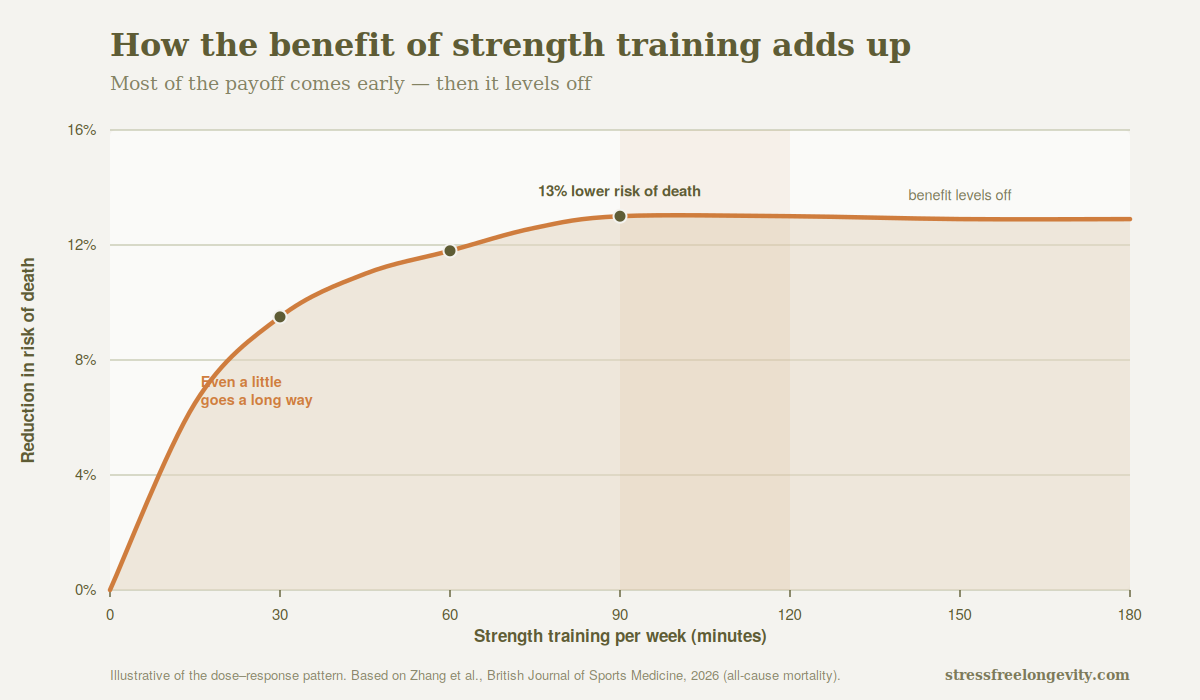
This is the curve we see across exercise and health generally. The steepest, most valuable part is right at the start — going from nothing to something. After that you keep gaining, but you work harder for less. The first thirty minutes a week does far more for you than the jump from ninety to a hundred and twenty.
So where does that leave you? If you do nothing right now, the single most valuable thing you can do is start — and you don't need to carve out two hours. Two sessions of 20 to 30 minutes captures most of what's on offer. If you already do more, keep going; you're earning a little extra, and there's no sign it's doing you harm. But you don't need to.
This is why the balance matters. The best amount of strength training is the amount you'll actually keep doing — and a manageable dose you sustain for years beats an ambitious one you abandon in a few months.
One thing worth adding, in that same Harvard study, aerobic exercise mattered even more than strength training, but the people who did both had the lowest risk of all. Lifting isn't a substitute for getting out of breath — it's a complement. If your cardio isn't sorted, that's at least as important, and I've written about how to start, with walking.
How to Make It That Small
If the optimal amount is well under two hours a week, and most of the benefit comes early, the obvious question is how to fit a meaningful dose into two short sessions. Two things make that possible:
You only need one hard set. A lot of people doing strength training do three or four sets of each exercise. For building maximum size once you're well trained, that extra volume helps. But for strength and health — especially when you're starting out, or older — a single hard set per movement gives you the large majority of the benefit. The first set is doing most of the work; the rest are topping it up. One good set per exercise, across the main muscle groups, is a genuinely effective dose.
And you don't need to train to failure. Some advocate pushing every set until you physically can't manage another rep — the muscle reaches its failure point. There's a logic to it, and for advanced lifters chasing every last bit of growth it has its place. But the evidence suggests it isn't necessary. Stopping two or three reps short builds almost exactly the same strength, with less fatigue, less strain on your joints, and a smaller spike in blood pressure during the set. For anyone older or newer to this, that's a good trade — pushing all the way to failure is where the strain and the injuries tend to happen, and it isn't buying you much.
So what you're aiming for is one set per movement, with a weight that feels genuinely hard somewhere around 8 to 12 reps — stopping with a couple still in reserve.
One safety point while we're here: breathe out as you lift, and don't hold your breath. Holding your breath under effort is what sends blood pressure spiking. Exhale on the hard part.
What Exercises to Actually Do
Your body doesn't know what kind of resistance you're using. It just needs the muscle to work against a meaningful load.
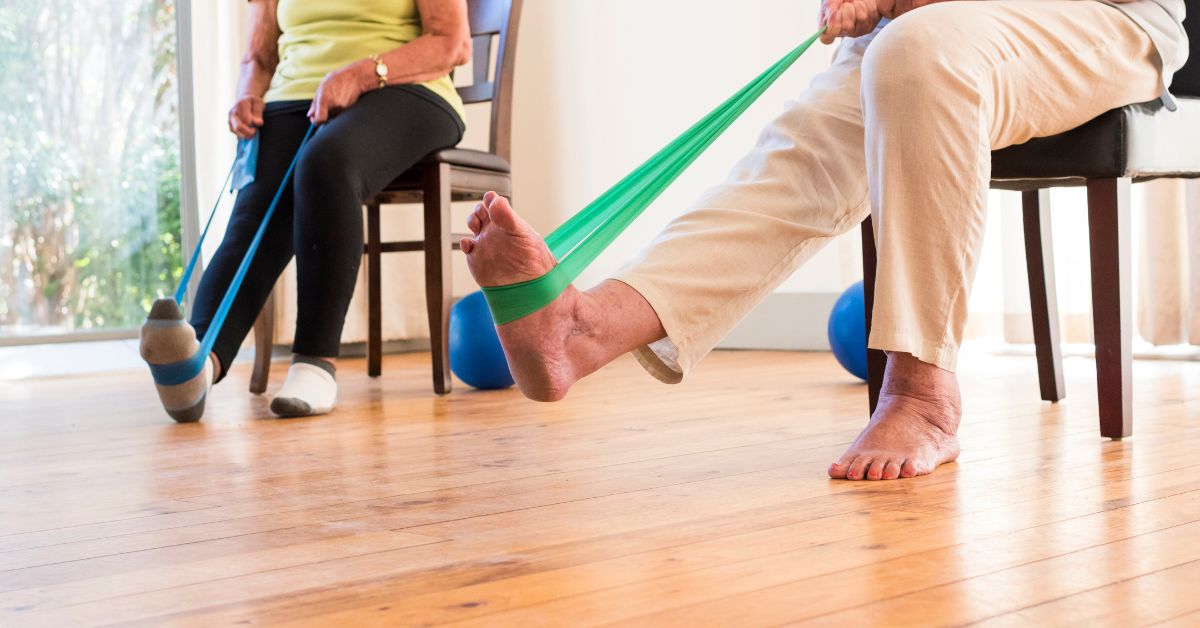
That load can come from anything — your own bodyweight, resistance bands, dumbbells, or machines at a gym. For someone starting out, these are essentially equivalent for building strength. Bands and machines are often easier and safer to learn on. But the best choice is simply the one you'll actually use. So no, you don't need a gym membership — you need a way to make your muscles work hard, and a bit of space.
From there, you want a handful of movements covering the main muscle groups — legs, back, chest, shoulders, arms, and core. One hard set of each, twice a week, and you're inside the window that delivers most of the benefit.
When you begin, start lighter than you think you need to. The first few weeks are about learning the movements and letting your muscles, tendons, and bones adapt to the loads. Then build the weight up gradually over the following weeks.
Be patient with what you see, because the timeline isn't what most people expect. For the first month or so, your strength climbs mainly because your nervous system is getting better at recruiting the muscle you already have. Visible changes in the muscle itself tend to show up from around six weeks.
For what it's worth, I do a short routine at home with a set of dumbbells, twice a week. Total time 34 minutes. No gym, no travelling, nothing that takes long enough to talk me out of it. I’ve seen dramatic improvements in my strength and muscle definition. And by keeping it short and easy is exactly what makes the habit stick.
One Tweak That Adds a Little More
Once you've got a routine going, there's a small adjustment worth knowing about.
Most strength training builds exactly that — strength, or how much you can lift. But there's a related quality called power: how fast you can produce force. Power is what fires when you catch yourself mid-stumble, and it tends to fade faster than raw strength as we age.
The change is simple. On some of your lifts, push the weight up quickly, then lower it slowly and under control. Same exercise, same time, one small adjustment. The evidence here is still developing, so treat it as a reasonable bonus rather than a rule — but it costs you nothing, and it may protect the very thing that keeps you steady on your feet.
I also cover this topic in a video on my YouTube channel - https://www.youtube.com/@stressfreelongevity
When to Check With Your Doctor
Strength training is safe for the large majority of people, including well into older age. But a few situations are worth a conversation first.
If you have a heart condition, uncontrolled high blood pressure, or any chronic condition that affects your heart or circulation, check with your doctor before starting — particularly before lifting anything heavy. The same applies if you've had a recent injury, surgery, or a joint problem that's still settling.
And if something feels wrong during training — chest pain, unusual breathlessness, dizziness, or pain that's sharp rather than the normal burn of effort — stop, and get it looked at. Normal training discomfort fades when you rest. Pain that doesn't is worth taking seriously.
None of this is a reason to avoid strength training. For most people it's one of the best things they can do as they age. It's just worth starting on the right footing.
The Bottom Line
How much strength training do you need per week? Less than you've probably been told.
Two short sessions. One hard set per movement, stopping a couple of reps short of failure, covering the main muscle groups. Around 30 to 60 minutes does most of the work, and you can build from there if you want to. Whatever equipment you'll actually use is the right equipment.
And do your cardio alongside it — the two together beat either one alone.
The amount that protects you is small enough to start this week and keep going for years. That's the part that matters. Not perfect. Consistent.
Ready to Build Habits That Actually Last?
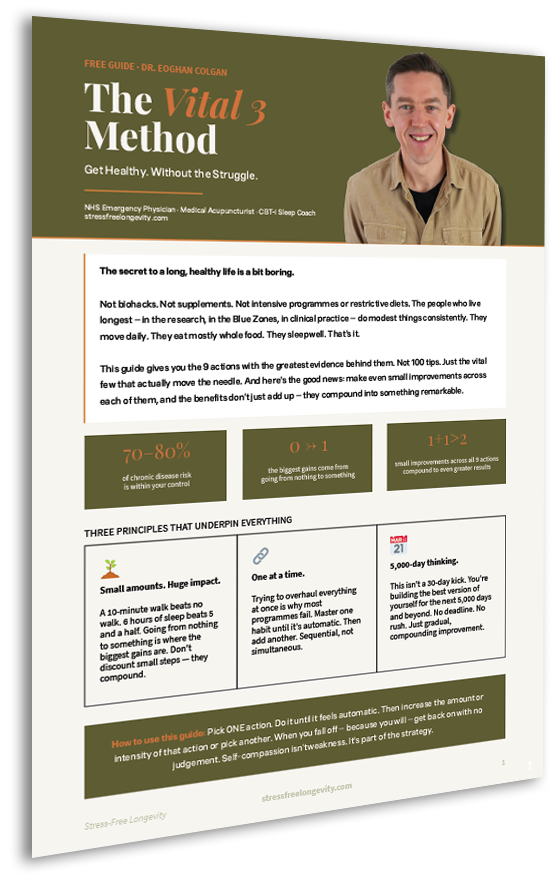
The best amount of strength training is the amount you'll keep doing. The same is true of everything that moves the needle on your health.
- The highest-impact actions across Sleep, Nutrition, and Exercise
- The Build Good Habits framework to make changes stick
- Start with one, build from there — no overhaul required
No spam. Unsubscribe anytime.
Frequently Asked Questions
Sources
- Zhang Y et al. (2026). Long-term resistance training with all-cause and cause-specific mortality: assessing dose-response and joint associations with aerobic physical activity. British Journal of Sports Medicine. PubMed
- Momma H et al. (2022). Muscle-strengthening activities are associated with lower risk and mortality in major non-communicable diseases: a systematic review and meta-analysis of cohort studies. British Journal of Sports Medicine. PubMed
- Leong DP et al. (2015). Prognostic value of grip strength: findings from the Prospective Urban Rural Epidemiology (PURE) study. The Lancet. PubMed
- Fazzini B et al. (2023). The rate and assessment of muscle wasting during critical illness: a systematic review and meta-analysis. Critical Care. PubMed
- Balachandran AT et al. (2022). Power Training for Improving Physical Function in Older Adults. JAMA Network Open. PubMed
Medical disclaimer
This content is for informational purposes only and is not intended as medical advice. Always consult your healthcare provider before making changes to your health routine. What works for one person may not work for another — this is a roadmap, not a prescription.
About Dr. Eoghan Colgan
Emergency medicine physician researching what actually works for longevity. I interview world-class experts in health and longevity and test everything personally. Everything I teach is what I'm implementing myself. More about me →

Related Articles

Creatine Side Effects: What’s Real and What Isn’t
Creatine Side Effects: What’s Real and What Isn’t Key Takeaways Creatine is one of the […]
Grip Strength Chart by Age: What Your Number Means
Grip Strength Chart by Age: What Your Number Means Key Takeaways Grip strength is used […]

The Sitting-Rising Test: What Your Score Actually Means
The Sitting-Rising Test: What Your Score Actually Means Key Takeaways A score of 8 or […]