
Does Losing Weight Increase Testosterone? What the Evidence Says

Key Takeaways
- Yes — and it's dose-dependent. The more fat you lose, the more your testosterone rises. Modest weight loss helps; large losses can raise it substantially.
- Your waistline matters more than your age. In one study of nearly 1,900 men, four inches on the waist raised the odds of low testosterone by 75% — a decade of ageing raised it by just 36%.
- For most heavier men, low testosterone is a reversible signal, not a permanent verdict. Lose the fat and your own production usually switches back on — which is something testosterone therapy can't do.
Low testosterone has long been treated as an inevitable part of getting older. But the research points somewhere else: for most middle-aged men, it's tied far more to weight gain than to age itself.
Fat in the wrong places switches off the signal that tells your body to make testosterone. And the good news is that losing that fat turns the signal back on — your levels can rise again on their own.
The short answer to the question, then, is yes. For the great majority of men carrying extra weight, losing it raises testosterone, and the more you lose, the more it climbs.
In this article I'll show you what's actually happening in the body, how much weight you need to lose to move the number, how long it takes, how to go about losing it, and why testosterone therapy often does more harm than good. Let's start with the question most men arrive with.
Does Losing Weight Increase Testosterone, or Is It Just Ageing?
It's the natural assumption. Testosterone does decline with age — by roughly 1 to 2% a year from your forties onward. That part is real.
But we've badly overstated how much of that is age — and badly underestimated how much is weight.
Consider one study of nearly 1,900 men. Adding four inches to the waistline raised the odds of low testosterone by 75%. Ten years of ageing raised those odds by just 36%. Your waistline matters a lot more than your age and the simplest measure is your waist-to-height ratio, which is a better guide to the fat that matters than the bathroom scales. I cover how to check yours in this article.
And when researchers in a long-running study of ageing men accounted for other health conditions — obesity, diabetes, heart disease — age on its own no longer predicted a meaningful decline in testosterone. It was the accumulating illness driving the drop, not the years themselves. A large European study reached the same conclusion: the decline men blame on age lives overwhelmingly in the conditions that pile up alongside it — especially excess weight.
So for most middle-aged men, low testosterone isn't a hormone quietly running out with age. It's a signal that something underneath needs attention — usually the fat around the middle. And that's a problem you can do something about.
Why Fat Lowers Your Testosterone
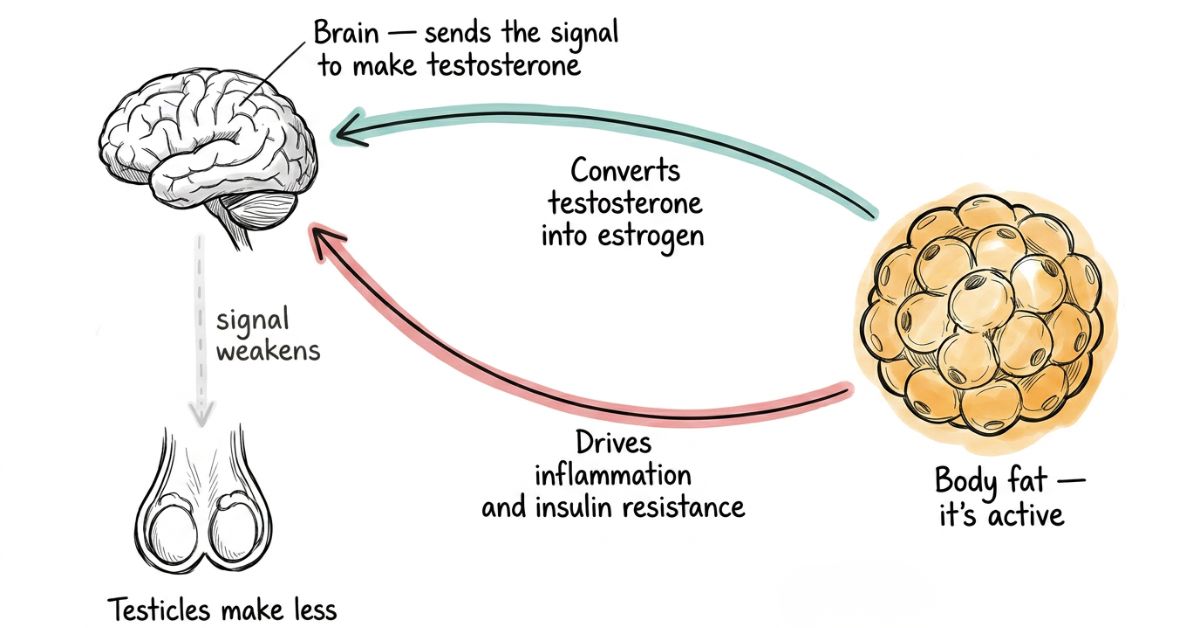
Fat tissue isn't just storage. It's biologically active — it behaves almost like an organ. And one of the things it produces is an enzyme called aromatase.
Aromatase has a specific job: it converts testosterone into oestrogen. The more fat you carry, the more aromatase you produce, and the more of your testosterone gets quietly converted into oestrogen.
Now here's the problem. Your brain monitors your hormone levels. When it detects that rising oestrogen, it reads the signal as "there must be plenty here" and dials down the message it sends to your testicles to produce testosterone. So you get hit twice — testosterone is being converted into something else, and less is being made in the first place.
And it gets worse. Low testosterone itself encourages your body to store more fat, particularly around the belly. More belly fat means more aromatase. More aromatase means less testosterone. Less testosterone means more belly fat.
That's the loop. Doctors call it the hypogonadal-obesity cycle, and it's self-reinforcing — each part feeds the next.
On top of that, excess fat drives insulin resistance and low-grade inflammation, and both of those also suppress the brain's signal to the testicles. So there are multiple pathways, all pointing the same direction — but the practical message is simple: the fat is driving the low testosterone.
And the good news is the loop runs in reverse. Lose the fat, and you produce less aromatase. Less aromatase means less testosterone converted to oestrogen. The brain stops getting the "plenty here" signal and switches your own production back on.
So How Much Weight Do You Need to Lose?
The relationship is proportional. For every kilogram of fat you lose, total testosterone rises by roughly 0.6%. There's no magic switch — it's a steady climb that tracks your fat loss.
Modest losses help. Losing 3 to 5% of your body weight reliably improves your metabolic health and can ease symptoms — a sensible first goal. The robust testosterone rise, the kind that shifts you out of the low range, generally kicks in beyond 10%, with the strongest effects around 15% and above. And at the far end, men who lose around a third of their body weight after bariatric surgery can raise their testosterone by roughly 250 ng/dL — for many, the difference between a low reading and a healthy one.
For a 220-pound man, 10% is 22 pounds. It's significant, but it's not extreme, and you don't have to get there overnight.

How to Actually Lose It
The key point is this: any sensible method works. It's the weight loss that raises testosterone, not the way you go about losing it. There's no special hormone-boosting diet — the one that works is the one you'll stick to.
That said, nutrition is the biggest lever by far. You can't out-train a poor diet — what you eat drives weight loss far more than exercise does, because it's far easier to avoid eating a few hundred calories than to burn them off afterward. Get the food right and most of the work is done.
A few changes do most of that work:
Cut the liquid sugar first. Sugary drinks, juices, and the calories you drink without noticing are the easiest win — they spike blood sugar, drive fat storage, and barely register as food. Removing them is often the single highest-impact change.
Eat in a Mediterranean-style pattern. Plenty of vegetables, protein, legumes, nuts, olive oil, and whole foods. It's one of the few eating patterns with strong long-term evidence behind it.
Get a little out of breath, regularly. Aerobic activity — brisk walking, cycling, swimming — burns fat and improves the insulin resistance that's suppressing your testosterone. Consistency beats intensity.
Hold onto your muscle. When you lose weight, some resistance training and adequate protein help ensure you're losing fat rather than muscle — which matters more as you age. You can read my article on maintaining muscle mass here.
A quick word on the weight-loss medications everyone's asking about. Early studies suggest GLP-1 drugs like semaglutide and tirzepatide raise testosterone too — in one analysis, the proportion of men with normal testosterone rose from 53% to 77% alongside about 10% weight loss. But the mechanism appears to be the same one we've covered: the drug drives the fat loss, and the fat loss switches your production back on. There may be a small additional direct effect, but that's unproven. They're simply another means to reach the same endpoint — losing the fat.
How Long Until It Works?
In a 52-week trial of overweight and obese men, testosterone began rising measurably within the first 12 weeks of weight loss. And it kept climbing — total testosterone rose further between week 12 and week 52 as the men continued losing fat.
So you'll likely see movement within about three months, and the rise continues as long as you keep the weight coming off.
One thing worth knowing: the gain holds as long as the weight does. Testosterone tracks your weight in both directions, so if the fat comes back, the testosterone tends to follow it down. This isn't a one-time reset — it's a benefit you maintain by keeping the weight off.
I also cover this topic in a video on my YouTube channel - https://www.youtube.com/@stressfreelongevity
What About Testosterone Therapy?
Could you just ignore the weight and take a supplement instead? That's what many men do — and it's exactly why it can do more harm than good.
The low number is a warning light telling you there's a problem with the engine. Top up the light without fixing the engine and the underlying problem carries on regardless.
We know from good studies that raising testosterone this way does nothing for long-term health — it doesn't lengthen life or lower the risk of dying. It's the underlying fat and insulin resistance harming your health, not the number on the lab report.
And in addition, it barely delivers on the reasons men take it in the first place. The best evidence shows it modestly improves sex drive and function, corrects some types of anaemia, and increases bone density. For mood and energy, the effect is small. For sharper thinking and focus, there's no clear benefit at all. A lot of what men report feeling is a small genuine effect amplified by expectation.
In heavier men it's even partly self-defeating — all that aromatase in your fat tissue converts a good chunk of the testosterone you take straight into oestrogen, feeding the very cycle you're trying to escape.
And there's an additional side effect of taking testosterone therapy: it shuts down your own supply. Your brain detects it, assumes there's enough, and stops signalling your testicles. The effect on fertility is dramatic — sperm counts drop to zero or near-zero in most men within months. For most it reverses when they stop, but recovery isn't guaranteed, and it's slower in men who've used it longer or who are older.
None of this means therapy is never appropriate — there are genuine cases where it's the right call. But for the typical man whose low testosterone is driven by his weight, losing the fat treats the actual cause, keeps fertility intact, and lifts mood, energy and drive — the very things therapy struggles to deliver. Plus it improves your health in dozens of other ways a hormone never could.
When Should You See a Doctor?
If you've got the symptoms of low testosterone — persistently low mood, poor focus, flagging drive, or sexual problems — don't self-diagnose and don't order a prescription online. Get it checked properly.
See your doctor and ask for a morning blood test, when testosterone is at its peak. A single low reading isn't enough to act on, so it's usually repeated on a second morning to confirm.
If it's genuinely low, your doctor will look for a specific cause before anything else — a pituitary problem, certain medications, or an issue with the testicles themselves. These are less common, but they need different treatment, so they should be ruled out.
For most middle-aged men, though, the cause won't be rare or mysterious. It'll be the metabolic one we've been discussing — the creeping waistline. And that points to where the real work lies.
The Bottom Line
For most men carrying extra weight, low testosterone isn't a hormone running out with age. It's a sign that something underneath needs attention — usually the fat around the middle.
Lose that weight and the number tends to follow. Not instantly, and not without keeping it off — but reliably, and in proportion to the fat you shed.
A low level is a warning worth taking seriously. But it's pointing at something you can fix — and fixing it does far more for you than topping up the number ever could.
Ready to Fix the Cause, Not Just the Number?
Your testosterone reflects your weight, your activity, and your metabolic health. Get those right and the number takes care of itself — no prescription required.
- The highest-impact actions across Sleep, Nutrition, and Exercise
- The Build Good Habits framework to make changes stick
- Start with one, build from there — no overhaul required
No spam. Unsubscribe anytime.
Frequently Asked Questions
Sources
- Pellitero S et al. (2024). Sex-differential testosterone response to long-term weight loss. International Journal of Obesity. PubMed
- Corona G et al. (2013). Body weight loss reverts obesity-associated hypogonadotropic hypogonadism: a systematic review and meta-analysis. European Journal of Endocrinology. PubMed
- Camacho EM et al. (2013). Age-associated changes in hypothalamic-pituitary-testicular function in middle-aged and older men (EMAS). European Journal of Endocrinology. PubMed
- Endocrine Society (2025). Anti-obesity medications can normalize testosterone levels in men (ENDO 2025). Endocrine Society
- Kelly DM & Jones TH (2015). Testosterone and obesity. Obesity Reviews (PMC). PubMed
Medical disclaimer
This content is for informational purposes only and is not intended as medical advice. Always consult your healthcare provider before making changes to your health routine. What works for one person may not work for another — this is a roadmap, not a prescription.
About Dr. Eoghan Colgan
Emergency medicine physician researching what actually works for longevity. I interview world-class experts in health and longevity and test everything personally. Everything I teach is what I'm implementing myself. More about me →

Related Articles

Creatine Side Effects: What’s Real and What Isn’t
Creatine Side Effects: What’s Real and What Isn’t Key Takeaways Creatine is one of the […]
Grip Strength Chart by Age: What Your Number Means
Grip Strength Chart by Age: What Your Number Means Key Takeaways Grip strength is used […]

The Sitting-Rising Test: What Your Score Actually Means
The Sitting-Rising Test: What Your Score Actually Means Key Takeaways A score of 8 or […]