
What Is a Good Waist-to-Height Ratio? (And How to Measure Yours)
Key Takeaways
- Keep your waist under half your height. A ratio over 0.5 suggests you may be carrying the kind of fat that drives heart disease and diabetes.
- Where you put the tape changes the number. Measure midway between your lowest rib and your hip bone, not at the navel.
- It tells you something BMI can't. You can have a normal weight, and a normal BMI, and still be carrying too much of the fat that matters.
Your bathroom scale is a useful tool. But it doesn't tell you the whole story.
There's a very simple test — one you can do at home in a minute — that predicts your risk of heart disease and diabetes more closely than your weight, and more closely than the BMI your doctor has used for decades. It's your waist-to-height ratio.
The rule is straightforward: your waist should be less than half your height.
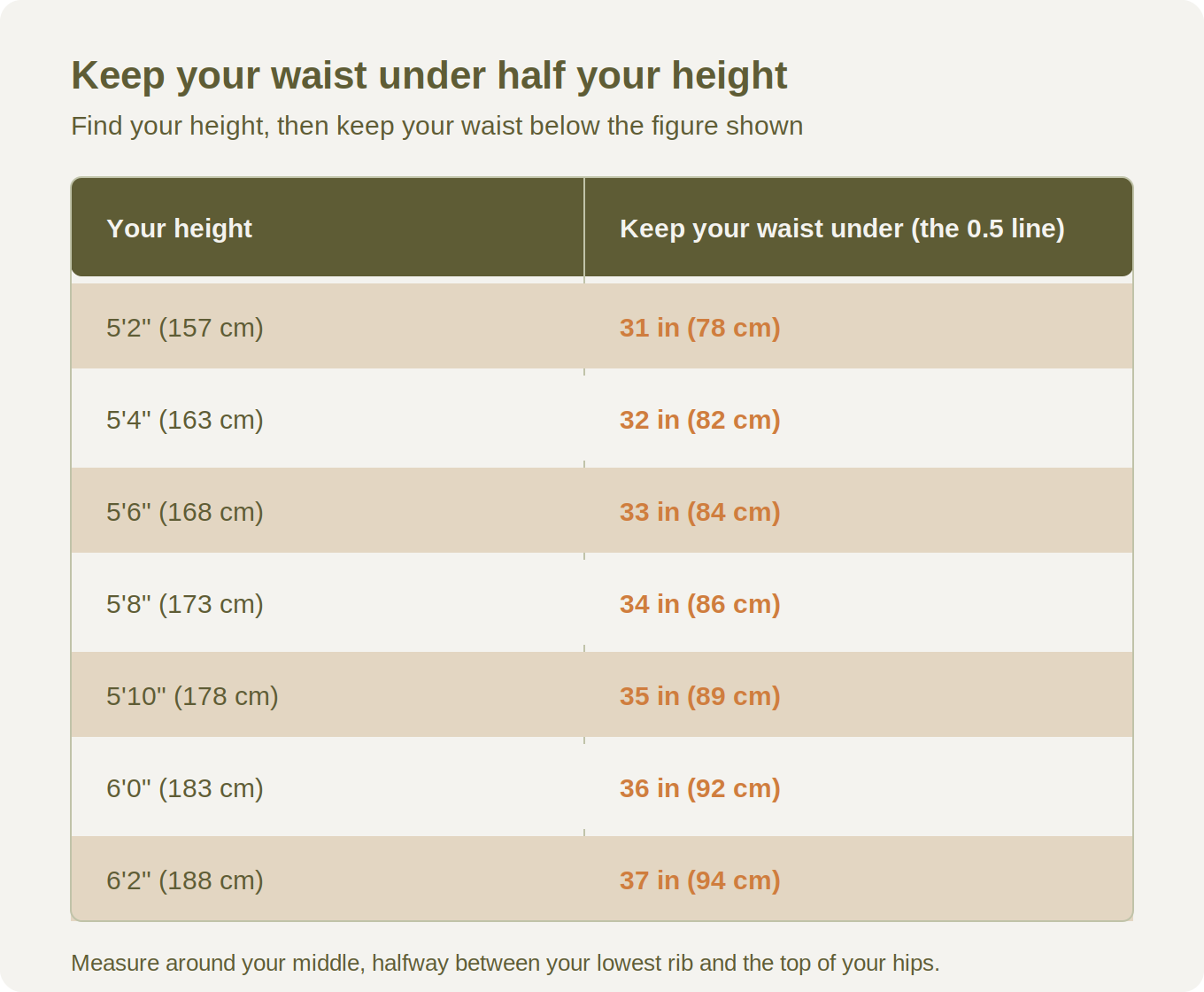
So if you're 5'10" — that's 70 inches — you're aiming to keep your waist under 35 inches. Half your height. Go much past that line and your body is likely storing fat in the places it does the most harm.
In this article I'll explain why this matters, how to measure yourself properly, what a healthy value is for your size, and what you can do to improve your ratio if it's too high.
Let's start with the fat itself.
Why Your Waist Tells You More Than Your Weight
Let's talk about fat — because fat, in itself, is a good thing.
It's how we store energy for when food is scarce. Our hunter-gatherer ancestors ate a little more when food was plentiful in summer, laid down some fat, and that fat carried them through the lean months of winter. It's a survival mechanism, and a brilliant one.
But our modern world is very different. The trouble now is, for most of us the lean months never come. Food is available all year round, and it's far richer in calories than it used to be. And we were never built with an off switch. So we keep storing fat for a winter that never arrives.
It starts where you can see it — the soft, pinchable fat around the belly, the hips, the bottom. That fat is largely harmless. But once those stores fill up, the body starts tucking fat into places it was never meant to go: deep in the abdomen, packed around the liver, the pancreas, the intestines.
This is visceral fat, and it's far more dangerous than the fat you can see. It isn't inert padding. It behaves like a busy, badly-behaved organ — it stokes inflammation, drives insulin resistance, and runs a private pipeline straight to your liver. This is the fat linked to type 2 diabetes, heart disease and fatty liver.
For most people, that's the order it happens in: you fill the visible stores first, then the dangerous internal ones. But not everyone follows that pattern. Some people can look slim and still be storing fat around their organs. I'll come back to who they are, and what they should do, later on — because it matters.
Here's the practical problem with visceral fat: it's hidden. You can't see it or pinch it, and it doesn't always show up on the scale. The best simple way we have to flag it is the size of your waist compared to your height. That captures the visible belly fat — and a larger belly is a strong hint that fat is building up internally too.
I've written about exactly how this hidden fat damages the body in my guide to cardiometabolic health. For now, let's measure yours.
How to Measure Your Waist Properly
The hard part of this isn't the maths. It's where you put the tape and you may come across different explanations.
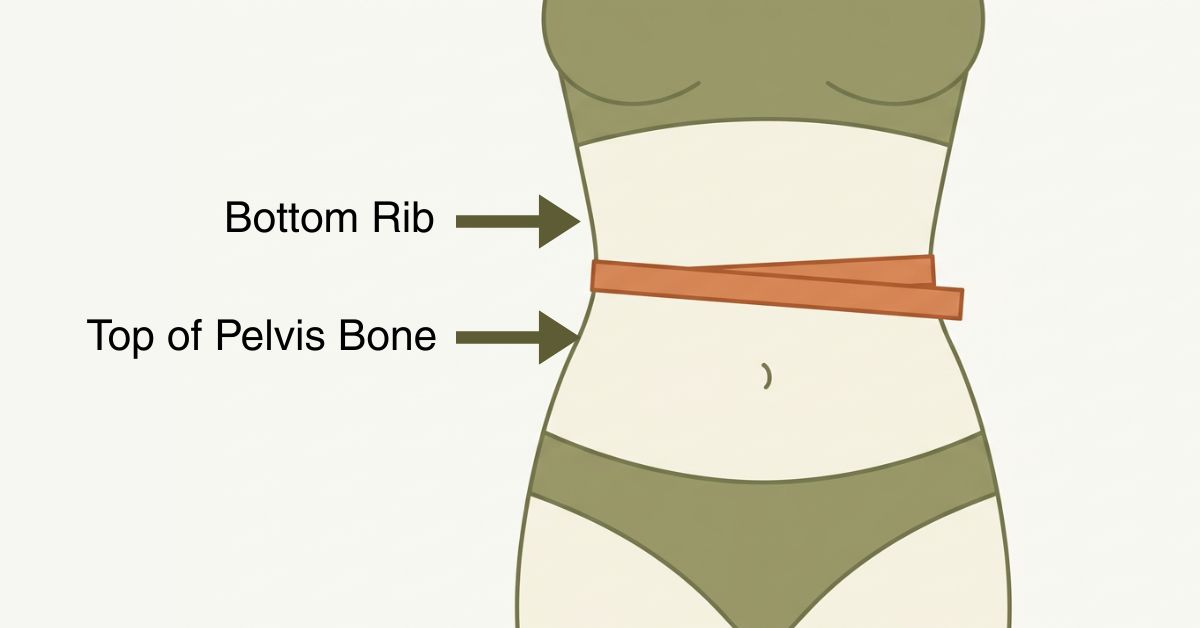
Most guides tell you to measure at your belly button. But this is not recommended by the leading medical experts. The navel moves around depending on your build and how much fat you carry, so it's an unreliable spot. The standard used by the World Health Organization, NICE and the International Diabetes Federation is this: measure at the midpoint between the bottom of your lowest rib and the top of your hip bone.
When researchers compared different measuring spots against CT scans, the readings varied by several centimetres depending on where the tape sat — enough, in some cases, to move someone from the healthy range into the high-risk one. So the exact spot matters.
Here's how to do it well:
- Find the bones, not the belly button. Feel for the bottom of your lowest rib and the top of your hip bone on your side. Your measuring point is halfway between them — often about an inch above the navel.
- Bare skin, or one thin layer. Not over a jumper.
- Stand relaxed, feet together, arms at your sides.
- Breathe out gently and measure at the end of that breath. Don't suck in. Don't puff out.
- Keep the tape horizontal and snug — flat against the skin all the way round, not digging in, not sagging.
- Measure twice. If the readings differ, take a third and average them.
Your waist changes slowly, so there's no need to measure daily. Once a month is plenty to see a trend — same time of day, same way, each time.
What Is a Good Waist-to-Height Ratio? (The Chart)
To work out your ratio, divide your waist by your height, using the same units for both. A 34-inch waist on a 68-inch frame is 34 ÷ 68 = 0.50. In centimetres, 86 ÷ 172 also comes to 0.50. The units don't matter, as long as both measurements use the same one.
Or, more simply: find your height in the chart below. The figure shown is your cut-off — you're aiming to be at or under it. This is the 0.5 line, the threshold NICE formally adopted in 2022.
The three bands are simple:
- 0.4 to 0.49 — healthy. No increased risk from central fat.
- 0.5 to 0.59 — increased risk. Time to take notice.
- 0.6 or above — high risk. Time to act.
Why This Beats BMI
BMI has one big flaw. It only knows your height and weight. It can't see where you carry fat. A lean person with a pot belly and a stocky, muscular rugby player can have the same BMI and completely different health risks. BMI can't tell them apart. Your waist can.
In October 2025, a study in The Lancet Regional Health – Americas followed 2,721 adults for just over five years. When the researchers accounted for everything else, waist-to-height ratio was the only body measurement that independently predicted calcium building up in the heart's arteries — an early, hard sign of heart disease. BMI didn't survive the analysis. Neither did waist size on its own. And the effect was strongest in people whose BMI was under 30 — the very people a doctor would usually reassure and send home.
There is one limitation worth being honest about. A tape measure can't separate visceral fat from the fat under your skin; it measures all your belly fat together. So your ratio isn't a precise reading of the dangerous fat. But it doesn't need to be. Over years of tracking real people, waist-to-height ratio still predicts disease and death better than BMI does. It's a screening tool, not a diagnosis — and a very good one, for the price of a tape measure.
I also cover this topic in a video on my YouTube channel - https://www.youtube.com/@stressfreelongevity
Does the 0.5 Rule Work for Everyone? Age and Sex
The simple rule has critics, and they make fair points. Here's where a bit of honest detail helps.
Does it apply at every age? For most adults under about 70, yes. It gets a little less reliable in older age, for two reasons. First, you can lose muscle as you age while your waist stays the same — so the number looks fine but you've lost some of the muscle that protects you. Second, people lose a little height as they get older, and since the ratio divides by height, a smaller height nudges the number up even when your fat hasn't changed. So past 70, treat 0.5 as a reason to have a chat with your doctor rather than a strict line. Through your 40s, 50s and 60s, it works well.
Does it differ for men and women? This is one of the rule's real strengths. Plain waist measurements need different cut-offs for men and women. The 0.5 ratio works for both, which is a big part of why NICE chose it. The chart above applies to everyone.
There's also a question of whether the rule slightly over-warns shorter people and under-warns taller ones. There's a little truth in it, but the effect is small for most people, and a simple rule everyone can remember beats a complicated one nobody uses.
So for the great majority of readers, the rule is sound. But there's one group it can genuinely miss — and if that's you, it's important to know.
What If You’re Slim but Still at Risk?
Most people fill their visible fat stores first, and only then start storing it internally. But some people don't follow that order. They store fat around their organs while still looking slim — sometimes with a perfectly normal waist and a perfectly normal BMI.
Doctors call this being "thin outside, fat inside," and it's more common than you'd think — affecting somewhere between roughly 1 in 10 and 1 in 5 adults, depending on how it's defined. For these people, the tape measure can give false reassurance. The waist looks fine. The risk is hidden inside.
A few groups are more prone to it:
- People of South Asian, Chinese and other Asian backgrounds. They tend to store fat internally, and to develop diabetes and heart disease, at lower body sizes than people of European descent — sometimes at a weight that looks completely healthy. If this is you, treat 0.5 as a firm ceiling rather than a target, and aim a little under it.
- Women after menopause, as the protective effect of oestrogen fades and fat shifts toward the middle and the organs.
- Anyone who has lost muscle with age while their weight has stayed the same.
So how would you know, if the tape can't tell you? You won't spot it with a measurement at home — but it tends to leave fingerprints elsewhere. Slightly raised blood sugar, raised blood pressure, an unhelpful cholesterol pattern, or a fatty liver picked up on a scan are all clues. If you're slim but you have a family history of type 2 diabetes or heart disease, or any of those markers have been flagged before, it's worth keeping an eye on the things that genuinely move the needle — which are the same things that help everyone else, and which we'll get to next.

What to Do If Your Number Is Too High
Here's the good news. For most people, visceral fat is the last fat to be added as they gain weight — and the first to go as they lose it. So as soon as you start losing weight, you're losing it from the places that matter most. You don't have to reach a distant goal weight before your risk starts to fall.
And the key is simply that: weight loss. There's no special trick, no fat that melts only with a particular food or workout. The fat comes off as the weight comes off, and you don't need a dramatic amount to make a difference. Losing just a few kilograms can start to clear fat from your liver. Keep going and the benefits build — by around 10% of your body weight, the effects are substantial, including, in many people with type 2 diabetes, pushing it into remission. You don't need to become slim. You just need to start, and let it add up.
A few things make that easier:
Move most days. Here's an encouraging detail: regular aerobic exercise shrinks visceral fat even when the scale barely moves. So you can be getting healthier in the place that matters while your weight looks unchanged. Brisk walking counts.
Cut the liquid sugar. Sugary drinks, fruit juice, and the sugar in your coffee reach your bloodstream faster than food and feed fat straight into your liver. Swapping them for water or tea is one of the easiest high-impact changes there is. Liver fat can improve with as little as 3 to 5% weight loss.
Eat a Mediterranean-style diet. Olive oil, fish, nuts, vegetables, whole grains, not much processed food. It has the best evidence of any eating pattern for clearing fat out of the liver.
None of this needs a gym, a fad, or a strict plan. Move most days. Drink your calories far less often. Eat mostly real food. The waist follows.
What I Actually Do
I measured my own waist-to-height ratio once, out of curiosity, a few years ago. I was 93.4 kg, with a BMI around 28, and my ratio was well over the line. I found the tape a bit fiddly, so I didn't keep it up. I decided my weight was an easier thing to track once a week — and I knew that as the weight came off, it would be coming off the dangerous places first.
I've since lost around 21% of my body weight. My smart scale tells me my visceral fat has dropped a long way. I've no idea how accurate that gadget is — these devices estimate rather than measure, and I take the number with a pinch of salt. But the direction is unmistakable, and the science is clear that a good chunk of what I've lost is the visceral fat that mattered most.
I re-measured my waist recently, a year into the change. My ratio is now 0.47 — comfortably back under the line.
The point isn't precision. If the tape feels like a faff, you're in good company. Track your weight, watch your waistband, or measure now and then — any of them beats doing nothing. What matters is the direction, and the most dangerous fat is the first to go.
The Bottom Line
Your weight tells you how much of you there is. Your waist, divided by your height, tells you something more useful — whether you're carrying fat in the place it does the most harm.
For most people, the rule is simple: keep your waist under half your height. Measure it the same way every few months, and watch the trend rather than any single number.
And if you're over the line, hold onto the most reassuring fact in all of this — the dangerous fat is the first to leave.
Ready to Build Health That Lasts?
Your waist reflects your sleep, your food and your movement. Get those three right and the number takes care of itself.
- The highest-impact actions across Sleep, Nutrition, and Exercise
- The Build Good Habits framework to make changes stick
- Start with one, build from there — no overhaul required
No spam. Unsubscribe anytime.
Frequently Asked Questions
Sources
- National Institute for Health and Care Excellence (2022). Obesity: identification, assessment and management — waist-to-height ratio classification. NICE
- Ashwell M et al. (2014). Waist-to-Height Ratio Is More Predictive of Years of Life Lost than Body Mass Index. PLOS ONE. PubMed
- Mendes TB et al. (2025). Waist-to-height ratio and coronary artery calcium incidence: the Brazilian Longitudinal Study of Adult Health (ELSA-Brasil). The Lancet Regional Health – Americas. DOI
- Verheggen RJHM et al. (2016). Effects of exercise training versus hypocaloric diet on body weight and visceral adipose tissue. Obesity Reviews. PubMed
- Gepner Y et al. (2018). Effect of Distinct Lifestyle Interventions on Mobilization of Fat Storage Pools (CENTRAL trial). Circulation. PubMed
Medical disclaimer
This content is for informational purposes only and is not intended as medical advice. Always consult your healthcare provider before making changes to your health routine. What works for one person may not work for another — this is a roadmap, not a prescription.
About Dr. Eoghan Colgan
Emergency medicine physician researching what actually works for longevity. I interview world-class experts in health and longevity and test everything personally. Everything I teach is what I'm implementing myself. More about me →

Related Articles

Creatine Side Effects: What’s Real and What Isn’t
Creatine Side Effects: What’s Real and What Isn’t Key Takeaways Creatine is one of the […]

Grip Strength Chart by Age: What Your Number Means
Grip Strength Chart by Age: What Your Number Means Key Takeaways Grip strength is used […]

The Sitting-Rising Test: What Your Score Actually Means
The Sitting-Rising Test: What Your Score Actually Means Key Takeaways A score of 8 or […]