
Sleep Schedule for Busy Professionals: The 1-Hour Rule

Key Takeaways
- The 1-hour rule: Keep your wake time within 1 hour every day — including weekends. This single habit matters more than how many hours you get.
- Anchor your wake time first. Work backwards for bedtime. Your body will naturally get tired at the right time each night.
- 70% of working adults have "social jetlag" — the weekday/weekend mismatch that quietly undermines health. The 1-hour rule fixes this automatically.
You're up at 6am Monday for an early call. Wednesday you work late and don't get to bed until 1am. Friday you're exhausted. Saturday you sleep until 9:30 — you've earned it. Sunday night you can't fall asleep because your body has no idea what time zone it's in.
You've read the advice. Dark room. No screens. Wind-down routine. But none of it sticks when your schedule is at the mercy of clients, deadlines, and time zones.
So what actually makes a difference?
I'm a medical doctor and CBT-i trained sleep coach. I've interviewed global sleep experts and circadian scientists to find out what genuinely matters. And the finding that changed everything for me: sleep regularity predicts mortality more strongly than sleep duration.
Getting 7-9 hours is still important. But consistency might matter even more.
And it comes down to one simple rule.
The 1-Hour Rule
Get up at the same time every day, including weekends.
That's the rule. Never deviate by more than an hour. So if you get up at 7am during the week, don't sleep beyond 8am on the weekends (even if you have a night out).
Why does this matter so much?
Your body runs on two systems that control sleep. The first is your circadian rhythm — your internal 24-hour clock. This clock doesn't just control when you feel sleepy. It coordinates your hormones, body temperature, digestion, metabolism, even your heart rate and blood pressure. When you wake at the same time each day, all these systems run in sync.
The second is your sleep drive. You accumulate sleepiness from the moment you wake, like slowly filling a tank. If you're an 8-hour sleeper, you need about 16 hours awake before that tank is full enough to sleep well.
A regular wake time syncs both systems. You feel tired at the same time each night. You fall asleep faster. You sleep more deeply.
As Professor Stafford Lightman, a neuroendocrinologist I interviewed, told me: "It's not just the length of time you sleep — if you sleep too little, obviously that's bad — but what's most important is the regularity of it. The time you go to bed and the time you wake up in the morning."
And the research backs this up. A large UK study of 60,000 people found that the most regular sleepers had 30% lower mortality than the most irregular sleepers. When researchers added sleep duration to their models, it didn't improve predictions. Regularity had already captured what mattered.
Here's how to make it work.
Start by choosing the earliest time you need to get up most days. If you're up at 6am for work a few days a week, make 6am your anchor — every day.
Then work backwards. If you're a 7-hour sleeper, that means an 11pm bedtime. If you need 8 hours, it's 10pm.
As Professor Russell Foster, one of the world's leading circadian scientists, told me: "Above all, it's defining what works for you and then sticking to that routine. And don't be pushed around by so-called sleep experts."
Want the complete framework?
Get "The Vital 3 Method" free guide — including how to anchor your rhythm even with a chaotic schedule, and how sleep synergises with nutrition and exercise.
Social Jetlag: Why Weekends Undo Your Progress
There's a name for what happens when you sleep in on weekends: social jetlag.
It affects about 70% of working adults. And if your wake time on the weekends is more than 2 hours different to your wake time during the week, your risk of metabolic syndrome doubles.
Here's the problem. You're an 8-hour sleeper. Which means you need about 16 hours of wakefulness to fill your sleep tank. If you wake at 6am, you'll be fully tired 16 hours later at 10pm. This would be the optimal time to try to sleep.
Now, you have a busy week, so you sleep in until 10am on Sunday morning. Your tank starts to fill and will be full 16 hours later — at 2am. But you try to go to sleep at 10pm, 4 hours before you're fully tired. The result: a broken night's sleep, and you feel worse for wear on Monday morning.
In fact, for most people, the worst night of sleep is Sunday. This is exactly why.
You've just given yourself jet lag. It's as if you've switched to a time zone 4 hours ahead, and you're fighting against your body's natural sleep rhythm.
The 1-hour rule solves this automatically. Keep your weekend wake time within an hour of your weekday time, and you skip the Monday morning jet lag entirely.

Quieting the work brain
Another common issue for busy professionals: carrying the day's stresses into the night.
You get into bed, and your brain starts running. Tomorrow's presentation. That email you forgot to send. The conversation you need to have with your manager.
Here's why this happens. We evolved on the African plains surrounded by threats. Sleep is when we're vulnerable, so we developed the ability to wake easily and stay alert if something felt wrong. We no longer need to worry about lions — but our brains treat modern stresses the same way. If you wake and think of something you need to do, your brain flags it as a threat. And sleep becomes difficult.
You can't force sleep. But you can empty your head before you try.
Three things that help:
1. Write tomorrow's list before you finish work. At the end of your working day, get everything out of your head and onto paper (or a digital list). Every task, every worry, every "I mustn't forget." You're telling your brain: it's stored, I'll deal with it tomorrow, I don't need to hold onto it now.
2. Create a buffer zone. Have a strict 1-2 hour barrier before bedtime when work is finished. No emails. No "just checking one thing." Getting a frustrating message just before bed is not ideal for sleep.
3. Keep paper by your bed. If you wake in the night and think of something you need to do — write it down. One line. Then let it go. It's stored. You won't forget it. You can deal with it in the morning.
As Professor Russell Foster told me: "Don't worry about waking up in the middle of the night. You'll almost certainly get back to sleep again if you remain calm."
You can't force yourself to sleep. But you can create the conditions that let sleep happen.

What about sleep trackers?
If you're the type who likes to measure and optimise, a sleep tracker probably seems like the obvious next step.
Be careful.
There's a clinical term for what happens when people obsess over their sleep data: orthosomnia. It's a real thing — recognised in the medical literature. And it affects about 3-5% of people who use sleep trackers.
Here's what happens. You get a tracker. You start monitoring your sleep scores. You notice your deep sleep was "low" last night. So you go to bed earlier. You try harder to relax. You lie there thinking about whether you're relaxing properly. Your sleep gets worse. Your scores drop. You try even harder.
You've created a problem you didn't have before.
As Dr. Allie Hare, a sleep physician I interviewed, told me: "I'm seeing more and more people in my clinics who have got themselves really tied up in knots around their sleep. They didn't have a sleep problem, but by trying to optimise their sleep, they've actually ended up worsening things for themselves."
The uncomfortable truth: trying to perfect your sleep can be the thing that breaks it. You cannot force yourself to sleep. You cannot engineer good sleep. Sleep is about abandoning wakefulness. Being so relaxed in your mind and body, that you give in to it.
If you find yourself lying awake worrying about your sleep score, ditch the tracker. Consistency matters more than metrics. The 1-hour rule doesn't need an app.
Making It Stick
Changing something like sleep can feel overwhelming. There are many opinions and many options. That's why I've focused on what matters most. Keep it simple.
Start with one thing: anchor your wake time. Same alarm, every day — including weekends — for the next two to three weeks. Don't touch anything else yet. Not your bedtime. Not your caffeine. Not your evening routine. Just the wake time.
Once that feels automatic — and it will, usually within two to three weeks — then add one more thing. Maybe it's the buffer zone. Maybe it's the bedside paper. One habit at a time, built until it's automatic, then add the next.
This is how I approach all habit change. The temptation is to overhaul everything at once. But that's stressful. And sleep does not like stress. Be patient. You may find things get slightly worse before they get better as you break old patterns — but the changes, once they take hold, tend to last.
The goal isn't perfect sleep. It's consistent, sustainable sleep that fits your actual life.
Want the complete framework?
The Vital 3 Method guide gives you all 9 principles across Sleep, Nutrition, and Exercise — plus AI prompts to build YOUR personalised anchor around your actual schedule.
The Bottom Line
You don't need perfect sleep. You need consistent sleep.
The 1-hour rule is your anchor. Keep your wake time regular every day — including weekends. That single habit does more for your long-term health than chasing 8 hours ever will.
And if worries keep you awake, get them out of your head and onto paper.
No gadgets. No supplements. No complicated protocols.
Do these things consistently — it doesn't have to be perfect.

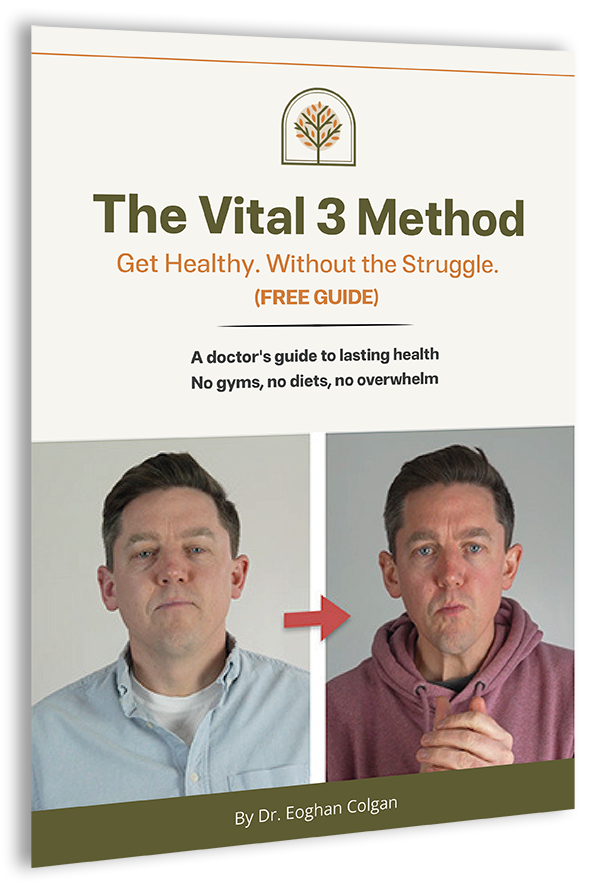
Ready to Transform Your Sleep?
Get the complete Vital 3 Method guide - FREE
You've just learned the 1-hour rule — the evidence-based approach to sleep scheduling that works for busy lives.
What's inside:
- The 3 sleep principles that matter most — regularity is just the start
- How to extend this to nutrition and exercise for compounding benefits
- AI prompts to build YOUR anchor around your actual constraints
No spam. Unsubscribe anytime.
Frequently Asked Questions
Sources
- Windred DP et al. "Sleep regularity is a stronger predictor of mortality risk than sleep duration: A prospective cohort study." Sleep. 2024.
- Cribb L et al. "Sleep regularity and mortality: a prospective analysis in the UK Biobank." eLife. 2023.
- National Sleep Foundation. "The importance of sleep regularity: a consensus statement of the National Sleep Foundation sleep timing and variability panel." Sleep Health. 2023.
- Baron KG et al. "Orthosomnia: Are Some Patients Taking the Quantified Self Too Far?" Journal of Clinical Sleep Medicine. 2017.
- Centers for Disease Control and Prevention. "About Sleep."
Medical disclaimer
This content is for informational purposes only and is not medical advice. Consult your healthcare provider before making health changes. This is one evidence-based approach — find what works for you.
About Dr. Eoghan Colgan
Emergency medicine physician researching what actually works for longevity. I interview world-class experts in health and longevity and test everything personally. Everything I teach is what I'm implementing myself. More about me →

Related Articles

The Sitting-Rising Test: What Your Score Actually Means
The Sitting-Rising Test: What Your Score Actually Means Key Takeaways A score of 8 or […]

High Protein Foods for GLP-1: The Short List That Actually Works
High Protein Foods for GLP-1 (When You Can Barely Eat) Key Takeaways Aim for 25 […]
How to Sleep When Stressed: Why Trying Harder Fails
How to Sleep When Stressed: Why Trying Harder Fails Key Takeaways You can’t make yourself […]