
Healthspan vs Lifespan: Why Living Longer Means Nothing Without Living Better

Key Takeaways
- Lifespan is how long you live; healthspan is how long you live well — free from disease, disability, and decline
- The average person spends 9-12 years at the end of life in poor health — but this isn't inevitable
- Five simple lifestyle factors can add 12-14 healthy years to your life (Harvard study, n=123,219)
- Muscle strength is the #1 predictor of both how long you live AND how well you live
- It's never too late: adding healthy behaviours at 40, 50, or even 60 still delivers meaningful gains
Imagine two people who both live to 85.
The first spends their final 15 years gradually losing independence. First the stairs become difficult. Then getting out of a chair requires help. Then the world shrinks to a single room. They're alive, but they're not really living.
The second is active into their early 80s. They travel, play with grandchildren, walk daily, live on their own terms. When decline comes, it's measured in months, not decades.
Same lifespan. Completely different healthspans.
Here's what I've learned from interviewing world-experts in health and longevity: we've been measuring the wrong thing. Modern medicine obsesses over lifespan — keeping people alive. But the question that actually matters is: alive and doing what?
The United States has the world's largest gap between lifespan and healthspan — 12.4 years spent, on average, in poor health. That's not a statistic. That's your mum needing help to shower. Your dad unable to attend your daughter's wedding. A decade of life that doesn't feel like living.
But here's the thing. This gap isn't fixed. The research shows you can compress that period of decline dramatically. Not with extreme protocols or expensive interventions. With a small number of evidence-based practices sustained over time.
And this isn't about perfecting one area of health. True longevity comes from doing a few high-impact things across ALL pillars — sleep, nutrition, and exercise working together. That synergy is where the real gains happen.
The quick answer: Lifespan measures quantity (years alive); healthspan measures quality (years in good health). The goal isn't to live longer — it's to compress illness into the shortest possible period at the end of life. Research shows lifestyle factors can extend healthspan by a decade or more. And it's never too late to start.
What’s the Difference Between Healthspan and Lifespan?
The distinction is simple.
Lifespan is how many years you're alive. The number on your death certificate.
Healthspan is how many of those years you spend in good health — free from chronic disease, disability, and cognitive decline. The years where you can do what you want to do, live independently, and actually enjoy your life.
Lifespan is quantity. Healthspan is quality.
Professor Niels Vollaard, who studies exercise science at the University of Stirling, put it to me bluntly: "Yes, you might become 90 years old, but if 20 of those years at the end are spent lying in bed, then what's the point? Being physically active will mean that you are more likely to spend those 20 years enjoying life."
Professor Leigh Breen, who researches muscle physiology at the University of Birmingham, introduced me to the concept of the "disability threshold" — the point where you can no longer function independently.
As he explained: "Once we lose the ability to rise independently from a chair or to climb the stairs, that really is very closely linked with poor quality of life and loss of independence and a reliance on external care provision."
Think about that. The ability to stand up from a chair without help. To climb a flight of stairs. These aren't fitness goals. They're the baseline for independent living.
This is 5000-Day Thinking in action. You're not training for a marathon or trying to look good at the beach. You're building capacity for the 5000+ days between now and your 70s, 80s, and beyond.
Every choice you make today will impact the quality of your life as you age.
Want the complete framework?
Get The Vital 3 Method guide free — the evidence-based system for sustainable health after 40.
How Big Is the Gap Between Healthspan and Lifespan?
The numbers are sobering. But understanding them is the first step to changing them.
A 2024 study looked at 183 countries. The average person spends 9.6 years at the end of life in poor health. And that gap is growing — up 13% since 2000.
The United States has the world's largest healthspan-lifespan gap at 12.4 years — 29% higher than the global average. The UK isn't far behind at 11.3 years. And healthy life expectancy in England has actually fallen by nearly two years since the pandemic.
Here's what these numbers mean in real terms. A decade of daily medication. Years of doctor's appointments. Gradually losing the ability to drive, to cook, to live in your own home.
But remember — this is an average. Some people spend 20 years in decline. Others compress that period into months.
Decline will happen. The question is how much of your life it takes.

What Actually Predicts How Long You’ll Live Well?
But here's the good news.
A landmark Harvard study followed 123,219 people for up to 34 years, tracking five lifestyle factors: never smoking, maintaining a healthy weight, exercising 30+ minutes daily, moderate alcohol intake, and eating a healthy diet.
The results? Women who followed all five habits at age 50 could expect to live 14 additional years free of diabetes, cardiovascular disease, and cancer compared to women who followed none. For men, the difference was 12 years.
That's 12-14 extra years of healthy life. Not from cutting-edge medicine or expensive treatments — from five straightforward behaviours anyone can adopt.
But here's what the research shows most clearly. Of all these factors, one stands out.
Professor Keith Baar studies molecular exercise physiology at UC Davis. When I asked him what predicts longevity, his answer surprised me: "The number one predictor of your length of life, not even just your quality of life, but your length of life for people is your muscle mass and your strength relative to your size. So we know that if we're stronger, we live longer."
Not cardio. Not flexibility. Not VO2 max. Strength.
The data backs this up. As Keith told me: "If you are in the strongest third of the population, you are half as likely to die between 40 and 60 as somebody who's in the weakest third of the population."
And it's not just about dying. Keith shared something that reframes how we should think about strength: "Fully 30% of the people who die from cancer actually are dying from the muscle weakness that's associated with the cancer... If you're not strong enough to survive those treatments, because even though they are effective, many of them are very, very hard on the rest of our body, if you don't have the strength when you start those treatments, you're not going to come out the other side."
This isn't about aesthetics. It's about resilience. The capacity to survive what life throws at you.
Can You Actually Compress Illness Into a Shorter Period?
This idea — that you can push illness and disability closer to the end of life rather than spreading it across your final decades — was first proposed by physician James Fries in 1980. He called it the "compression of morbidity."
For years, it was just a hypothesis. Now we have decades of data confirming it works.
The Stanford Runners Study followed 538 runners over 50 and compared them to 423 non-runners for 22 years. The runners developed disability at one-quarter the rate of sedentary people. More importantly, they postponed disability by more than 12 years.
Same lifespan. Compressed illness. Exactly what Fries predicted.
Professor Leigh Breen explained why maintaining muscle matters so much: "When muscle mass levels are so low that they can't rise from a chair, they can't function independently — that's the disability threshold... the amount of muscle you lose could be really, really important."
The message is clear. You can't prevent decline entirely. But you can delay when it starts and shorten how long it lasts.
This isn't just theory for me. When I started doing these things — prioritising strength training, getting my sleep consistent, focusing on the fundamentals rather than chasing biohacks — I lost 14kg, gained 3% skeletal muscle mass, and reversed my metabolic age.
No extreme protocols. No living at the gym. No restrictive diets. Just consistent effort on the vital few.
That's it.
Is It Ever Too Late to Improve Your Healthspan?
One of the most common things I hear is: "I've left it too late. The damage is done."
The research says otherwise.
Professor Jason Gill, who studies cardiometabolic health at the University of Glasgow, shared something that genuinely surprised me: "I've done nothing till I'm 40, and I pick it up when I'm 40, and I'm the same as someone that's been active their whole life? That's what the evidence suggests, or even 50 or whatever age."
Read that again. Starting at 40 — or 50, or 60 — can get you to the same place as lifelong exercisers.
Jason emphasised this: "It's like you don't have to look back with regret. Just start whatever age you are now, start, and there are benefits to be gained."
Data from the American Heart Association supports this. Their research on "Life's Essential 8" lifestyle factors shows that each healthy behaviour you add delivers meaningful gains — and the benefits compound. People who adopt all eight factors show dramatically better outcomes than those who adopt none.
This is what I call the "Game of Percentages." The biggest gains don't come from going from good to perfect — from running 50km a week to 60km, or from eating well to eating perfectly. They come from going from nothing to something.
- From sedentary to moving daily
- From processed food to mostly real food
- From chaotic sleep to consistent sleep
Professor Vollaard captured the mindset perfectly: "Do it for your future self. Make sure that when you're 70, you're still healthy."
Start now.
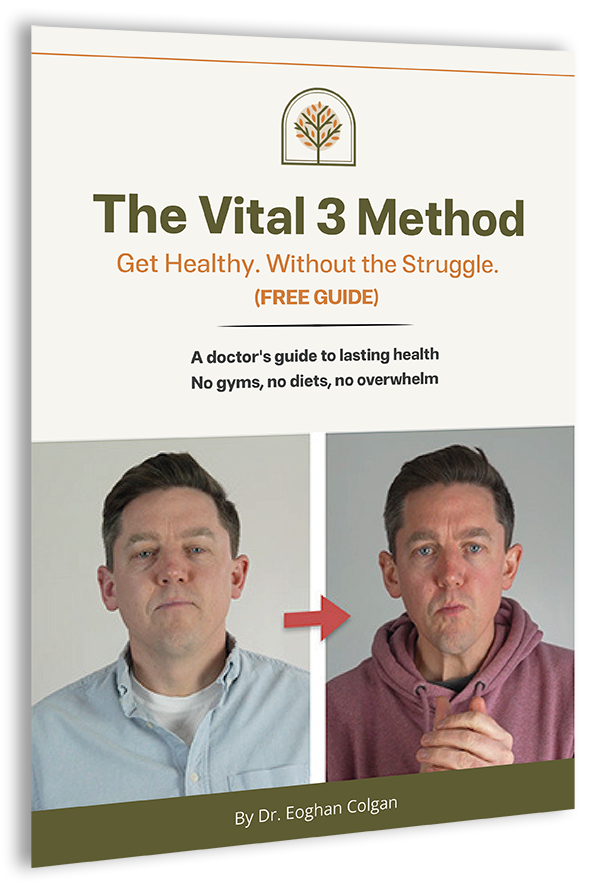
Want the Complete Framework?
A doctor's guide to healthy living and making it stick
What's inside
- Why most health advice fails — and what actually works
- The Vital 3 actions for sleep, nutrition, and exercise (the 20% that delivers 80% of health benefits)
- The Build Good Habits framework — make it enjoyable, easy, and automatic
- How to implement one habit at a time until it sticks
No spam. Unsubscribe anytime.
What Are the Most Important Things You Can Do?
After reviewing the research and interviewing dozens of experts, I've distilled this down to three interconnected pillars. Not 100 biohacks. Not expensive interventions. Three areas that, when you work on them together, create compounding benefits.
Exercise: The Non-Negotiable Foundation
Combined aerobic and resistance training delivers a 40% reduction in all-cause mortality. That's the largest effect of any single intervention we know of.
- Strength training: 30-60 minutes per week is the sweet spot. Professor Leigh Breen was direct: "The squat in all its forms is essential for longevity and healthy aging."
- Daily movement: For those over 60, 6,000-8,000 steps daily delivers maximum benefit. Under 60, aim for 8,000-10,000.
- Cardio: Even 15 minutes of moderate activity daily adds approximately 3 years of life expectancy. Brisk walking counts.
Sleep: The Underrated Multiplier
Sleep regularity predicts mortality more powerfully than sleep duration. The most regular sleepers have up to 48% lower mortality risk — going to bed and waking at roughly the same time matters more than hitting a perfect eight hours.
Poor sleep undermines everything else. It impairs glucose regulation, increases inflammation, and accelerates muscle loss. You can't out-exercise or out-eat bad sleep.
Professor Joann Manson from Harvard Medical School summarised it simply: "For someone who is seeking a healthy life, the lowest risk possible of chronic diseases — the focus really should be on healthy diet and healthy lifestyle."
The specifics matter less than the fundamentals:
- More fibre — feeds beneficial gut bacteria, improves metabolic health
- Adequate protein — particularly important after 40 for preserving muscle mass
- Fewer ultra-processed foods — the single biggest improvement most people can make
- Minimise excess calories — start by removing liquid calories (fizzy drinks, fruits juices, frappucinos)
Explore my nutrition content →
Why Synergy Matters
Most health advice misses this. These pillars don't work in isolation. Exercise improves sleep quality. Better sleep improves food choices and reduces cravings. Better nutrition supports exercise recovery and muscle building. Each reinforces the others.
This is why I don't teach perfection in one area. True longevity comes from being good enough across all three pillars — and letting them compound together.

What Should You Prioritise at Different Ages?
One question the research helps answer: does it matter how old you are when you start?
The short answer: no. At any age, the fundamentals remain the same — sleep, nutrition, and exercise working together. The synergy across all three pillars is what delivers results, not perfecting one area while neglecting others.
That said, there are some nuances worth considering as you move through life:
In your 40s: This is prime time for building the foundation. Strength training becomes increasingly important — the muscle you build now is easier to maintain than rebuilding later. But don't neglect sleep consistency or nutrition quality. All three matter equally.
In your 50s: Protein becomes increasingly important — your body becomes less efficient at using it, so you need more. Balance becomes a trainable skill worth developing. Keep all three pillars in focus; this is the decade to establish patterns you'll maintain for life.
In your 60s and beyond: The game shifts slightly toward maintenance and injury prevention. Keep strength training but focus on compound movements you can sustain safely. Social connection matters increasingly for cognitive health — isolation is a genuine risk factor. Sleep, nutrition, and movement still work together as a system.
The common thread: whatever your age, balance across all three pillars beats obsessing over one. And starting today beats waiting until tomorrow.
What’s Happening in Longevity Science Right Now?
If lifestyle delivers 80% of the benefit, why pay attention to longevity research? Because the science validates why these fundamentals work — and hints at what's coming next.
In 2024, researchers published a breakthrough in Nature showing that blocking a protein called IL-11 extended mouse lifespan by 25% while improving muscle function, metabolism, and frailty markers. Human trials are already underway.
The $101 million XPRIZE Healthspan Competition — the largest health prize in history — is pushing teams worldwide to develop interventions that can reverse muscle, cognitive, and immune function by 10-20 years.
Biological age testing is becoming more sophisticated, with epigenetic clocks that measure how fast you're actually ageing versus your calendar age.
But here's what I keep coming back to. Even the scientists leading this research emphasise that lifestyle interventions remain the most powerful tools we have today. The future treatments may extend our lives further — but the foundation is still the same fundamentals humans have known for generations.
How Do You Know If You’re Ageing Well?
You don't need expensive tests to assess your trajectory. Some of the most predictive measures are simple functional tests you can do at home:
Chair rise test: Can you stand up from a chair five times without using your arms? Time yourself — under 12 seconds is good for most adults over 60.
Grip strength: A simple hand dynamometer (around £20-30) measures one of the strongest predictors of overall health. It ties directly to what Keith Baar told me about strength being the #1 predictor of longevity.
Single-leg balance: Can you stand on one leg for 10 seconds with your eyes open? Balance is a trainable skill that predicts fall risk and functional capacity as we age.
Walking pace: People who naturally walk faster than 0.8 metres per second have consistently better outcomes across multiple studies.
For those wanting more data, key blood markers to discuss with your doctor include fasting insulin, hs-CRP (inflammation), and triglycerides. These respond to lifestyle changes and track your metabolic health over time.
The point isn't to obsess over numbers. It's to establish a baseline and watch trends. Are you getting stronger or weaker? More stable or less? Moving better or worse?

A Roadmap, Not a Prescription
I want to be clear about something. What I've shared here is one evidence-based approach that prioritises sustainability and cross-pillar synergy. It's the approach I use myself, and it's worked — but it's not the only path.
Some people thrive on intensity. Some medical conditions require more aggressive interventions. Some situations need professional guidance beyond what any article can provide.
The key is finding what YOU'LL actually sustain. Because here's the fundamental truth:
The most important choices are the ones you'll stick to for the rest of your life.
Not the perfect protocol you follow for six weeks and abandon. Not the extreme intervention that burns you out. The sustainable practices you'll still be doing in 5, 10, 20 years.
That's the long view. That's how you close the gap between lifespan and healthspan.
Ready to transform your health?
Get the complete Vital 3 Method guide - FREE
It's not about living longer, it's about living well for longer.
The research is clear. Lifestyle is all that matters. And it's never too late to start.
What's inside:
- The actions you need to take to close YOUR healthspan gap
- Built for busy lives — no gyms, no diets, no overwhelm
- The exact approach that helped me lose 14kg and reverse my metabolic age in 5 months
No spam. Unsubscribe anytime.
Frequently Asked Questions
Sources
- Garmany A, Terzic A. Global Healthspan-Lifespan Gaps Among 183 WHO Member States. JAMA Network Open. 2024;7(12):e2450241
- Li Y, et al. Impact of Healthy Lifestyle Factors on Life Expectancies in the US Population. Circulation. 2018;138(4):345-355
- Li Y, et al. Healthy lifestyle and life expectancy free of major chronic diseases. BMJ. 2020;368:l6669
- Chakravarty EF, et al. Reduced Disability and Mortality Among Aging Runners. Archives of Internal Medicine. 2008;168(15):1638-1646
- Vita AJ, et al. Aging, Health Risks, and Cumulative Disability. NEJM. 1998;338(15):1035-1041
- Widjaja AA, et al. Inhibition of IL-11 signalling extends mammalian healthspan and lifespan. Nature. 2024
- UK Office for National Statistics. Health State Life Expectancies, UK. December 2024
- Expert interviews conducted by Dr. Eoghan Colgan with Keith Baar, Leigh Breen, Niels Vollaard, Jason Gill, Joann Manson, and Colin Hill
Medical disclaimer
This content is for informational purposes only and is not medical advice. Consult your healthcare provider before making health changes. What works for one person may not work for another — this is a roadmap, not a prescription.
About Dr. Eoghan Colgan
Emergency medicine physician researching what actually works for longevity. I interview world-class experts in health and longevity and test everything personally. Everything I teach is what I'm implementing myself. More about me →

Related Articles

The Sitting-Rising Test: What Your Score Actually Means
The Sitting-Rising Test: What Your Score Actually Means Key Takeaways A score of 8 or […]

High Protein Foods for GLP-1: The Short List That Actually Works
High Protein Foods for GLP-1 (When You Can Barely Eat) Key Takeaways Aim for 25 […]
How to Sleep When Stressed: Why Trying Harder Fails
How to Sleep When Stressed: Why Trying Harder Fails Key Takeaways You can’t make yourself […]