
Healthy Aging Tips: What the Evidence Shows and How to Start
Key Takeaways
- What you believe about ageing affects how long you live — by up to 7.5 years. More than exercise. More than blood pressure.
- Frailty isn't inevitable. It's mostly the result of decades of inactivity, poor nutrition, and poor sleep — not necessarily ageing itself.
- You don't need to overhaul your life. Pick one thing, make it automatic, then add the next.
There's a version of getting older that most people quietly dread.
Slowing down. Losing strength. Needing help with things you used to do easily. Watching independence shrink, year by year, until frailty feels inevitable.
And there's a whole industry built around that fear. Supplements that promise to reverse ageing. Extreme protocols that cost a fortune. Alarming headlines designed to make you feel like you're running out of time. A relentless stream of biohacks, most with thin or no science behind them.
The result is a lot of noise — and the things that actually make a difference get drowned out.
I'm an NHS emergency medicine doctor. I've also spent the last few years systematically interviewing over 50 of the world's leading researchers in health and longevity — sleep scientists, exercise physiologists, nutritionists, behavioural scientists. I see the consequences of how people age every single shift.
What the evidence actually shows is more encouraging than most people expect. And simpler than most of what's being sold.
These are the healthy aging tips that made a real difference — to the research, and to how I live.
What you believe about ageing affects how you age
Before food or exercise, there's something more fundamental worth knowing.
Across multiple studies, people with positive beliefs about getting older lived significantly longer — up to 7.5 additional years. That's a bigger effect than not smoking. Bigger than exercise. Bigger than having low blood pressure.
Why does this happen? People who approach ageing with a sense of continued possibility tend to stay more active, maintain better habits, seek care when they need it, and bounce back more effectively from illness and setbacks. Their stress response is also measurably lower — and chronic stress is one of the most damaging things for the ageing body.
The same research found that positive beliefs about ageing roughly halved the risk of developing dementia, even in people carrying the strongest genetic risk factor for Alzheimer's.
So if you're reading this thinking it's probably too late for you — that belief itself is working against you. And the evidence says it's wrong.
It’s not too late. The evidence is strong.
There is compelling evidence that counters the fear of inevitable decline.
One study found that 90-year-olds in a nursing home nearly tripled their strength in just eight weeks with simple resistance exercises. Some no longer needed their walking aids. One was able to dance for the first time in years.
Another — the largest analysis of its kind — found that people who became physically active later in life had a 20 to 25 percent lower risk of death. The benefit was actually stronger in older adults than in younger ones.
We also know that the brain continues forming new connections throughout life. Learning new skills, staying mentally challenged, picking up a new hobby — these build cognitive reserve, a protective buffer against decline.
The things most people associate with ageing — needing help with stairs, managing a dozen medications, losing independence — are largely the result of decades of inactivity, poor nutrition, and poor sleep. Not necessarily ageing itself.
Most of what people fear about getting older is within their control. That's an important thing to hold onto.
Move — and understand why each type matters
Two broad areas of movement make the greatest impact on health and longevity as you age. They protect different things, and you need both.
Aerobic exercise: for your heart, lungs, and brain
Aerobic exercise is anything that gets you moving and raises your heart rate — walking, swimming, cycling, dancing, gardening. The benefits accumulate throughout your body: your heart muscle gets stronger and more efficient, your blood vessels stay more flexible, and blood flow improves to every organ including your brain. It helps regulate blood sugar, lifts mood, strengthens your immune system, and reduces the risk of most chronic diseases.
The amount required is less than most people think. A study of over 400,000 people found that just 15 minutes a day of moderate activity — a brisk walk — cut mortality by 14% and added three years to life.
Which activity you choose also matters. A 25-year study compared different aerobic activities. Tennis added nearly 10 years of life. Gym cardio alone added one and a half. The difference appears to be social interaction — something we'll return to.
Strength and balance: for your independence
After about 40, you lose roughly 1 to 2 percent of muscle mass every year. Strength drops even faster. Once it falls below a certain threshold, everyday tasks become difficult — getting out of a chair, climbing stairs, carrying shopping. Independence starts to slip.
Strength training directly counters this. It stimulates muscle growth, strengthens bones, and improves how your body uses energy. Beyond the physical, it also supports mental health — reducing symptoms of depression and anxiety and improving cognitive function. You don't need a gym. Bodyweight is enough to start: sit-to-stand from a chair, wall push-ups, step-ups on a low step. Two sets of 10 to 15 repetitions, twice a week.
There's an additional element that often gets overlooked: balance training.
One in three people over 65 falls at least once a year. One in five who break a hip will die within a year. Falls look like bad luck. They're largely not — they're the result of declining coordination, reflexes, and postural control.
Strength training helps you withstand the impact of a fall and recover from injury. But it doesn't necessarily prevent the fall itself. That's what balance training does — it maintains the neuromuscular coordination and reflexes that help you catch yourself before you go down.
The simplest starting point: stand on one leg near something stable every day — while you brush your teeth, for example. Practise heel-to-toe walking along a straight line. For something more structured, tai chi has the strongest evidence of any single activity for preventing falls.
Do both. Strength and balance together are far more effective than either alone.
The simple summary
Move more, get slightly out of breath regularly, build strength, practise balance — and whenever possible, do it with other people.
The two things worth changing about how you eat
Nutrition can feel complicated. But for healthy ageing, two things matter more than anything else.
Protein — more than you think, earlier in the day than you think
As you get older, your muscles become less efficient at using protein. You need roughly 68% more protein per meal to trigger the same muscle-building response as in your younger years. Yet most people's protein intake actually goes down with age. A third of men and half of women over 70 aren't getting enough.
The target is 25 to 30 grams of quality protein at each meal. That's two to three eggs, 100 grams of meat or fish, or a cup of nuts. Breakfast and lunch are where most people fall short — a piece of toast has almost no protein in it.
The practical fix is simpler than it sounds. Add some Greek yoghurt and a handful of nuts to breakfast. Have leftover chicken or a tin of tuna with lunch. Small additions to meals you're already eating.
Fibre — the most underrated thing you can do for your health
Higher fibre intake is linked to lower rates of heart disease, cancer, diabetes, and cognitive decline. A large analysis found that people with the highest fibre intake had a 23% lower risk of dying from any cause compared to those with the lowest.
Over 90% of adults aren't getting enough.
Why does fibre matter so much? It slows how quickly glucose enters your bloodstream, keeping energy levels more stable and reducing the strain on your metabolism. It feeds the beneficial bacteria in your gut, which produce compounds that reduce inflammation throughout the body. And fibre-rich foods are dense in vitamins, minerals, and plant compounds that support almost every system in the body.
Fibre means fruits, vegetables, legumes — beans, lentils, chickpeas — wholegrains, nuts, and seeds. Variety and colour matter more than perfection. A handful of mixed nuts each day alone is associated with a 22% reduction in all-cause mortality.
What about supplements?
Most don't do what they claim. The trendiest one right now — NMN — showed no health benefits beyond placebo in trials. Exercise raises the same compounds NMN claims to boost. For free. With far more additional benefits on top.
There are two genuine exceptions.
Vitamin D. Your skin makes less of it as you age, and if you live at higher latitudes, you get no useful UVB radiation for months at a time. You simply can't get enough from food alone. The NHS recommends 10 micrograms daily, year-round for older adults. It costs pennies.
B12. As you age, your stomach may absorb B12 less efficiently from food — particularly if you take acid-reducing medication. Worth mentioning to your GP if you notice unusual fatigue, tingling, or memory changes. A simple blood test covers it.
Everything else? Spend the money on better food.
Sleep — regularity matters more than hours
There's a myth worth clearing up: that you need less sleep as you get older.
You don't. The need stays roughly the same — 7 to 9 hours. What changes is that it becomes harder to get. You get less deep sleep, wake more easily, and sleep becomes more fragmented.
The most striking recent finding, from a study of over 61,000 people, is this: sleep regularity predicts mortality risk more strongly than total sleep duration. People with the most consistent sleep patterns had a 30% lower risk of dying compared to those with the least regular sleep — and regularity had a greater effect than how many hours they slept.
Going to bed and waking at the same time every day — including weekends — matters more than trying to squeeze in an extra hour.
Four things that genuinely help:
Morning light. Ten minutes outside early in the day resets your body clock. It's one of the most effective things you can do for sleep quality, and it costs nothing.
Naps — done right. A short daytime nap is fine. Keep it under 30 minutes. Longer naps make it harder to fall asleep at night and leave you groggy.
Caffeine timing. A coffee at 2pm is still roughly a quarter active in your brain at midnight. As you get older, you metabolise caffeine more slowly — it could be closer to a third still active at bedtime. An earlier cut-off is worth considering.
Sleeping tablets — be careful. They're widely used as people age, but long-term they actually worsen sleep quality — they sedate rather than produce real restorative sleep. They also increase fall risk and are linked to cognitive impairment. If you're taking them regularly, talk to your doctor about tapering safely. CBT for insomnia is more effective long-term and carries none of the same risks.
For more on sleep and what actually improves it, explore my sleep content →.
The people in your life
Move, eat well, sleep consistently. Those three form the foundation. But there's a fourth factor with a comparable effect on how long you live.
Social connection.
One major analysis of 148 studies found that people with strong social relationships had a 50% greater likelihood of survival compared to those who were more isolated. Another large study found that social isolation increased mortality risk by 29% — an effect roughly equivalent to smoking 15 cigarettes a day.
The mechanism is real. Chronic loneliness raises stress hormones, drives inflammation, disrupts sleep, and undermines almost every other healthy behaviour. Social isolation is also one of the most common experiences in later life — and one of the most underacknowledged health risks.
The practical implication: social activities aren't extras. They're a health intervention. A walking group, a tennis club, a dance class — anything that combines movement with genuine human connection multiplies the benefit. This is why that 25-year study found tennis added nearly 10 years to life, while solo gym cardio added one and a half. It wasn't just the exercise.
How to start — without overhauling your life
It can feel like a lot. Where do you begin?
Two things are worth holding onto.
The biggest gains come from going from nothing to something. If you're currently doing very little, even small changes will have a meaningful impact on your health. A ten-minute walk beats no walk by a wider margin than a 45-minute walk beats a 30-minute walk. One extra portion of vegetables matters more than the difference between a good diet and a perfect one. The first step is disproportionately valuable — don't underestimate it.
The second is that there's no rush. You're not trying to transform your health in 30 days. You're building habits for the rest of your life. A habit built gradually and made genuinely automatic is worth far more than ten habits attempted at once and abandoned by February.
Pick one thing from this post — whatever feels most manageable. Do it until it feels like part of your routine. Then add the next.
The key is consistency. Not intensity. Consistently doing something sustainable will always outperform bursts of effort that don't last.
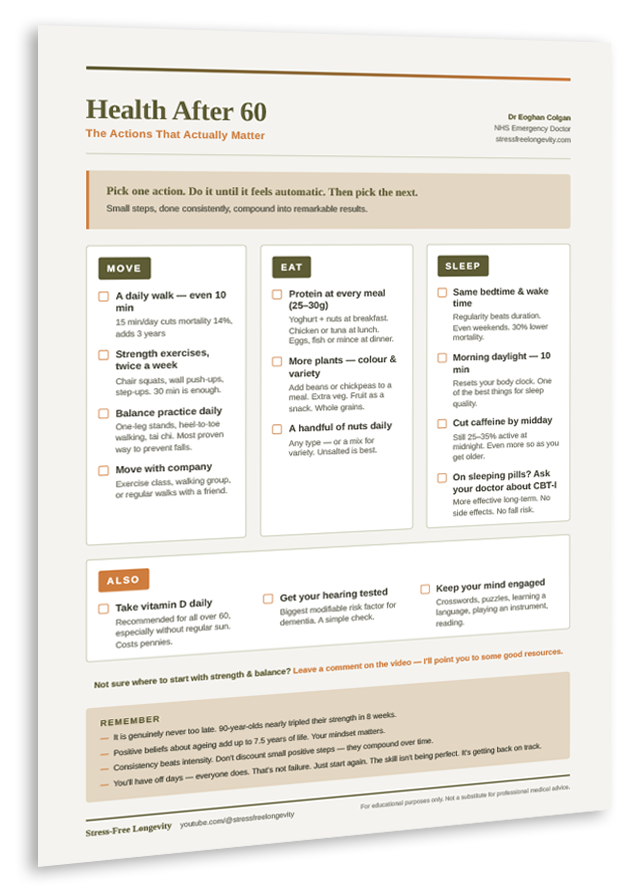
I've put together a free one-page checklist with every action from this post — print it, and work through it one item at a time.
The Bottom Line
The science is genuinely encouraging. Your body responds to the right inputs at any age — and the evidence shows that meaningful improvements are possible well into your 60s, 70s, and beyond.
Healthy ageing comes down to a small number of things done consistently: moving in ways that build strength, balance, and cardiovascular health; eating enough protein and fibre; sleeping at consistent times; and staying genuinely connected to other people.
None of it requires extreme effort. None of it requires expensive products. It just requires showing up — consistently, over time.
You have more control over how you age than most people realise. And it's not too late to use it.
Need help getting started?
The Health After 60 Checklist
The free checklist summarises every principle from this post — plus two additional ones not covered here. Print it, put it somewhere visible, and pick one to start with. Build it until it feels automatic. Then add another.
No spam. Unsubscribe anytime.
Frequently Asked Questions
Sources
- Levy BR et al. (2002). Longevity increased by positive self-perceptions of aging. Journal of Personality and Social Psychology. PubMed
- Levy BR et al. (2016). Positive age beliefs protect against dementia even among elders with high-risk gene. PLOS ONE. PubMed
- Wen CP et al. (2011). Minimum amount of physical activity for reduced mortality and extended life expectancy. The Lancet. PubMed
- Sherrington C et al. (2019). Exercise for preventing falls in older people living in the community. Cochrane Database of Systematic Reviews. PubMed
- Moore DR et al. (2015). Protein ingestion to stimulate myofibrillar protein synthesis requires greater relative protein intakes in healthy older versus younger men. Journals of Gerontology. PubMed
- Ramezani Tehrani F et al. (2023). Dietary fibre intake and all-cause and cause-specific mortality. Clinical Nutrition. PubMed
- Windred DP et al. (2024). Sleep regularity is a stronger predictor of mortality risk than sleep duration. Sleep. PubMed
- Holt-Lunstad J et al. (2010). Social relationships and mortality risk. PLoS Medicine. PubMed
Medical disclaimer
This content is for informational purposes only and is not intended as medical advice. Always consult your healthcare provider before making changes to your health routine. What works for one person may not work for another — this is a roadmap, not a prescription.
About Dr. Eoghan Colgan
Emergency medicine physician researching what actually works for longevity. I interview world-class experts in health and longevity and test everything personally. Everything I teach is what I'm implementing myself. More about me →

Related Articles
What Is a Good HRV? (And How to Improve Yours)
What Is a Good HRV? (And How to Improve Yours) Key Takeaways Your trend matters […]

What Is Cardiometabolic Health? (And Why Only 7% of Us Pass)
What Is Cardiometabolic Health? (And Why Only 7% Pass) Key Takeaways It’s one system, not […]
What Is a Good Resting Heart Rate? (And Why “Normal” Isn’t the Same as Healthy)
What Is a Good Resting Heart Rate? (And Why “Normal” Isn’t the Same as Healthy) […]