
Forever Chemicals: How to Reduce Your PFAS Exposure

Key Takeaways
- You can't fully avoid them — and for most people, that's fine. PFAS are in nearly everyone's blood, but at levels well below where harm has been shown.
- Detection isn't danger. We can now measure a single drop in twenty swimming pools. Finding a chemical doesn't mean the amount can harm you.
- A good water filter and more home cooking beat bottled water or binning your pans. Diet and water are what matter.
You've probably heard about "forever chemicals" — and wondered whether they're something to actually worry about.
The short answer: they're real, they're nearly everywhere, and for most people the day-to-day risk is low.
In this article, I'll explain what these chemicals are, how dangerous they actually are — including what we still don't know — and how widespread they are. Then I'll give you the short list of things that actually work to minimise your exposure.
Most of that list is easier and cheaper than the internet would have you believe.
First, what are we talking about?
What Are Forever Chemicals, Exactly?
PFAS — per- and polyfluoroalkyl substances — are man-made chemicals built around the bond between carbon and fluorine. That bond is one of the strongest in chemistry.
That single fact explains both why we use them and why they're a problem. The strength of that bond makes PFAS repel water, oil and heat. That's why they end up in non-stick pans, waterproof jackets, stain-resistant sofas and grease-proof food packaging. But the strength of that bond also means they do not break down easily. They can last for years in water, in soil, in your body. Hence the nickname: forever chemicals.
Now, "PFAS" isn't one chemical. It's a huge family — somewhere between 10,000 and several million of them, depending on how you count. A few are well studied. Most aren't. So when you see a claim that "forever chemicals cause X," be cautious. It's rarely true of all of them.
The two most studied are PFOA and PFOS. These are the older ones, largely banned over the last two decades. The newer PFAS that replaced them were assumed to be safer, mainly because they leave the body faster. But leaving faster isn't the same as being safe, and several of the replacements are now under scrutiny too. For most of them, we simply don't know yet.
Because they've been used for decades and barely break down, they're now genuinely everywhere — in soil, water, wildlife and people. Test the blood of almost anyone in the world and you'll find PFAS. That sounds frightening, so it's worth knowing what it does and doesn't mean.
So How Dangerous Are They, Really?
The honest answer is more reassuring than the headlines would suggest, and it comes down to separating what's proven from what's suspected.
In 2022, the US National Academies — about as cautious and credible as scientific bodies get — reviewed the evidence and sorted the possible health effects into tiers. Four had strong enough evidence to call a 'likely link': higher cholesterol, a weaker antibody response to vaccines, slightly lower birth weight, and kidney cancer.
A second group had weaker, suggestive evidence — a 'possible link', but not a confident one. This included testicular cancer, thyroid problems, and pregnancy-related high blood pressure. And a long list of conditions people often blame on PFAS — type 2 diabetes, heart disease, infertility — didn't have enough evidence either way.
Three things put that in perspective.
The strong evidence comes from people exposed to far more than you are. The clearest findings come from factory workers, firefighters, and people living next to contaminated industrial sites — where blood levels were often ten to twenty times higher than normal. What happens at those levels doesn't map neatly onto the average person with average exposure.
A link isn't the same as a personal risk. When a chemical is "linked to" cancer, that's a pattern seen across large populations, usually at high exposure. It doesn't tell you how much your own risk changes from trace amounts. The cancer agency that classifies these things puts PFOA in the same hazard group as processed meat and sunlight — things that can cause harm in some conditions, but that nobody panics about day to day.
Detection isn't danger. PFAS are measured in nanograms per litre — parts per trillion. One part per trillion is about one drop of water in twenty Olympic swimming pools. Our instruments can now find these chemicals long before there's any sign the amounts are harming us. That gap is where the scary headlines come from.
None of this means PFAS are harmless, or that we should stop reducing them. The case for cutting them — in the environment and in us — is sound. It just isn't a reason to panic. It's a reason for sensible action over time.
One honest caveat: nobody yet knows the long-term effect of the low levels most of us carry. That's reason enough to cut down where it's easy — not out of fear, just sensible caution.
Where Your PFAS Exposure Actually Comes From
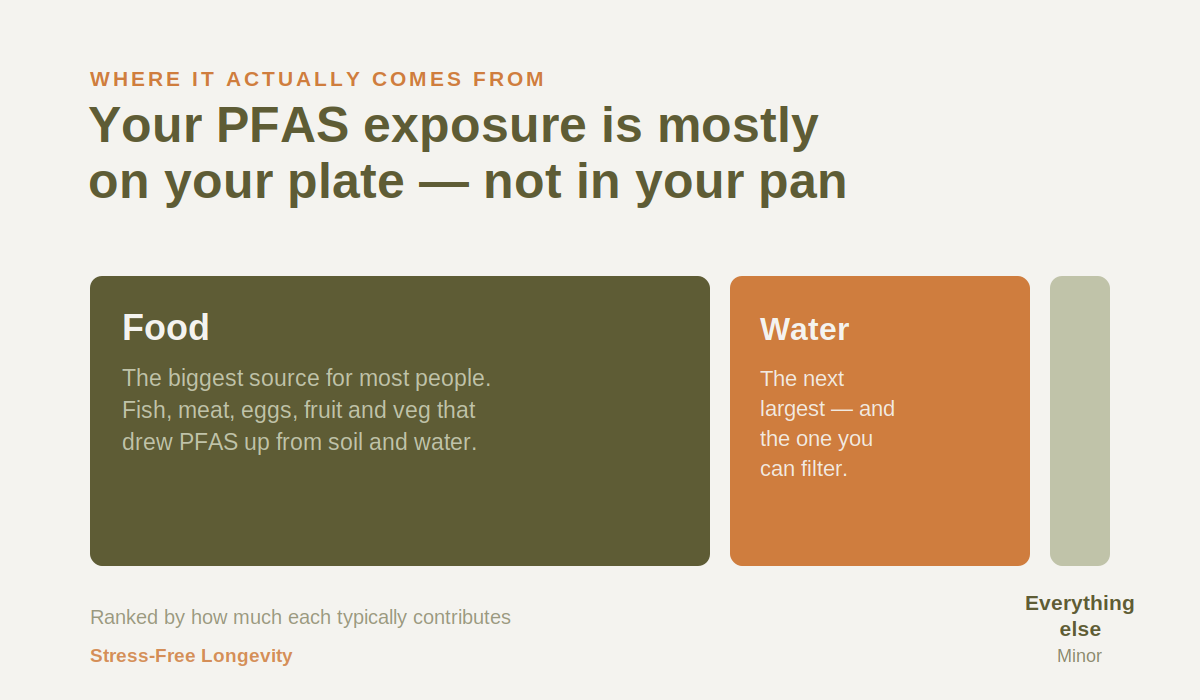
If you want to act, it helps to know where PFAS actually reach you — and the answer surprises most people. It's not the frying pan. It's your plate.
Food is the biggest source by far. Depending on the study, diet accounts for anywhere from 40% to almost all of a person's exposure. It turns up right across the diet — meat, fruit, vegetables — but fish and seafood stand out, because PFAS build up in animals higher up the food chain.
Drinking water comes next. It's a real source, but a smaller one, and mainly a concern in areas with a contaminated supply. Everything else — household dust, the air, the products around you — is minor, usually just a percent or two.
That's because of how PFAS spread. They escape into the environment wherever they're made, used and thrown away, and because they don't break down, they build up in soil, rivers and the food chain over time. So they reach you the same way most things do: through what you eat and drink.
That ranking is the useful part — it tells you where effort is worth spending. The internet wants you to audit every object in your house. The data says two things dominate: what you eat, and what you drink.
I also cover this topic in an interview on my YouTube channel - https://www.youtube.com/@stressfreelongevity
How to Reduce Your PFAS Exposure (What Actually Works)
Before I discuss actions you can take to reduce your exposure, it's worth saying that you could do nothing!
One of the scientists I spoke to while researching this had made few changes in his own life. His reasoning was that any one person's influence over their exposure is limited — these chemicals are already in the environment — and there are bigger, more rewarding things to focus on for your health. That's a perfectly reasonable position.
But if you do want to act, a few things genuinely help. Here they are, in order of impact for effort.
Fit a good water filter
This is the highest-value single thing you can do. It targets a real source you directly control.
The type matters. In the largest independent test of home filters, reverse osmosis systems removed almost all PFAS — around 94% or more. Activated carbon filters worked reasonably but less consistently. Standard jug filters — the basic Brita-style ones most people own — did very little.
So if you're going to filter, do it properly. Look for one certified to NSF/ANSI 53 (carbon block) or NSF/ANSI 58 (reverse osmosis) that names PFOA, PFOS or total PFAS. An under-sink filter is worth far more than a jug.
This matters most if you're pregnant, planning a pregnancy, or have young children — small bodies take in far more per kilo than adults.
Cook more of your own food
Since food is the main source, what you eat matters more than the pan you cook it in. You don't need a special diet. Choosing fresh, home-cooked meals over ultra-processed and takeaway food cuts several exposures at once — including the grease-proof packaging fast food comes in. People who cook at home more tend to have lower PFAS in their blood.
Skip the worst food packaging
Grease-resistant wrappers, microwave popcorn bags and some takeaway containers are common PFAS sources. You don't need to check every label. Just don't make the greasy, grease-proof packaging a daily habit — which mostly sorts itself out once you're cooking more at home.
Don't worry about your non-stick pans
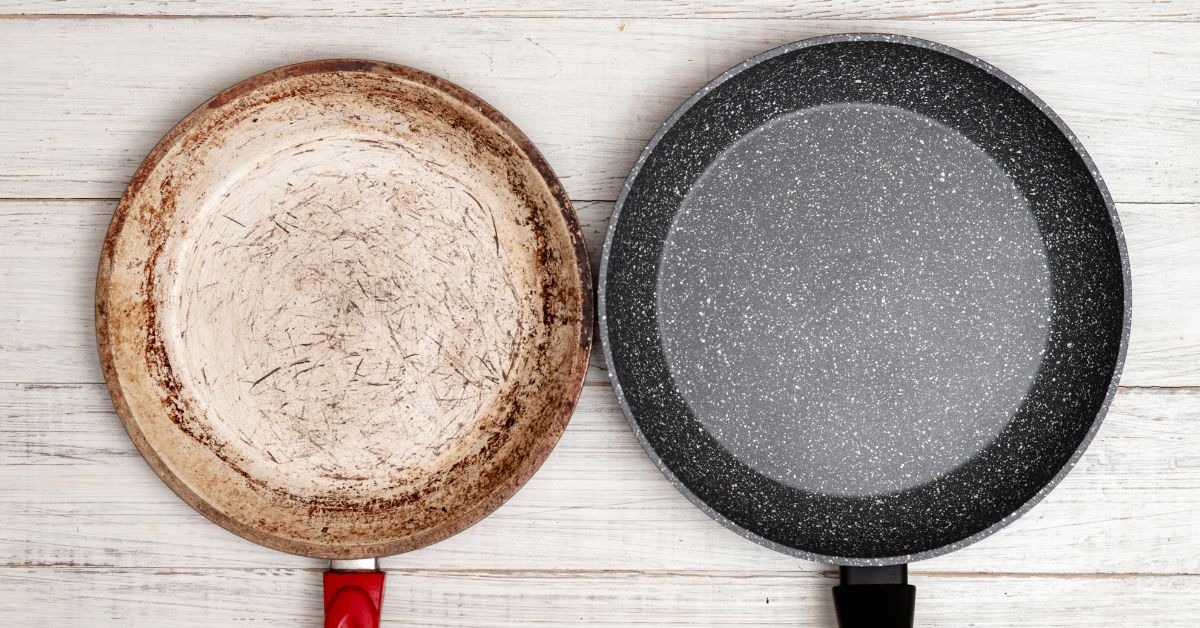
The coating itself — PTFE, better known as Teflon — is harmless. Even if it's scratched and you swallow a flake, it passes straight through you. The danger was never the pan in your cupboard.
The harm comes from making Teflon — the PFAS used in manufacturing are the ones that pollute and bioaccumulate. So the useful thing isn't binning your pan. It's not buying new ones unnecessarily, which is what drives the production. When you do need to replace one, choosing cast iron, stainless steel or a verified PFAS-free pan is a small vote against more being made.
A few things not worth doing
Boiling your water doesn't remove PFAS. Heat can't break that carbon–fluorine bond, and as water evaporates, boiling actually concentrates what's left.
Bottled water isn't an upgrade. It can contain PFAS too, and it carries far more microplastics than tap water — one study found hundreds of thousands of plastic particles in a single litre. You'd be trading a small exposure for a bigger one.
Routine PFAS blood testing isn't useful for most people. It won't change anything you'd actually do, so the result tends to worry you without helping you.
The Bottom Line
Forever chemicals are real, they're widespread, and for most people the levels we live with aren't a cause for alarm.
The strong evidence of harm comes from people exposed to far more than you are. The amounts most of us carry sit below where harm has been shown. However, the long-term picture at low levels is still unclear — a reason to reduce sensibly, but not to worry constantly.
If you want to do something, fit a good filter and cook a little more of your own food. That's most of the benefit, for very little cost. Then focus on the other, more important, factors that really move your health — sleep, food, movement. Those will move the 'health needle' far more than anything in this article.
Ready to Focus on What Actually Matters?
Forever chemicals are a good example of a bigger truth: most of your health comes down to a few high-impact things, not endless small worries.
- The highest-impact actions across Sleep, Nutrition, and Exercise
- The Build Good Habits framework to make changes stick
- Start with one, build from there — no overhaul required
No spam. Unsubscribe anytime.
Frequently Asked Questions
Sources
- National Academies of Sciences, Engineering, and Medicine (2022). Guidance on PFAS Exposure, Testing, and Clinical Follow-Up. National Academies
- Herkert NJ et al. (2020). Assessing the Effectiveness of Point-of-Use Residential Drinking Water Filters for PFAS. Environmental Science & Technology Letters. PubMed
- European Food Safety Authority (2020). PFAS in food: EFSA assesses risks and sets tolerable intake. EFSA
- Imperial College London (2026). Major survey of London tap water shows 'forever chemicals' within safe limits. Imperial
- US Environmental Protection Agency (2024). Final PFAS National Primary Drinking Water Regulation. EPA
Medical disclaimer
This content is for informational purposes only and is not intended as medical advice. Always consult your healthcare provider before making changes to your health routine. What works for one person may not work for another — this is a roadmap, not a prescription.
About Dr. Eoghan Colgan
Emergency medicine physician researching what actually works for longevity. I interview world-class experts in health and longevity and test everything personally. Everything I teach is what I'm implementing myself. More about me →

Related Articles
Creatine Side Effects: What’s Real and What Isn’t
Creatine Side Effects: What’s Real and What Isn’t Key Takeaways Creatine is one of the […]

Grip Strength Chart by Age: What Your Number Means
Grip Strength Chart by Age: What Your Number Means Key Takeaways Grip strength is used […]

The Sitting-Rising Test: What Your Score Actually Means
The Sitting-Rising Test: What Your Score Actually Means Key Takeaways A score of 8 or […]